

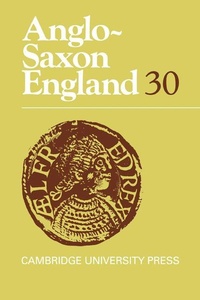
Anglo-Saxon England
Published on 11. October 2007
Book
Paperback/Softback
384 pages
978-0-521-03856-0 (ISBN)
Description
The pre-eminence of Anglo-Saxon England in its field can be seen as a result of its encouragement of interdisciplinary approaches to the study of all aspects of Anglo-Saxon culture. Thus this volume includes an important assessment of the correspondence of St Boniface, in which it is shown that the unusually formulaic nature of Boniface's letters is best understood as a reflex of the saint's familiarity with vernacular composition. A wide-ranging historical contextualization of The Letter of Alexander to Aristotle illuminates the way English readers of the later tenth century may have defined themselves in contradistinction to the monstrous unknown, and a fresh reading of the gendering of female portraiture in a famous illustrated manuscript of the Psychomachia of Prudentius (CCCC 23) shows the independent ways in which Anglo-Saxon illustrators were able to respond to their models. The usual comprehensive bibliography of the previous year's publications rounds off the book; and a full index of the contents of volumes 26-30 is provided. (Previous indexes have appeared in volumes 5, 10, 15, 20 and 25.)
More details
Series
Language
English
Place of publication
Cambridge
United Kingdom
Target group
Professional and scholarly
College/higher education
Product notice
Paperback (trade)
Illustrations
Worked examples or Exercises
Dimensions
Height: 229 mm
Width: 152 mm
Thickness: 23 mm
Weight
622 gr
ISBN-13
978-0-521-03856-0 (9780521038560)
Copyright in bibliographic data and cover images is held by Nielsen Book Services Limited or by the publishers or by their respective licensors: all rights reserved.
Schweitzer Classification
Persons
Content
List of illustrations; 1. Place-name evidence for an Anglo-Saxon animal name: OE *pohha/*pocca 'fallow deer' Carole Hough; 2. Old sources, new resources: finding the right formula for Boniface Andy Orchard; 3. The illness of King Alfred the Great David Pratt; 4. The social context of narrative disruption in The Letter of Alexander to Aristotle Brian McFadden; 5. Broken bodies and singing tongues: gender and voice in the Cambridge, Corpus Christi College 23 Psychomachia Catherine E. Karkov; 6. The prodigal fragment: Cambridge, Gonville and Caius College 734/782a Rebecca Rushforth; 7. Contextualising the Knutsdrapur: skaldic praise-poetry at the court of Cnut Matthew Townend; 8. Anglo-Saxon prognostics in context: a survey and handlist of manuscripts Roy Michael Liuzza; 9. Junius's knowledge of the Old English poem Durham Daniel Paul O'Donnell; 10. Bibliography for 2000 Debby Banham, Carl T. Berkhout, Carole P. Biggam, Mark Blackburn, Carole Hough, Teresa Webber and Simon Keynes; Index to volumes 26-30.