

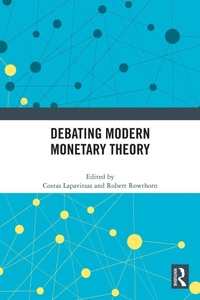
Debating Modern Monetary Theory
1st Edition
Published on 28. April 2022
Book
Hardback
104 pages
978-1-032-24942-1 (ISBN)
Description
This book considers the theoretical and empirical claims of Modern Monetary Theory (MMT) in developed and developing countries. It is structured as a debate between leading MMT theorists and MMT critics.
MMT threw down a challenge to mainstream economics and forced it to respond, above all in the USA. This is a rare occurrence, almost unknown, for heterodox economics during the last few decades. It is not surprising, therefore, that MMT has attracted strong attention from a broad swathe of researchers. It is even less surprising that it has become the theoretical vehicle of choice for political activists opposing austerity. Its influence is remarkable and has gradually spread to other social disciplines, including even cultural theory. Furthermore, the policy responses to coronavirus by several governments, particularly the extraordinary expansion of central bank balance sheets in 2020, appears to support MMT in practice.
This volume takes into account the rising popularity of MMT and considers its theoretical claims in depth, since popularity does not necessarily equate to being right in theory. It also considers MMT claims regarding fiscal and monetary policy in view of the implications of the pandemic crisis for public spending and public debt. It is not accidental that the strongest support for MMT, in both theory and policy, is to be found in the USA, since MMT conclusions rely heavily on close institutional analysis of US government financing mechanisms.
The chapters in this book were originally published as a special issue of The Japanese Political Economy.
MMT threw down a challenge to mainstream economics and forced it to respond, above all in the USA. This is a rare occurrence, almost unknown, for heterodox economics during the last few decades. It is not surprising, therefore, that MMT has attracted strong attention from a broad swathe of researchers. It is even less surprising that it has become the theoretical vehicle of choice for political activists opposing austerity. Its influence is remarkable and has gradually spread to other social disciplines, including even cultural theory. Furthermore, the policy responses to coronavirus by several governments, particularly the extraordinary expansion of central bank balance sheets in 2020, appears to support MMT in practice.
This volume takes into account the rising popularity of MMT and considers its theoretical claims in depth, since popularity does not necessarily equate to being right in theory. It also considers MMT claims regarding fiscal and monetary policy in view of the implications of the pandemic crisis for public spending and public debt. It is not accidental that the strongest support for MMT, in both theory and policy, is to be found in the USA, since MMT conclusions rely heavily on close institutional analysis of US government financing mechanisms.
The chapters in this book were originally published as a special issue of The Japanese Political Economy.
More details
Language
English
Place of publication
London
United Kingdom
Publishing group
Taylor & Francis Ltd
Target group
College/higher education
Dimensions
Height: 260 mm
Width: 183 mm
Thickness: 11 mm
Weight
425 gr
ISBN-13
978-1-032-24942-1 (9781032249421)
Copyright in bibliographic data and cover images is held by Nielsen Book Services Limited or by the publishers or by their respective licensors: all rights reserved.
Schweitzer Classification
Other editions
Additional editions
Costas Lapavitsas | Robert Rowthorn
Debating Modern Monetary Theory
Book
01/2024
1st Edition
Routledge
€63.30
Shipment within 10-20 days
Costas Lapavitsas | Robert Rowthorn
Debating Modern Monetary Theory
E-Book
04/2022
1st Edition
Routledge
€59.49
Available for download
Costas Lapavitsas | Robert Rowthorn
Debating Modern Monetary Theory
E-Book
04/2022
1st Edition
Routledge
€59.49
Available for download
Persons
Costas Lapavitsas is Professor of Economics at the School of Oriental and African Studies, University of London. He is internationally known and published widely on money and finance, contemporary capitalism, the Eurozone, and other topics.
Robert Rowthorn is Emeritus Professor at the University of Cambridge. He is a leading political economist of the post-war period and has has written extensively on economic theory, capitalist development, inflation, and other topics.
Robert Rowthorn is Emeritus Professor at the University of Cambridge. He is a leading political economist of the post-war period and has has written extensively on economic theory, capitalist development, inflation, and other topics.
Content
Introduction: Debating modern monetary theory 1. Is government debt net wealth? 2. The Job Guarantee and the Phillips Curve 3. Does the national debt matter? 4. External debt matters: What are the limits to monetary sovereignty? 5. Modern monetary theory on money, sovereignty, and policy: A marxist critique with reference to the Eurozone and Greece