

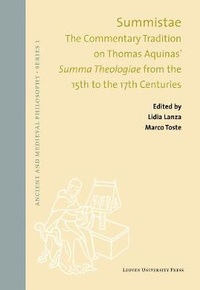
Summistae
The Commentary Tradition on Thomas Aquinas' Summa Theologiae from the 15th to the 17th Centuries
Published on 10. March 2021
Book
Hardback
456 pages
978-94-6270-262-2 (ISBN)
Description
Thomas Aquinas' Summa theologiae is one of the classics in the history of theology and philosophy. Beyond its influence in the Middle Ages, its importance is also borne out by the fact that it became the subject of commentary. During the sixteenth century it was gradually adopted as the official text for the teaching of scholastic theology in most European Catholic universities. As a result, university professors throughout Europe and the colonial Americas started lecturing and producing commentaries on the Summa and using it as a starting point for many theological and philosophical discussions. Some of the works of major authors such as Vitoria, Soto, Molina, Suarez and Arriaga are nothing more than commentaries on the Summa. This book is the first scholarly endeavour to investigate this commentary tradition. As it examines late scholasticism against its institutional backdrop and contains studies of manuscripts and texts unpublished, it will remain an authoritative source for the research of late scholasticism.
Contributors: Igor Agostini (University of Salento), Monica Brinzei (CNRS-IRHT, Paris), William Duba (University of Fribourg), Matthew Gaetano (Hillsdale College), Helen Hattab (University of Houston), Lidia Lanza (University of Lisbon), Mauro Mantovani (Salesian Pontifical University), Daniel D. Novotny and Tomas Machula (University of South Bohemia in Ceske Budejovice), Chris Schabel (University of Cyprus), Jean-Luc Solere (Boston College), Marco Toste (University of Fribourg), Andreas Wagner (Goethe University of Frankfurt), Ueli Zahnd (University of Geneva)
Contributors: Igor Agostini (University of Salento), Monica Brinzei (CNRS-IRHT, Paris), William Duba (University of Fribourg), Matthew Gaetano (Hillsdale College), Helen Hattab (University of Houston), Lidia Lanza (University of Lisbon), Mauro Mantovani (Salesian Pontifical University), Daniel D. Novotny and Tomas Machula (University of South Bohemia in Ceske Budejovice), Chris Schabel (University of Cyprus), Jean-Luc Solere (Boston College), Marco Toste (University of Fribourg), Andreas Wagner (Goethe University of Frankfurt), Ueli Zahnd (University of Geneva)
Reviews / Votes
The overall achievement of this volume shows that the tradition of commenting on the *Summa should be studied as a subject in its own right.* Joerg Alejandro Tellkamp, Renaissance Quarterly, 76(1), 316-317, https://doi.org/10.1017/rqx.2023.170 Accanto a tutti gli altri meriti gia menzionati, un pregio indiscutibile del volume curato da Lidia Lanza e Marco Toste e il bilanciamento molto ben studiato, nell'analisi della tradizione dei commentari, tra le questioni metafisiche e quelle etico-giuridiche (per quanto le une e le altre compaiano, in questa stessa tradizione, in un quadro d'insieme che resta - com'e anche naturale che sia - squisitamente teologico). Maria Evelina Malgieri, <<Quaestio>>, 22 (2022), 533-561, https://doi.org/10.1484/J.QUAESTIO.5.133425 AEusserlich ueberzeugt der Band durch seine Kompaktheit und Struktur. Alle Beitraege liegen in zumeist sehr gutem Englisch vor; zudem achten die Herausgeber auf eine einheitliche Zitation der Summa Theologiae und anderer historischer Quellen. Die im Anhang befindlichen Indizes verwendeter Handschriften wie auch (vor-)moderner Autoren ermoeglichen den raschen Zugriff auf Detailergebnisse. Gabriel J. Theis OP, Wien, Archa Verbi 18 (2021). Trotzdem zeichnet es den Sammelband aus, eine jedenfalls bis ins fruehe 20. Jahrhundert einflussreiche Epoche der Philosophie und Theologie mit wichtigen Beispielen sehr kundig zu praesentieren und damit hoffentlich weitere Forschungen anzuregen. Bernhard Knorn SJ, Zeitschrift fuer Theologie und Philosophie, Bd. 144 Nr. 3 (2022), DOI: 10.35070/ztp.v144i3.3839 A highly instructive, even outstanding, review article by the editors is followed by several detailed case studies.Benjamin Dahlke, Theologische Rundschau (ThR), Jahrgang 87 (2022) / Heft 2, S. 227-237 (11), DOI: 10.1628/thr-2022-0009 No fim desta algo inusitadamente longa recensao, creio que ficou bem claro todo o nosso apreco por esta tao relevante publicacao e acima de tudo pelo louvavel trabalho dos seus editores. Qualquer que seja a sua proveniencia - a teologia, a filo-sofia, a historia e a historia das ideias, o genero comentaristico, etc . - encontrara o/a leitor/a um rico manancial de informacoes e um opulento cadinho de pistas para fu-turas e cada vez mais aprofundadas pesquisas. Resta -nos, por isso, deixar sem qual-quer reserva os parabens e votos de continuacao de tao notavel e competente inves-tigacao aos dois tao jovens investigadores, Lidia Lanza e Marco Toste.Mario Santiago de Carvalho, Revista Filosofica de Coimbra - n.o 60 (2021), https://impactum-journals.uc.pt/rfc/article/view/10392/7567 [...] overall the collection is impressive and all the contributions are of a high standard.
Dominic Ryan OP, New Blackfriars, Volume 104, Issue 1110, Mar 2023, https://doi.org/10.1111/nbfr.12812 Overall, this collection of essays provides a sampling of the fruitful exchanges that 'Summa' commentators carried on within the centuries indicated. - Romanus Cessario, The Thomist, October 2023, https://muse.jhu.edu/pub/16/article/907650 Le volume comporte deux parties complementaires. La premiere montre comment la Somme de theologie est devenue un texte qui fait autorite, comment surgissent ses commentaires et en quelle mesure cette tradition se rattache a la pensee medievale. La seconde partie comporte, en revanche, des cas d'etude qui montrent, a travers les differentes manieres de travailler des auteurs, comment cette tradition philosophique et theologique s'est constituee et a contribue a la pensee moderne. Les differences entre les commentateurs revelent une approche au texte variee et riche, qui justifie aussi le titre du recueil : il ne s'agit pas necessairement de thomistes, mais d'auteurs qui, a partir du texte de la Somme de theologie, elaborent des reflexions personnelles, parfois meme tres differentes des positions de l'ouvrage qu'ils commentent. Le volume ne porte directement ni sur l'etude de la reception de la Somme de theologie ni sur celle de la tradition thomiste pour elle-meme (p. 4). Les visees des editeurs, ainsi exposees au debut de l'ouvrage, contribuent a sa belle reussite intellectuelle. - A. O., Revue des Sciences philosophiques et theologiques,Tome 108 N degrees 1 janv.-mars 2024
More details
Series
Language
English
Place of publication
Leuven
Belgium
Target group
College/higher education
US School Grade: College Graduate Student and over
Dimensions
Height: 233 mm
Width: 156 mm
Thickness: 25 mm
Weight
790 gr
ISBN-13
978-94-6270-262-2 (9789462702622)
Copyright in bibliographic data and cover images is held by Nielsen Book Services Limited or by the publishers or by their respective licensors: all rights reserved.
Schweitzer Classification
Other editions
Additional editions
Lidia Lanza | Marco Toste
Summistae
The Commentary Tradition on Thomas Aquinas' Summa Theologiae from the 15th to the 17th Centuries
E-Book
03/2021
Leuven University Press
€134.99
Available for download
Persons
Lidia Lanza is research fellow at the Centre of Philosophy of the University of Lisbon.
Marco Toste is affiliated with the University of Fribourg.
Marco Toste is affiliated with the University of Fribourg.
Content
Part 1: Framing the commentary tradition
1.The Commentary Tradition on the 'Summa Theologiae'Lidia Lanza - Marco Toste
2. Thomas Aquinas as Authority and the 'Summa Theologiae' as Auctoritas in the Late Middle AgesMonica Brinzei - Chris Schabel
3.The Genesis of a Genre? Late Medieval Commentaries on the 'Summa Theologiae'Ueli Zahnd
4.Theology in 'via sancti Thomae' at the University of Padua and the 'Summa Theologiae'Matthew Gaetano
Part 2: Discussions in the commentary tradition
5.Remarks on the Debate on 'Summa Theologiae' I, q. 2, art. 2 in 17th-Century Dominican TheologyIgor Agostini
6.The Proofs of God's Existence: The Discussion of the Value of the 'Five Ways' in the 16th-Century Iberian Commentaries on the 'Summa Theologiae' Mauro Mantovani
7.The Light of Glory in Molina, Vazquez, and SuarezWilliam Duba
8.Creation and Subsistence: Early Modern Commentators on the Subsistence of Prime MatterHelen Hattab
9.Ways of Angelic Location: 16th-Century Dominican Summistae on 'Summa Theologiae' I, q. 52, art. 1Daniel D. Novotny - Tomas Machula
10.From Invincible Ignorance to Tolerance: Arriaga, Vazquez, and BayleJean-Luc Solere
11.The Approach of Some Major Commentators on 'Summa Theologiae' II-II, q. 10: 'De Infidelitate'Andreas Wagner
12.Between Self-Preservation and Self-Sacrifice: The Debate in 16th-Century ScholasticismMarco Toste
13."Si peccavit per hoc quod fregit ostium, paguelo!": The Debate on Whether the Prisoner Condemned to Death Can Lawfully Escape in the 16th-Century Commentary Tradition on the 'Summa Theologiae'Lidia Lanza
Indices
Index of Manuscripts 427
Index of Names ( -19th Century)
Index of Names (19th Century- )
1.The Commentary Tradition on the 'Summa Theologiae'Lidia Lanza - Marco Toste
2. Thomas Aquinas as Authority and the 'Summa Theologiae' as Auctoritas in the Late Middle AgesMonica Brinzei - Chris Schabel
3.The Genesis of a Genre? Late Medieval Commentaries on the 'Summa Theologiae'Ueli Zahnd
4.Theology in 'via sancti Thomae' at the University of Padua and the 'Summa Theologiae'Matthew Gaetano
Part 2: Discussions in the commentary tradition
5.Remarks on the Debate on 'Summa Theologiae' I, q. 2, art. 2 in 17th-Century Dominican TheologyIgor Agostini
6.The Proofs of God's Existence: The Discussion of the Value of the 'Five Ways' in the 16th-Century Iberian Commentaries on the 'Summa Theologiae' Mauro Mantovani
7.The Light of Glory in Molina, Vazquez, and SuarezWilliam Duba
8.Creation and Subsistence: Early Modern Commentators on the Subsistence of Prime MatterHelen Hattab
9.Ways of Angelic Location: 16th-Century Dominican Summistae on 'Summa Theologiae' I, q. 52, art. 1Daniel D. Novotny - Tomas Machula
10.From Invincible Ignorance to Tolerance: Arriaga, Vazquez, and BayleJean-Luc Solere
11.The Approach of Some Major Commentators on 'Summa Theologiae' II-II, q. 10: 'De Infidelitate'Andreas Wagner
12.Between Self-Preservation and Self-Sacrifice: The Debate in 16th-Century ScholasticismMarco Toste
13."Si peccavit per hoc quod fregit ostium, paguelo!": The Debate on Whether the Prisoner Condemned to Death Can Lawfully Escape in the 16th-Century Commentary Tradition on the 'Summa Theologiae'Lidia Lanza
Indices
Index of Manuscripts 427
Index of Names ( -19th Century)
Index of Names (19th Century- )