

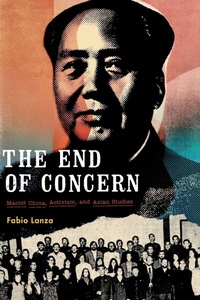
The End of Concern
Maoist China, Activism, and Asian Studies
Published on 2. October 2017
Book
Paperback/Softback
280 pages
978-0-8223-6947-9 (ISBN)
Description
In 1968 a cohort of politically engaged young academics established the Committee of Concerned Asian Scholars (CCAS). Critical of the field of Asian studies and its complicity with the United States' policies in Vietnam, the CCAS mounted a sweeping attack on the field's academic, political, and financial structures. While the CCAS included scholars of Japan, Korea, and South and Southeast Asia, the committee focused on Maoist China, as it offered the possibility of an alternative politics and the transformation of the meaning of labor and the production of knowledge. In The End of Concern Fabio Lanza traces the complete history of the CCAS, outlining how its members worked to merge their politics and activism with their scholarship. Lanza's story exceeds the intellectual history and legacy of the CCAS, however; he narrates a moment of transition in Cold War politics and how Maoist China influenced activists and intellectuals around the world, becoming a central element in the political upheaval of the long 1960s.
Reviews / Votes
"Lanza's book is an important historical documentation of the beginning of a shift in the scholarly study of Asia in the United States and the move to critically assess the foundations of knowledge creation." - Miriam Sharma (Critical Asian Studies) "[A] thoughtful and meticulously researched study..." - Perry Johansson (Sixties) "Sheds vital light on an important US New Left intervention and constitutes necessary reading for scholars of modern China and the global 1960s. . . . Lanza's sympathetic yet critical excavation of the endeavors of CCAS offers present-day scholars, especially scholars of East Asia working in US institutions, resources to critically evaluate aspects of our own practices." - Maggie Clinton (Twentieth-Century China) "Fabio Lanza has an extraordinary ability to find profound historical signiificances in student organizations' publications and records. . . . The contents of The End of Concern are extremely relevant to the field [of Chinese studies] as a whole, and this book should interest all those interested in the Global Sixties, the intellectual histories of the American and French Left, fellow travelers of Maoist China, and the impact of Maoism globally." - Patrick David Buck (China Review)More details
Language
English
Place of publication
North Carolina
United States
Target group
Professional and scholarly
Product notice
Paperback (trade)
Illustrations
2 photographs
Dimensions
Height: 229 mm
Width: 152 mm
Thickness: 16 mm
Weight
404 gr
ISBN-13
978-0-8223-6947-9 (9780822369479)
Copyright in bibliographic data and cover images is held by Nielsen Book Services Limited or by the publishers or by their respective licensors: all rights reserved.
Schweitzer Classification
Other editions
Additional editions
E-Book
08/2017
1st Edition
De Gruyter
€198.99
Available for download
Person
Fabio Lanza is Associate Professor of History and East Asian Studies at the University of Arizona, author of Behind the Gate: Inventing Students in Beijing, and coeditor of De-Centering Cold War History: Local and Global Change.
Content
Acknowledgments ix
Introduction. Of Ends and Beginnings; or, When China Existed 1
1. America's Asia: Discovering China, Rethinking Knowledge 23
2. To Be, or Not to Be, a Scholar: The Praxis of Radicalism in Academia 67
3. Seeing and Understanding: China as the Place of Desire 101
4. Facing Thermidor: Global Maoism at Its End 143
Epilogue. Area Redux: The Destinies of "China" in the 1980s and 1990s 175
Notes 195
Bibliograpy 241
Index 257
Introduction. Of Ends and Beginnings; or, When China Existed 1
1. America's Asia: Discovering China, Rethinking Knowledge 23
2. To Be, or Not to Be, a Scholar: The Praxis of Radicalism in Academia 67
3. Seeing and Understanding: China as the Place of Desire 101
4. Facing Thermidor: Global Maoism at Its End 143
Epilogue. Area Redux: The Destinies of "China" in the 1980s and 1990s 175
Notes 195
Bibliograpy 241
Index 257