

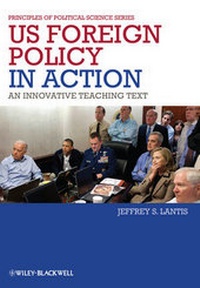
US Foreign Policy in Action
An Innovative Teaching Text
Published on 14. December 2012
Book
Paperback/Softback
356 pages
978-1-4443-3100-4 (ISBN)
Description
This innovative teaching text on United States foreign policy interprets the foreign policy decision-making process through the lens of political debate and exchange. It introduces historical developments and theories of U.S. foreign policy and engages students in the politics of the foreign policy process through innovative learning exercises.
* Features critical analysis of contemporary trends in U.S. foreign policy, including debates in the Obama administration, foreign policy and the 2012 presidential election, and reaction to the Arab Spring
* Written by an award-winning teacher-scholar in international relations, with extensive experience in both policy making and pedagogy
* Views foreign policy decision making through the lends of political debate
* Offers fresh perspectives on historical developments as well as surveying prominent foreign policy theories
* Includes new and innovative participatory learning exercises exploring a range of themes including executive/ legislature conflict
* Contains extensive teaching and learning applications, including discussion questions, document templates, worksheets, suggested readings, and links to web resources throughout
Reviews / Votes
"Jeffrey Lantis has written a first rate study of US Foreign Policy in an age of uncertainty, complexity and transition. This comprehensive book, covering both theory and practice, looks at economic, security, environmental, and human rights issues, as well as the US's relationships with other great powers. In particular, it provides an excellent pedagogical approach for students with a range of active learning frameworks designed to promote engagement with critical issues of international relations and help students experience the real world of policy making."--John Baylis, Swansea University "Topical. Innovative. Engaging. This textbook will draw students in with a crisp discussion of United States foreign policy history and process and enhances the learning experience with well-designed classroom exercises. If you've been looking for a textbook to help you foster a more active learning classroom environment, this is it!"--Douglas Foyle, Wesleyan UniversityMore details
Series
Edition
1. Auflage
Language
English
Place of publication
Hoboken
United Kingdom
Publishing group
John Wiley and Sons Ltd
Target group
Professional and scholarly
Product notice
Paperback (trade)
Unsewn / adhesive bound
Dimensions
Height: 241 mm
Width: 172 mm
Thickness: 17 mm
Weight
547 gr
ISBN-13
978-1-4443-3100-4 (9781444331004)
Schweitzer Classification
Other editions
Additional editions
Book
12/2012
Wiley
€99.86
Article exhausted; check different version
E-Book
10/2012
Wiley-Blackwell
€33.99
Available for download
E-Book
10/2012
Wiley-Blackwell
€33.99
Available for download
Person
Jeffrey S. Lantis is Professor of Political Science at The College of Wooster, USA. He teaches courses on U.S. foreign policy, international security, comparative foreign policy, and war and peace on film. A former Fulbright Senior Scholar at the Australian National University, Lantis is author of The Life and Death of International Treaties (2009), and co-editor of Foreign Policy in Comparative Perspective: Domestic and International Influences on State Behavior (2012). He is past president of the Active Learning in International Affairs Section of the International Studies Association (ISA), and has directed numerous workshops on active learning approaches. In 2010, he was co-recipient of the Deborah J. Gerner Innovative Teaching Award in International Studies, the highest teaching award bestowed by the ISA.
Content
List of Photos
List of Figures
List of Maps
List of Tables
Preface and Acknowledgments
1 Introduction: United States Foreign Policy in Action
Historical Foundations
Major Actors in the Foreign Policy Process
Pedagogical Approach: How to Use This Book
Key Features
Overview of the Book
2 The History of US Foreign Policy
Revolutionary Values
The Struggle to Defi ne the New Nation
Manifest Destiny?
The Civil War
Rise to Globalism
The "American Century" and World Wars
Discussion Questions
3 Foreign Policy in the Cold War and Post-Cold War Era
Introduction
The Cold War
The Truman Doctrine
Korea and Vietnam
Redefi ning Values and Interests?
The End of the Cold War
Engagement and Enlargement
Interests versus Values? The War on Terrorism
Discussion Questions
4 Key Government Institutions: The President, Congress, and the Courts
Section I: Constitutional Authority and the "Invitation to Struggle"
The President and the Executive Branch
Presidential Influence
Instruments of Presidential Power
Congress: The Legislative Branch
The Courts: The Judicial Branch
Conclusion
Discussion Questions
Section II: Structured Debate: Leadership in Action and the War on Terrorism
Guidelines and Rules of Procedure
Debate: Executive Dominance and the War on Terrorism
Background: The War on Terrorism
Framing the Debate: Values and Interests
Position 1: YES, The President Should Have Greater Authority in the War on Terrorism
Additional Resources
Position 2: NO, The President Should Not Have More Foreign Policy Authority
Additional Resources
5 Bureaucracies: Unelected Actors in the Foreign Policy Process
Section I: Bureaucracies and Foreign Policy
Key Characteristics of Bureaucracies
The Theory of Bureaucratic Politics
The Department of Defense
The Department of State
Intelligence Bureaucracies
Discussion Questions
Section II: National Security Council Simulation: Bureaucratic Politics in Action
Exercise Scenario: Proliferation Threats
Iranian Nuclear Ambitions
Appendices: Templates and Role Assignments
Additional Resources
6 Interest Groups and Political Parties
Section I: The Power of Unelected Actors
Interest Groups
What Do You Want? How to Lobby Effectively
Types of Interest Groups
Political Parties
Conclusion: Are All Politics "Local"?
Discussion Questions
Section II: Interest Groups in Action: Case-Based Learning
Pedagogical Approach
Environmental Policy: The United States, Interest Groups, and Climate Change
A Change of Climate?
Legislative Showdown
Case Discussion Questions
7 Public Opinion and the Media
Section I: Reaching the Masses? Public Opinion and the Media
Public Opinion
Public Attitudes and Foreign Policy: A Direct Line?
Media and Foreign Policy
The Functions of Media
Contemporary Trends in Media Coverage
Discussion Questions
Section II: Public Opinion and the Media in Action: Problem-Based Cooperative Learning
Research Project 1: Alternative News Media and Foreign Policy: Educating the Public?
Research Project 2: The Media and National Security: Is There a Public "Right to Know"?
8 Grand Strategy: Then and Now
Section I: What is Grand Strategy?
Alternative Grand Strategy Frames for US Foreign Policy Positions
Hegemony/Unilateralism
Multilateralism
Isolationism/Parochialism
Formulating Grand Strategy in the Post-9/11 World
Discussion Questions
Section II: Structured Debate: A New Grand Strategy for the Twenty-First Century?
Guidelines and Rules of Procedure
Framing the Debate
Position 1: YES, A New Foreign Policy Should be Strongly Multilateral - Vital Interests are Global
What Does Multilateralism Mean for Foreign Policy?
Transnational Issues and Multilateral Solutions
Additional Resources
Position 2: NO, A New Foreign Policy Should be Isolationist/Parochial - Vital Interests are Domestic
"It's the Economy, Stupid"
What Does Parochialism Mean for US Foreign Policy?
The War on Terror and US Parochialism
A Sustainable Foreign Policy Agenda?
Additional Resources
9 Contemporary Foreign Policy Analysis
Fundamental Dynamics of Foreign Policy
Obama Foreign Policy
The Arab Spring Meets Liberal Engagement
Domestic Political Constraints
Foreign Policy Continuity versus Change
What Can You Do?
Bibliography
Index