

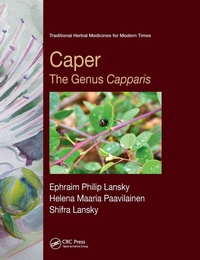
Caper
The Genus Capparis
1st Edition
Published on 18. October 2019
Book
Paperback/Softback
348 pages
978-0-367-37920-9 (ISBN)
Description
Caper: The Genus Capparis presents a pharmacognostic and ethnopharmacological exploration of the genus Capparis, emphasizing its medicinal potential. There is a long history of safe usage of Capparis parts both in diet and as plant drugs throughout the world, and the details of this usage are summarized in 39 tables covering numerous Capparis species. This detailed survey of historical and traditional medical uses of capers provides a forum for the integration of ethnomedicine and modern pharmacology.
This book tracks the use of the genus Capparis from the present position of caper fruit and its flowers as a niche culinary article of economic importance, to ancient times and its use in traditional medicine of the Mediterranean and the Middle East. Section I covers the various classes of compounds found in Capparis that hold potential for being physiologically and medically active, including alkaloids, flavonoids, vitamins, and proteins and amino acids. Section II examines therapeutic uses for Capparis species for medical conditions such as inflammation, rheumatism, diabetes mellitus, pain and fever, cancer, infections and infestations, hypertension, and more.
The authors balance the role of this plant in mythological and religious thinking with advances in modern chemical and pharmacological research. Coverage of ethnomedical usage leads to practical discussions of how the unique evolution of the genus Capparis impacts present and future applications of the different species for medicine and therapeutic nutrition. Providing chemical and pharmacological reviews to an extent not previously undertaken, this book will serve as a firm basis for scientists interested in conducting research on this novel source of safe phytoceutical agents.
This book tracks the use of the genus Capparis from the present position of caper fruit and its flowers as a niche culinary article of economic importance, to ancient times and its use in traditional medicine of the Mediterranean and the Middle East. Section I covers the various classes of compounds found in Capparis that hold potential for being physiologically and medically active, including alkaloids, flavonoids, vitamins, and proteins and amino acids. Section II examines therapeutic uses for Capparis species for medical conditions such as inflammation, rheumatism, diabetes mellitus, pain and fever, cancer, infections and infestations, hypertension, and more.
The authors balance the role of this plant in mythological and religious thinking with advances in modern chemical and pharmacological research. Coverage of ethnomedical usage leads to practical discussions of how the unique evolution of the genus Capparis impacts present and future applications of the different species for medicine and therapeutic nutrition. Providing chemical and pharmacological reviews to an extent not previously undertaken, this book will serve as a firm basis for scientists interested in conducting research on this novel source of safe phytoceutical agents.
Reviews / Votes
"The literature is very large, and the authors give the full literature citation at the end of every chapter ... I think readers will appreciate this approach..."-Neil A. Harriman, Biology Department, University of Wisconsin-Oshkosh, USA, in Plant Science Bulletin
More details
Series
Language
English
Place of publication
London
United Kingdom
Publishing group
Taylor & Francis Ltd
Target group
College/higher education
Academic and Professional Reference
Illustrations
464 s/w Abbildungen, 10 farbige Abbildungen, 78 s/w Tabellen
78 Tables, black and white; 10 Illustrations, color; 464 Illustrations, black and white
Dimensions
Height: 246 mm
Width: 189 mm
Thickness: 19 mm
Weight
674 gr
ISBN-13
978-0-367-37920-9 (9780367379209)
Copyright in bibliographic data and cover images is held by Nielsen Book Services Limited or by the publishers or by their respective licensors: all rights reserved.
Schweitzer Classification
Other editions
Additional editions
E-Book
11/2013
CRC Press
€89.99
Available for download
Book
11/2013
1st Edition
CRC Press
€286.40
Shipment within 15-20 days
E-Book
11/2013
1st Edition
CRC Press
€89.99
Available for download
Persons
Ephraim Philip Lansky, MD (University of Pennsylvania), PhD (Leiden University), MBA (University of Bradford), BA (New College, Sarasota, Florida), is the author or coauthor of 28 peer-reviewed publications, five patents, and two books (Pomegranate: The Most Medicinal Fruit, Basic Books, New York; and Figs: the Genus Ficus, CRC Press, Boca Raton, FL). He is also the founder of Rimonest Limited and Punisyn Pharmaceuticals Limited, companies devoted to the economic development of the pomegranate fruit for nutraceutical, cosmeceutical, and medical applications, respectively. He has 30 years of clinical experience in acupuncture, herbology, homeopathy, and hypnosis. He directs the Laboratory of Applied Metabolomics and Pharmacognosy (LAMP) within the Institute of Evolution, University of Haifa, Israel, and maintains an international consulting practice in complementary medicine and pharmacognosy.
Shifra Lansky holds a BSc in chemistry from Hebrew University in Jerusalem, Israel, where she is presently pursuing her graduate studies. Her focus is on characterizing the three-dimensional structures of naturally occurring proteins. Shifra enjoys playing the violin, painting, and skiing in her spare time.
Helena Paavilainen is a researcher at the Hadassah Medical School, Hebrew University of Jerusalem, Israel. Her main research interests are ethnomedicine, historical ethnopharmacology, and the history of pharmacology, especially the Hebrew, Arabic, and Latin traditions. She wrote her PhD thesis (published as "Medieval Pharmacotherapy: Continuity and Change; Case Studies from Ibn Sina and Some of His Late Medieval Commentators," Leiden: Brill 2009) on the development of medical drug therapy in medieval times and on the potential validity of medieval herbal treatments. She also coauthored with Dr. Lansky the monograph Figs: The Genus Ficus (Boca Raton, FL: CRC Press, 2010). She currently works as a freelance consultant bioprospecting ancient and medieval herbal texts for practical applications in medicine, functional nutrition, and agriculture.
Shifra Lansky holds a BSc in chemistry from Hebrew University in Jerusalem, Israel, where she is presently pursuing her graduate studies. Her focus is on characterizing the three-dimensional structures of naturally occurring proteins. Shifra enjoys playing the violin, painting, and skiing in her spare time.
Helena Paavilainen is a researcher at the Hadassah Medical School, Hebrew University of Jerusalem, Israel. Her main research interests are ethnomedicine, historical ethnopharmacology, and the history of pharmacology, especially the Hebrew, Arabic, and Latin traditions. She wrote her PhD thesis (published as "Medieval Pharmacotherapy: Continuity and Change; Case Studies from Ibn Sina and Some of His Late Medieval Commentators," Leiden: Brill 2009) on the development of medical drug therapy in medieval times and on the potential validity of medieval herbal treatments. She also coauthored with Dr. Lansky the monograph Figs: The Genus Ficus (Boca Raton, FL: CRC Press, 2010). She currently works as a freelance consultant bioprospecting ancient and medieval herbal texts for practical applications in medicine, functional nutrition, and agriculture.
Content
Mythopoesis/Meditation. Botany and Introduction. Section I: Chemistry. Alkaloids. Fatty Acids. Flavonoids. Glucosinolates and Isothiocyanates. Minerals. Proteins and Amino Acids. Sterols. Terpenoids and Other Volatile Compounds Excepting Isothiocyanates. Vitamins. Other Compounds. Section II: Medical Uses. Oxidative Tension. Inflammation. Rheumatism. Lipid Dyscrasias. Diabetes Mellitus. Sunburn. Pain and Fever. Xerostomia. Cancer. Infections and Infestations. Lepsis. Hypertension. Section III: Miscellany. Reviews. Propagation. Fermentation. Recipes. Breaking Advances in Medical Capparology. Centers of Capparology. Epilogue. Index.