

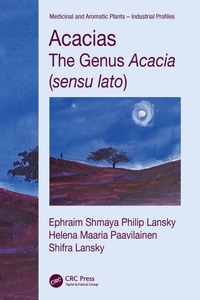
Acacias
The Genus Acacia (sensu lato)
1st Edition
Published on 19. April 2023
Book
Hardback
176 pages
978-1-138-33980-4 (ISBN)
Description
Acacias: The Genus Acacia (sensu lato) is an evidence-based treatment of this supergenus, through the eyes of a clinical pharmacognosist and integrative medicine specialist. The book begins with antiviral activity, revealing within the five genera of Acacia s.l., pharmacological properties and pharmacologically active compounds. Profiles of prominent species within these genera, including photographs, accompany the narrative of current research and traditional usage into antibacterial, antifungal, anticancer, antidiabetic, metabolic syndrome ameliorative, and psychotherapeutic potential.
Features
Comprehensive treatment of the entire Acacia sensu lato genus
Aids ethnopharmacological prospectors of new sources of novel botanically based medicines for modern metabolic and psychiatric diseases
Illuminates the presence of psychedelic simple substituted tryptamines in trees and their medical and psychotherapeutic potential
Continuing in the tradition of the previous volumes of the esteemed Medicinal and Aromatic Plants: Industrial Profiles series, Acacias: The Genus Acacia (sensu lato) provides a unique and comprehensive coverage of one of the most interesting and diverse genera of trees, firmly entrenched in the Levant, Africa, Australia, the Far East, and the New World. The influence of these genera on pharmacy and industry (especially through gum arabic, wildcrafted in Africa from Senegalia senegal), human consciousness, the advent and development of religions, planetary ecology, botanical therapeutics, and the emergence of psychedelic medicine reflect both the history of our species and the transformative promise of tomorrow.
Features
Comprehensive treatment of the entire Acacia sensu lato genus
Aids ethnopharmacological prospectors of new sources of novel botanically based medicines for modern metabolic and psychiatric diseases
Illuminates the presence of psychedelic simple substituted tryptamines in trees and their medical and psychotherapeutic potential
Continuing in the tradition of the previous volumes of the esteemed Medicinal and Aromatic Plants: Industrial Profiles series, Acacias: The Genus Acacia (sensu lato) provides a unique and comprehensive coverage of one of the most interesting and diverse genera of trees, firmly entrenched in the Levant, Africa, Australia, the Far East, and the New World. The influence of these genera on pharmacy and industry (especially through gum arabic, wildcrafted in Africa from Senegalia senegal), human consciousness, the advent and development of religions, planetary ecology, botanical therapeutics, and the emergence of psychedelic medicine reflect both the history of our species and the transformative promise of tomorrow.
More details
Series
Language
English
Place of publication
London
United Kingdom
Publishing group
Taylor & Francis Ltd
Target group
Professional and scholarly
Academic and Professional Reference
Illustrations
51 s/w Abbildungen, 202 farbige Abbildungen, 3 s/w Photographien bzw. Rasterbilder, 201 Farbfotos bzw. farbige Rasterbilder, 48 s/w Zeichnungen, 1 farbige Zeichnung, 3 s/w Tabellen
3 Tables, black and white; 1 Line drawings, color; 48 Line drawings, black and white; 201 Halftones, color; 3 Halftones, black and white; 202 Illustrations, color; 51 Illustrations, black and white
Dimensions
Height: 260 mm
Width: 183 mm
Thickness: 16 mm
Weight
585 gr
ISBN-13
978-1-138-33980-4 (9781138339804)
Copyright in bibliographic data and cover images is held by Nielsen Book Services Limited or by the publishers or by their respective licensors: all rights reserved.
Schweitzer Classification
Other editions
Additional editions
Ephraim Philip Lansky | Helena Maaria Paavilainen | Shifra Lansky
Acacias
The Genus Acacia (sensu lato)
E-Book
04/2023
1st Edition
CRC Press
€218.99
Available for download
Ephraim Philip Lansky | Helena Maaria Paavilainen | Shifra Lansky
Acacias
The Genus Acacia (sensu lato)
E-Book
04/2023
1st Edition
CRC Press
€218.99
Available for download
Persons
Ephraim Lansky holds an M.D. from the University of Pennsylvania Perelman School of Medicine and a Ph.D. in Pharmacognosy from Leiden University. He is licensed in Israel as both a physician and hypnotherapist, and currently, during the pandemic, practices classical homeopathy and Hypnoidal Suggestive Therapy remotely with patients worldwide over Zoom. Dr. Lansky is a well-known expert in the field of Medical Punicology, the use of pomegranate fruit, Punica granatum, for cosmeceutical and medical treatments, and is co-author of three books by CRC on the genera Ficus, Capparis, and Peganum. He has authored or co-authored over 35 scientific papers and is a Research Fellow at the University of Haifa in the Institute of Evolution, an interdisciplinary biological think tank and research center. He is also Series Editor for CRC's two series on medicinal plants, Medicinal and Aromatic Plants: Industrial Profiles and Traditional Herbal Medicines for Modern Times... both inaugurated and established by Dr. Roland Hardman. Dr. Lansky welcomes book proposals for either of these series from potential authors. He can be reached by email at punisyn@gmail.com.
Shifra Lansky holds a PhD in chemistry from the Hebrew University of Jerusalem in Israel, and is currently working as a postdoctoral fellow at Weill Cornell Medicine in New York, USA. Her research focuses on studying the structure and dynamics of various membrane proteins. Shifra coauthored with Ephraim Lansky and Helena Paavilainen the books Caper: The Genus Capparis and Harmal: The Genus Peganum (CRC Press), and has additionally published 19 peer-reviewed articles in different international scientific journals.
Helena Paavilainen is a researcher at the Hadassah Medical School, Hebrew University of Jerusalem, Israel. Her main research interests are ethnomedicine, historical ethnopharmacology, and the history of pharmacology, especially the Hebrew, Arabic, and Latin traditions. She wrote her PhD thesis (published as Medieval Pharmacotherapy: Continuity and Change; Case Studies from Ibn Sina and Some of His Late Medieval Commentators, Leiden: Brill, 2009) on the development of medical drug therapy in medieval times and on the potential validity of medieval herbal treatments. She also coauthored with Dr. Lansky the monograph Figs: The Genus Ficus (Boca Raton, FL: CRC Press, 2010), and with Dr. Lansky and Shifra Lansky the sequels Caper: The Genus Capparis (2014) and Harmal: The Genus Peganum (2017). On the historical side, she has written a series of articles on the therapeutic choices of medieval physicians, for example, "Therapeutic Approaches in the Writings of Isaac Israeli," in Isaac Israeli: The Philosopher Physician, eds. K. Collins, S. Kottek, and H. Paavilainen (Jerusalem, 2015), pp. 139-171.
Shifra Lansky holds a PhD in chemistry from the Hebrew University of Jerusalem in Israel, and is currently working as a postdoctoral fellow at Weill Cornell Medicine in New York, USA. Her research focuses on studying the structure and dynamics of various membrane proteins. Shifra coauthored with Ephraim Lansky and Helena Paavilainen the books Caper: The Genus Capparis and Harmal: The Genus Peganum (CRC Press), and has additionally published 19 peer-reviewed articles in different international scientific journals.
Helena Paavilainen is a researcher at the Hadassah Medical School, Hebrew University of Jerusalem, Israel. Her main research interests are ethnomedicine, historical ethnopharmacology, and the history of pharmacology, especially the Hebrew, Arabic, and Latin traditions. She wrote her PhD thesis (published as Medieval Pharmacotherapy: Continuity and Change; Case Studies from Ibn Sina and Some of His Late Medieval Commentators, Leiden: Brill, 2009) on the development of medical drug therapy in medieval times and on the potential validity of medieval herbal treatments. She also coauthored with Dr. Lansky the monograph Figs: The Genus Ficus (Boca Raton, FL: CRC Press, 2010), and with Dr. Lansky and Shifra Lansky the sequels Caper: The Genus Capparis (2014) and Harmal: The Genus Peganum (2017). On the historical side, she has written a series of articles on the therapeutic choices of medieval physicians, for example, "Therapeutic Approaches in the Writings of Isaac Israeli," in Isaac Israeli: The Philosopher Physician, eds. K. Collins, S. Kottek, and H. Paavilainen (Jerusalem, 2015), pp. 139-171.
Content
Introduction: botany, taxonomy, and controversy. Overview of the Genera Acacia (s.l.): selected species with proven pharma potential. Phytochemistry of the Genera. Chemistry, pharmacology, and medical applications. Clinical Preparations. Gum arabic (chemistry, medical uses, culinary uses, industrial uses). Medicinal Uses and Evidence of Efficacy (traditional and modern). Under the Acacia (s.l.) trees: A view to the future: drug development and bioremediation.