

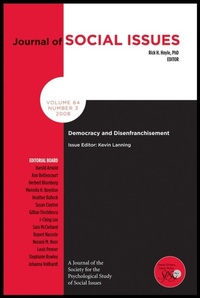
Democracy and Disenfranchisement
1st Edition
Published on 24. October 2008
Book
Paperback/Softback
300 pages
978-1-4051-9126-5 (ISBN)
Description
Psychologists, political scientists, and experts in election law present a multidisciplinary perspective on voting.
Personality characteristics such as motivation, values, and efficacy are considered, as are demographic variables such as education, age, and social class
Examines the reciprocal relationship that exists in the functions of voting for individual and society: the interplay between persons and institutions gives rise to the perception that a government is or is not legitimate, and to the sense that an individual does, or does not, belong
Personality characteristics such as motivation, values, and efficacy are considered, as are demographic variables such as education, age, and social class
Examines the reciprocal relationship that exists in the functions of voting for individual and society: the interplay between persons and institutions gives rise to the perception that a government is or is not legitimate, and to the sense that an individual does, or does not, belong
More details
Series
Language
English
Place of publication
Hoboken
United Kingdom
Publishing group
John Wiley and Sons Ltd
Target group
Professional and scholarly
Product notice
Paperback (trade)
Unsewn / adhesive bound
Dimensions
Height: 226 mm
Width: 150 mm
Thickness: 15 mm
Weight
358 gr
ISBN-13
978-1-4051-9126-5 (9781405191265)
Copyright in bibliographic data and cover images is held by Nielsen Book Services Limited or by the publishers or by their respective licensors: all rights reserved.
Schweitzer Classification
Other editions
Additional editions
Kevin Lanning | Rick H. Hoyle
Democracy and Disenfranchisement
E-Book
04/2009
Wiley-Blackwell
€51.99
Available for download
Persons
Kevin Lanning received his PhD from UC Berkeley and is an Associate Professor of Psychology at the Wilkes Honors College of Florida Atlantic University. His research examines personality measurement, personality development and the structure of sociopolitical attitudes. A resident of Palm Beach County, Florida, he is a voting rights activist and the author of a number of editorial pieces on election reform. Lanning recently edited a special issue of the SPSSI electronic journal ASAP on the Social Psychology of the 2004 US Presidential Election.
Content
INTRODUCTION
Democracy, Voting, and Disenfranchisement in the United States: A Social Psychological Perspective 431
Kevin Lanning
NORMATIVE PERSPECTIVES: THE FUNCTIONS OF POLITICAL PARTICIPATION
The Psychology of Enfranchisement: Engaging and Fostering Inclusion of Members through Voting and Decision-Making Procedures 447
Celia M. Gonzalez and Tom R. Tyler
A Game-Theoretic View of Voting 467
Joachim I. Brueger and Melissa Acevedo
Electoral Simultaneity: Expressing Equal Respect 487
Dennis F. Thompson
DIFFERENTIAL PERSPECTIVES: CHARACTERISTICS OF THE VOTER
The Psychological and Institutional Determinants of Early Voting 503
Paul Gronke and Daniel Krantz Toffey
Why Do People Vote? A Psychological Analysis of the Causes of Voter Turnout 525
Joshua Harder and Jon A. Krosnick
Beliefs about Deliberation: Personal and Normative Dimensions 551
Eugene Borgida, Keilah A. Worth, Brad Lippmann, Damla Ergun, and James Farr
DYNAMIC PERSPECTIVES: THE ROOTS OF POLITICAL PARTICIPATION
Political Participation and Cumulative Disadvantage: The Impact of Economic and Social Hardship on Young Citizens 571
Julianna Sandell Pacheco and Eric Pultzer
The "Antidemocratic Personality" Revisited: A Cross-NationalInvestigation of Working-Class Authoritarianism 595
Jaime L. Napier and John T. Jost
Race and Redistricting: What the Print Media Conveys to the Public about the Role of Race 619
Damla Ergun, Grace Deason, Eugene Borgida, and Guy-Uriel Charles
COMMENTARY
Will Democracy Win? 639
Gina V. Caprara
2007 SPSSI PRESIDENTIAL ADDRESS
Introduction to Irene Hanson Frieze's SPSSI Presidential Address 661
Marybeth Shinn
Social Policy, Feminism, and Research on Violence in Close Relationships 665
Irene H. Frieze
Democracy, Voting, and Disenfranchisement in the United States: A Social Psychological Perspective 431
Kevin Lanning
NORMATIVE PERSPECTIVES: THE FUNCTIONS OF POLITICAL PARTICIPATION
The Psychology of Enfranchisement: Engaging and Fostering Inclusion of Members through Voting and Decision-Making Procedures 447
Celia M. Gonzalez and Tom R. Tyler
A Game-Theoretic View of Voting 467
Joachim I. Brueger and Melissa Acevedo
Electoral Simultaneity: Expressing Equal Respect 487
Dennis F. Thompson
DIFFERENTIAL PERSPECTIVES: CHARACTERISTICS OF THE VOTER
The Psychological and Institutional Determinants of Early Voting 503
Paul Gronke and Daniel Krantz Toffey
Why Do People Vote? A Psychological Analysis of the Causes of Voter Turnout 525
Joshua Harder and Jon A. Krosnick
Beliefs about Deliberation: Personal and Normative Dimensions 551
Eugene Borgida, Keilah A. Worth, Brad Lippmann, Damla Ergun, and James Farr
DYNAMIC PERSPECTIVES: THE ROOTS OF POLITICAL PARTICIPATION
Political Participation and Cumulative Disadvantage: The Impact of Economic and Social Hardship on Young Citizens 571
Julianna Sandell Pacheco and Eric Pultzer
The "Antidemocratic Personality" Revisited: A Cross-NationalInvestigation of Working-Class Authoritarianism 595
Jaime L. Napier and John T. Jost
Race and Redistricting: What the Print Media Conveys to the Public about the Role of Race 619
Damla Ergun, Grace Deason, Eugene Borgida, and Guy-Uriel Charles
COMMENTARY
Will Democracy Win? 639
Gina V. Caprara
2007 SPSSI PRESIDENTIAL ADDRESS
Introduction to Irene Hanson Frieze's SPSSI Presidential Address 661
Marybeth Shinn
Social Policy, Feminism, and Research on Violence in Close Relationships 665
Irene H. Frieze