

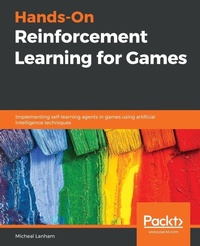
Hands-On Reinforcement Learning for Games
Implementing self-learning agents in games using artificial intelligence techniques
Published on 3. January 2020
Book
Paperback/Softback
432 pages
978-1-83921-493-6 (ISBN)
Description
Explore reinforcement learning (RL) techniques to build cutting-edge games using Python libraries such as PyTorch, OpenAI Gym, and TensorFlow
Key Features
Get to grips with the different reinforcement and DRL algorithms for game development
Learn how to implement components such as artificial agents, map and level generation, and audio generation
Gain insights into cutting-edge RL research and understand how it is similar to artificial general research
Book DescriptionWith the increased presence of AI in the gaming industry, developers are challenged to create highly responsive and adaptive games by integrating artificial intelligence into their projects. This book is your guide to learning how various reinforcement learning techniques and algorithms play an important role in game development with Python.
Starting with the basics, this book will help you build a strong foundation in reinforcement learning for game development. Each chapter will assist you in implementing different reinforcement learning techniques, such as Markov decision processes (MDPs), Q-learning, actor-critic methods, SARSA, and deterministic policy gradient algorithms, to build logical self-learning agents. Learning these techniques will enhance your game development skills and add a variety of features to improve your game agent's productivity. As you advance, you'll understand how deep reinforcement learning (DRL) techniques can be used to devise strategies to help agents learn from their actions and build engaging games.
By the end of this book, you'll be ready to apply reinforcement learning techniques to build a variety of projects and contribute to open source applications.What you will learn
Understand how deep learning can be integrated into an RL agent
Explore basic to advanced algorithms commonly used in game development
Build agents that can learn and solve problems in all types of environments
Train a Deep Q-Network (DQN) agent to solve the CartPole balancing problem
Develop game AI agents by understanding the mechanism behind complex AI
Integrate all the concepts learned into new projects or gaming agents
Who this book is forIf you're a game developer looking to implement AI techniques to build next-generation games from scratch, this book is for you. Machine learning and deep learning practitioners, and RL researchers who want to understand how to use self-learning agents in the game domain will also find this book useful. Knowledge of game development and Python programming experience are required.
Key Features
Get to grips with the different reinforcement and DRL algorithms for game development
Learn how to implement components such as artificial agents, map and level generation, and audio generation
Gain insights into cutting-edge RL research and understand how it is similar to artificial general research
Book DescriptionWith the increased presence of AI in the gaming industry, developers are challenged to create highly responsive and adaptive games by integrating artificial intelligence into their projects. This book is your guide to learning how various reinforcement learning techniques and algorithms play an important role in game development with Python.
Starting with the basics, this book will help you build a strong foundation in reinforcement learning for game development. Each chapter will assist you in implementing different reinforcement learning techniques, such as Markov decision processes (MDPs), Q-learning, actor-critic methods, SARSA, and deterministic policy gradient algorithms, to build logical self-learning agents. Learning these techniques will enhance your game development skills and add a variety of features to improve your game agent's productivity. As you advance, you'll understand how deep reinforcement learning (DRL) techniques can be used to devise strategies to help agents learn from their actions and build engaging games.
By the end of this book, you'll be ready to apply reinforcement learning techniques to build a variety of projects and contribute to open source applications.What you will learn
Understand how deep learning can be integrated into an RL agent
Explore basic to advanced algorithms commonly used in game development
Build agents that can learn and solve problems in all types of environments
Train a Deep Q-Network (DQN) agent to solve the CartPole balancing problem
Develop game AI agents by understanding the mechanism behind complex AI
Integrate all the concepts learned into new projects or gaming agents
Who this book is forIf you're a game developer looking to implement AI techniques to build next-generation games from scratch, this book is for you. Machine learning and deep learning practitioners, and RL researchers who want to understand how to use self-learning agents in the game domain will also find this book useful. Knowledge of game development and Python programming experience are required.
More details
Language
English
Place of publication
Birmingham
United Kingdom
Target group
Professional and scholarly
US School Grade: College Graduate Student
Dimensions
Height: 235 mm
Width: 191 mm
Thickness: 24 mm
Weight
802 gr
ISBN-13
978-1-83921-493-6 (9781839214936)
Copyright in bibliographic data and cover images is held by Nielsen Book Services Limited or by the publishers or by their respective licensors: all rights reserved.
Schweitzer Classification
Other editions
Additional editions
Micheal Lanham
Hands-On Reinforcement Learning for Games
Implementing self-learning agents in games using artificial intelligence techniques
E-Book
09/2024
Packt Publishing
€30.99
Available for download
Person
Micheal Lanham is a proven software and tech innovator with 20 years of experience. During that time, he has developed a broad range of software applications in areas such as games, graphics, web, desktop, engineering, artificial intelligence, GIS, and machine learning applications for a variety of industries as an R&D developer. At the turn of the millennium, Micheal began working with neural networks and evolutionary algorithms in game development. He was later introduced to Unity and has been an avid developer, consultant, manager, and author of multiple Unity games, graphic projects, and books ever since.
Content
Table of Contents
Understanding Rewards-Based Learning
Dynamic Programming and the Bellman Equation
Monte Carlo Methods
Temporal Difference Learning
Exploring SARSA
Going Deep with DQN
Going Deeper with DDQN
Policy Gradient Methods
Optimizing for Continuous Control
All about Rainbow DQN
Exploiting ML-Agents
DRL Frameworks
3D Worlds
From DRL to AGI
Understanding Rewards-Based Learning
Dynamic Programming and the Bellman Equation
Monte Carlo Methods
Temporal Difference Learning
Exploring SARSA
Going Deep with DQN
Going Deeper with DDQN
Policy Gradient Methods
Optimizing for Continuous Control
All about Rainbow DQN
Exploiting ML-Agents
DRL Frameworks
3D Worlds
From DRL to AGI