

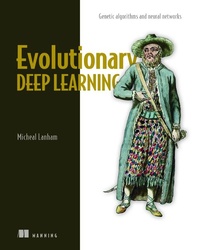
Evolutionary Deep Learning
Genetic Algorithms and Neural Networks
Published on 6. July 2023
Book
Paperback/Softback
350 pages
978-1-61729-952-0 (ISBN)
Description
Discover one-of-a-kind AI strategies never before seen outside of academic papers! Learn how the principles of evolutionary computation overcome deep learning's common pitfalls and deliver adaptable model upgrades without constant manual adjustment.
In Evolutionary Deep Learning you will learn how to:
Solve complex design and analysis problems with evolutionary computation
Tune deep learning hyperparameters with evolutionary computation (EC), genetic algorithms, and particle swarm optimization
Use unsupervised learning with a deep learning autoencoder to regenerate sample data
Understand the basics of reinforcement learning and the Q Learning equation
Apply Q Learning to deep learning to produce deep reinforcement learning
Optimize the loss function and network architecture of unsupervised autoencoders
Make an evolutionary agent that can play an OpenAI Gym game
Evolutionary Deep Learning is a guide to improving your deep learning models with AutoML enhancements based on the principles of biological evolution. This exciting new approach utilizes lesser-known AI approaches to boost performance without hours of data annotation or model hyperparameter tuning. about the technology Evolutionary deep learning merges the biology-simulating practices of evolutionary computation (EC) with the neural networks of deep learning. This unique approach can automate entire DL systems and help uncover new strategies and architectures. It gives new and aspiring AI engineers a set of optimization tools that can reliably improve output without demanding an endless churn of new data. about the reader For data scientists who know Python.
In Evolutionary Deep Learning you will learn how to:
Solve complex design and analysis problems with evolutionary computation
Tune deep learning hyperparameters with evolutionary computation (EC), genetic algorithms, and particle swarm optimization
Use unsupervised learning with a deep learning autoencoder to regenerate sample data
Understand the basics of reinforcement learning and the Q Learning equation
Apply Q Learning to deep learning to produce deep reinforcement learning
Optimize the loss function and network architecture of unsupervised autoencoders
Make an evolutionary agent that can play an OpenAI Gym game
Evolutionary Deep Learning is a guide to improving your deep learning models with AutoML enhancements based on the principles of biological evolution. This exciting new approach utilizes lesser-known AI approaches to boost performance without hours of data annotation or model hyperparameter tuning. about the technology Evolutionary deep learning merges the biology-simulating practices of evolutionary computation (EC) with the neural networks of deep learning. This unique approach can automate entire DL systems and help uncover new strategies and architectures. It gives new and aspiring AI engineers a set of optimization tools that can reliably improve output without demanding an endless churn of new data. about the reader For data scientists who know Python.
More details
Language
English
Place of publication
New York
United States
Target group
Professional and scholarly
Product notice
Paperback (trade)
Unsewn / adhesive bound
Dimensions
Height: 231 mm
Width: 185 mm
Thickness: 25 mm
Weight
666 gr
ISBN-13
978-1-61729-952-0 (9781617299520)
Copyright in bibliographic data and cover images is held by Nielsen Book Services Limited or by the publishers or by their respective licensors: all rights reserved.
Schweitzer Classification
Person
Micheal Lanham is a proven software and tech innovator with over 20 years of experience. He has developed a broad range of software applications in areas such as games, graphics, web, desktop, engineering, artificial intelligence, GIS, and machine learning applications for a variety of industries. At the turn of the millennium, Micheal began working with neural networks and evolutionary algorithms in game development.