

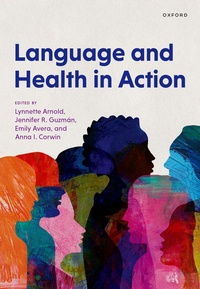
Language and Health in Action
Oxford University Press
Will be published approx. on 31. December 2025
Book
Hardback
256 pages
978-0-19-893391-5 (ISBN)
Description
Health and wellbeing are profoundly shaped by communication processes. Language and Health in Action explores these interconnections by bringing together cutting-edge global scholarship from linguistic and medical anthropology. The book highlights the centrality of language practices and language ideologies in how professionals, individuals, families, and communities navigate illness and pursue health across the lifecourse, in clinical contexts, and beyond. Each chapter includes immersive examples from qualitative and ethnographic research, captured in clear and accessible prose. The volume includes a breadth of perspectives on public and global health that include topics such as infectious disease and chronic illness, mental health and addiction, disability, dying, and healing. Contributions shed light on urban and rural settings and the experiences of immigrants, indigenous communities, and other racialized populations. Chapters profile research conducted in Argentina, Chile, Guatemala, South Korea, Mexico, South Africa, Tanzania, and the United States.
The book is organized into five thematic sections: clinical interaction, language access, community and communicability, language and environment, and healing practices. To support student readers and instructors, the book begins with an introduction to key terms in social scientific approaches to language and health, and each chapter includes a series of discussion and reflection questions. The volume demonstrates that linguistic and communicative practices, which are often taken for granted, nevertheless have far-reaching consequences for health outcomes.
The book is organized into five thematic sections: clinical interaction, language access, community and communicability, language and environment, and healing practices. To support student readers and instructors, the book begins with an introduction to key terms in social scientific approaches to language and health, and each chapter includes a series of discussion and reflection questions. The volume demonstrates that linguistic and communicative practices, which are often taken for granted, nevertheless have far-reaching consequences for health outcomes.
More details
Language
English
Place of publication
Oxford
United Kingdom
Target group
College/higher education
Product notice
sewn/stitched
Cloth over boards
Dimensions
Height: 250 mm
Width: 175 mm
Thickness: 20 mm
Weight
644 gr
ISBN-13
978-0-19-893391-5 (9780198933915)
Copyright in bibliographic data and cover images is held by Nielsen Book Services Limited or by the publishers or by their respective licensors: all rights reserved.
Schweitzer Classification
Persons
Dr. Lynnette Arnold is an Assistant Professor of Anthropology at the University of Massachusetts, Amherst. She is a linguistic anthropologist with a primary area of focus in the Americas, where she has conducted research on language, care, and migration. Dr. Arnold works to create interdisciplinary conversations about the social power of language, demonstrating that attention to linguistic practices can generate consequential new understandings of pressing current issues. This approach is exemplified in her monograph, Living Together Across Borders: Communicative Care in Transnational Salvadoran Families (Oxford University Press, Studies in the Anthropology of Language, 2024).
Dr. Jennifer R. Guzman is Associate Professor of Anthropology at SUNY Geneseo, where she coordinates the Interdisciplinary Program in Sociomedical Sciences. Her research focuses on how people confront health challenges and advocate for themselves within systems that are harmful to health, including intercultural health efforts in Chile and immigrant/labor rights organizing in New York. She has studied clinical interaction in conventional, Complementary and Alternative Medicine (CAM) and Integrative Medicine (IM) , and ethnomedical settings. Dr. Guzman is co-editor of Ethnographic Insights on Latin America and the Caribbean, an edited collection designed for undergraduate teaching.
Dr. Emily Avera is an assistant professor of anthropology at Colgate University. She received her PhD from Brown University and holds graduate degrees from Leiden University and University of Cape Town. Her research focuses on the sociocultural dimensions of health, race and racialization in medicine, and transplant and transfusion medicine, primarily in the South African context. She is the recipient of fellowships from the National Science Foundation and Fulbright IIE. Her scholarly interests include the intersections of medical and linguistic anthropology, science and technology studies approaches (science and society), critical race studies, development studies, and global health.
Dr. Anna I. Corwin is Associate Professor and Chair of the Women's Spirituality Program at the California Institute of Integral Studies. She received her Ph.D. from UCLA and is a recipient of fellowships from the National Science Foundation, the National Endowment for the Humanities, and the Templeton World Charity Foundation for her research on aging, well-being, and religious expertise.
Dr. Jennifer R. Guzman is Associate Professor of Anthropology at SUNY Geneseo, where she coordinates the Interdisciplinary Program in Sociomedical Sciences. Her research focuses on how people confront health challenges and advocate for themselves within systems that are harmful to health, including intercultural health efforts in Chile and immigrant/labor rights organizing in New York. She has studied clinical interaction in conventional, Complementary and Alternative Medicine (CAM) and Integrative Medicine (IM) , and ethnomedical settings. Dr. Guzman is co-editor of Ethnographic Insights on Latin America and the Caribbean, an edited collection designed for undergraduate teaching.
Dr. Emily Avera is an assistant professor of anthropology at Colgate University. She received her PhD from Brown University and holds graduate degrees from Leiden University and University of Cape Town. Her research focuses on the sociocultural dimensions of health, race and racialization in medicine, and transplant and transfusion medicine, primarily in the South African context. She is the recipient of fellowships from the National Science Foundation and Fulbright IIE. Her scholarly interests include the intersections of medical and linguistic anthropology, science and technology studies approaches (science and society), critical race studies, development studies, and global health.
Dr. Anna I. Corwin is Associate Professor and Chair of the Women's Spirituality Program at the California Institute of Integral Studies. She received her Ph.D. from UCLA and is a recipient of fellowships from the National Science Foundation, the National Endowment for the Humanities, and the Templeton World Charity Foundation for her research on aging, well-being, and religious expertise.
Actor
Assistant ProfessorAssistant Professor, Department of Anthropology, University of Massachusetts
Associate Professor of AnthropologyAssociate Professor of Anthropology, State University of New York
Assistant Professor of AnthropologyAssistant Professor of Anthropology, Department of Sociology and Anthropology, Colgate University
Associate Professor and ChairAssociate Professor and Chair, Women's Spirituality Department, California Institute of Integral Studies
Content
Section 1. Clinical Interaction: Editors' Introduction
1: Hannah S. Noblewolf and Lisa Wolf: Everyone is "Mom": Speaking Maternalism in US Emergency Departments
2: Hyemin Lee: Talking about Pain in Traditional Korean Medicine Clinics
3: Stephanie Keeney Parks: Autism Diagnostics as White Public Space in US Clinics
Section 2. Language Access: Editors' Introduction
4: Rachel Showstack, Raul Rangel Fernandez, and Margarita Francisco: Health Care Access for Mayan Communities in Kansas
5: Lissie Wahl: Of Worlds and Words: Medical Interpretation in a US Primary Care Clinic
6: Paula F. Saravia and Jorge Tibor Gutierrez: Translating the Invisible: Intercultural Health Facilitators in Indigenous Chile
Section 3. Community and Communicability: Editors' Introduction
7: Daniel W. Krugman and Mohamed Yunus Rafiq: Kansa, Saratani, and Biocommunicability in Coastal Tanzania
8: Xochitl Marsilli-Vargas: The Circulation of Psychoanalytic Discourses beyond the Clinic in Buenos Aires
9: Steven P. Black: Facing HIV Stigma with Scientific Medicine in a Bio-Speech Community in South Africa
Section 4. Language and Environment: Editors' Introduction
10: Merav Shohet and Insa M. Schmidt: "I'm still here!": Listening to African American Silences and Narratives of Life on Dialysis in Boston
11: T. S. Harvey: Water Everywhere, but Is It Safe to Drink?: Risk, Perception, and Public Health in Guatemala
12: Paja Faudree: Introducing Xka Pastora, One of the World's Newest "Drugs"
Section 5. Healing Practices: Editors' Introduction
13: Abby Mack: In the Spirit, in the Flesh: Performative Language, Embodiment, and Sustaining Recovery in Appalachia
14: Claudia Morales: Caught between Stories of Healing and Migration: Rehabilitation Care for Migrants with Amputations in Mexico
15: Marjorie Harness Goodwin, Federica Raia and Mario Deng: Learning to Experience Dying as a Part of Living: An Individual and Collective Journey
1: Hannah S. Noblewolf and Lisa Wolf: Everyone is "Mom": Speaking Maternalism in US Emergency Departments
2: Hyemin Lee: Talking about Pain in Traditional Korean Medicine Clinics
3: Stephanie Keeney Parks: Autism Diagnostics as White Public Space in US Clinics
Section 2. Language Access: Editors' Introduction
4: Rachel Showstack, Raul Rangel Fernandez, and Margarita Francisco: Health Care Access for Mayan Communities in Kansas
5: Lissie Wahl: Of Worlds and Words: Medical Interpretation in a US Primary Care Clinic
6: Paula F. Saravia and Jorge Tibor Gutierrez: Translating the Invisible: Intercultural Health Facilitators in Indigenous Chile
Section 3. Community and Communicability: Editors' Introduction
7: Daniel W. Krugman and Mohamed Yunus Rafiq: Kansa, Saratani, and Biocommunicability in Coastal Tanzania
8: Xochitl Marsilli-Vargas: The Circulation of Psychoanalytic Discourses beyond the Clinic in Buenos Aires
9: Steven P. Black: Facing HIV Stigma with Scientific Medicine in a Bio-Speech Community in South Africa
Section 4. Language and Environment: Editors' Introduction
10: Merav Shohet and Insa M. Schmidt: "I'm still here!": Listening to African American Silences and Narratives of Life on Dialysis in Boston
11: T. S. Harvey: Water Everywhere, but Is It Safe to Drink?: Risk, Perception, and Public Health in Guatemala
12: Paja Faudree: Introducing Xka Pastora, One of the World's Newest "Drugs"
Section 5. Healing Practices: Editors' Introduction
13: Abby Mack: In the Spirit, in the Flesh: Performative Language, Embodiment, and Sustaining Recovery in Appalachia
14: Claudia Morales: Caught between Stories of Healing and Migration: Rehabilitation Care for Migrants with Amputations in Mexico
15: Marjorie Harness Goodwin, Federica Raia and Mario Deng: Learning to Experience Dying as a Part of Living: An Individual and Collective Journey