

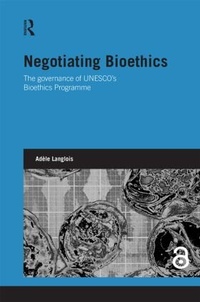
Negotiating Bioethics
The Governance of UNESCO's Bioethics Programme
1st Edition
Published on 6. August 2013
Book
Hardback
210 pages
978-0-415-53346-1 (ISBN)
Description
A PDF version of this book is available for free in Open Access at www.tandfebooks.com. It has been made available under a Creative Commons Attribution-Non Commercial-No Derivatives 3.0 license.
The sequencing of the entire human genome has opened up unprecedented possibilities for healthcare, but also ethical and social dilemmas about how these can be achieved, particularly in developing countries. UNESCO's Bioethics Programme was established to address such issues in 1993. Since then, it has adopted three declarations on human genetics and bioethics (1997, 2003 and 2005), set up numerous training programmes around the world and debated the need for an international convention on human reproductive cloning.
Negotiating Bioethics presents Langlois' research on the negotiation and implementation of the three declarations and the human cloning debate, based on fieldwork carried out in Kenya, South Africa, France and the UK, among policy-makers, geneticists, ethicists, civil society representatives and industry professionals. The book examines whether the UNESCO Bioethics Programme is an effective forum for (a) decision-making on bioethics issues and (b) ensuring ethical practice. Considering two different aspects of the UNESCO Bioethics Programme - deliberation and implementation - at international and national levels, Langlois explores:
how relations between developed and developing countries can be made more equal
who should be involved in global level decision-making and how this should proceed
how overlap between initiatives can be avoided
what can be done to improve the implementation of international norms by sovereign states
how far universal norms can be contextualized
what impact the efficacy of national level governance has at international level
The sequencing of the entire human genome has opened up unprecedented possibilities for healthcare, but also ethical and social dilemmas about how these can be achieved, particularly in developing countries. UNESCO's Bioethics Programme was established to address such issues in 1993. Since then, it has adopted three declarations on human genetics and bioethics (1997, 2003 and 2005), set up numerous training programmes around the world and debated the need for an international convention on human reproductive cloning.
Negotiating Bioethics presents Langlois' research on the negotiation and implementation of the three declarations and the human cloning debate, based on fieldwork carried out in Kenya, South Africa, France and the UK, among policy-makers, geneticists, ethicists, civil society representatives and industry professionals. The book examines whether the UNESCO Bioethics Programme is an effective forum for (a) decision-making on bioethics issues and (b) ensuring ethical practice. Considering two different aspects of the UNESCO Bioethics Programme - deliberation and implementation - at international and national levels, Langlois explores:
how relations between developed and developing countries can be made more equal
who should be involved in global level decision-making and how this should proceed
how overlap between initiatives can be avoided
what can be done to improve the implementation of international norms by sovereign states
how far universal norms can be contextualized
what impact the efficacy of national level governance has at international level
More details
Series
Language
English
Place of publication
London
United Kingdom
Publishing group
Taylor & Francis Ltd
Target group
College/higher education
Academic and Postgraduate
Illustrations
4 s/w Tabellen
4 Tables, black and white
Dimensions
Height: 234 mm
Width: 156 mm
Weight
560 gr
ISBN-13
978-0-415-53346-1 (9780415533461)
Copyright in bibliographic data and cover images is held by Nielsen Book Services Limited or by the publishers or by their respective licensors: all rights reserved.
Schweitzer Classification
Other editions
Additional editions
Book
10/2024
1st Edition
Routledge
€68.27
Shipment within 10-20 days
E-Book
08/2013
Routledge
€0.00
Available for download
E-Book
08/2013
Routledge
€0.00
Available for download
Person
Adele Langlois is Senior Lecturer in Politics and International Relations at the University of Lincoln. She has conducted fieldwork in India, Kenya and South Africa. Her research interests include the regulation of human genetic and biomedical research, polio eradication, environmental ethics and normative theories of global governance.
Content
1. Introduction 2. Bioethics: Human Genetic and Biomedical Research Ethics at UNESCO and Beyond 3. Global Governance: A Conceptual Framework for Analysing Bioethics at UNESCO 4. Deliberating Bioethics: UNESCO's Standard Setting Activities 5. Implementing Bioethics: UNESCO's Efforts to Realise and Enforce the Declarations 6. Contextualising Bioethics: The Declarations in Kenya and South Africa 7. Contextualising Bioethics: Mapping Progress in Kenya and South Africa 8. Conclusion. Appendix I: Interviews. Notes. References