

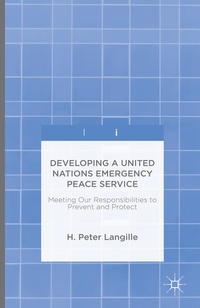
Developing a United Nations Emergency Peace Service
Meeting Our Responsibilities to Prevent and Protect
Published on 29. December 2015
Book
Hardback
X, 149 pages
978-1-137-60338-8 (ISBN)
Description
This book makes the case for a standing UN Emergency Peace Service. With this one development - effectively a UN first responder for complex emergencies - the organization would finally have a rapid, reliable capacity to help fulfill its tougher assigned tasks. To date, the UNEPS initiative has encountered an unreceptive political, fiscal, and security environment. Yet overlapping crises are now inevitable as are profound shifts. This book presents an insightful review of the worrisome security challenges ahead and analysis of two recent high-level UN reports. It addresses the primary roles, core principles, and requirements of a UNEPS, as well as the arguments for and against such a dedicated UN service. Further, it reveals that the primary impediments and lessons learned also help demonstrate what may work and, equally important, what won't. With modest support, the book shows, the next steps are feasible, although it's important to recall that ideas, even good ideas, don't work unless we do.
Reviews / Votes
"The idea of a UN Emergency Peace Service was always valid and the need for it has never been more obvious. Indeed, the failure of the UN to respond to recent crises, especially across the Middle East and North Africa, has been made much worse by the conspicuous lack of its own standing capability. Peter Langille's book is an excellent account of what could be done and what must be done." - Paul Rogers, Professor of Peace Studies, University of Bradford, UK"There is and always has been a very strong case for a standing UN rapid deployment force being available as a first responder in crisis situations, and Peter Langille here makes it powerfully. Although the resistance of key states to any such force now seems entrenched, good ideas and advocacy do sometimes prevail, and this is a debate we must continue to have." - Gareth Evans, Former Australian Foreign Minister, President Emeritus of the International Crisis Group, and Co-chair of the International Commission on Intervention & State Sovereignty and Global Centre for the Responsibility to Protect
"A UN Emergency Peace Service is an idea whose time has come. This highly credible proposal will allow the United Nations to bring succour to victims in a timely manner." - Erna Paris, Author, The Sun Climbs Slow: The International Criminal Court and the Struggle for Justice
"We now all agree 'never again.' An international tool-kit to halt mass atrocities and implement R2P should contain a UN Emergency PeaceService, which could help governments utter 'no more Holocausts, Cambodias, and Rwandas' - and occasionally even mean it." - Thomas G. Weiss, Presidential Professor of Political Science, Director Emeritus, Ralph Bunche Institute for International Studies, USA
More details
Edition
1st ed. 2015
Language
English
Place of publication
New York
United States
Publishing group
Palgrave Macmillan
Target group
Professional and scholarly
Illustrations
X, 149 p.
Dimensions
Height: 222 mm
Width: 145 mm
Thickness: 14 mm
Weight
343 gr
ISBN-13
978-1-137-60338-8 (9781137603388)
DOI
10.1057/9781137603135
Schweitzer Classification
Other editions
Additional editions
H. Peter Langille
Developing a United Nations Emergency Peace Service
Meeting Our Responsibilities to Prevent and Protect
E-Book
07/2016
Palgrave MacMillan
€53.49
Available for download
Person
H. Peter Langille directs Global Common Security i3.
Content
1. Introduction
2. What may be new?
3. The Arguments - Why not?
4. The Initiative for a United Nations Emergency Peace Service
5. Conclusion
2. What may be new?
3. The Arguments - Why not?
4. The Initiative for a United Nations Emergency Peace Service
5. Conclusion