

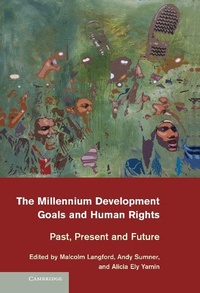
The Millennium Development Goals and Human Rights
Past, Present and Future
Published on 16. September 2013
Book
Hardback
571 pages
978-1-107-03191-3 (ISBN)
Description
The Millennium Development Goals (MDGs) have generated tremendous discussion in global policy and academic circles. On the one hand, they have been hailed as the most important initiative ever in international development. On the other hand, they have been described as a great betrayal of human rights and universal values that has contributed to a depoliticization of development. With contributions from scholars from the fields of economics, law, politics, medicine and architecture, this volume sets out to disentangle this debate in both theory and practice. It critically examines the trajectory of the MDGs, the role of human rights in theory and practice, and what criteria might guide the framing of the post-2015 development agenda. The book is essential reading for anyone interested in global agreements on poverty and development.
Reviews / Votes
'Human rights and the MDGs have been dominant discourses in their respective fields in the twenty-first century. But until the appearance of this volume, policy-makers, practitioners and scholars have struggled to bring them together. This superb collection of essays reveals the important synergies, acknowledges the pitfalls, and provides insightful and constructive analysis of how to proceed. It is an indispensable guide to a subject of the utmost importance in the fields of development, human rights, and international affairs.' Philip G. Alston, John Norton Professor of Law, New York University School of Law 'Could a future design of international development goals which strongly integrates human rights principles and standards be more powerful, in its impact for people, than the current framework of the Millennium Development Goals (MDGs)? The contributors to this book provide a wide range of perspectives on this question, drawing on experience since the 2000 Millennium Declaration and with the setting of a post-2015 Development Agenda in mind. These scholars and analysts provide well-timed lessons from the 'MDG era' and detailed proposals for ways in which a new global agenda could more clearly and consistently reflect the obligation of nations to pursue and respect the rights of all people, particularly those who are most disadvantaged and deprived.' Richard Morgan, Senior Advisor on Post-2015, UNICEFMore details
Language
English
Place of publication
Cambridge
United Kingdom
Target group
Professional and scholarly
Illustrations
37 Tables, unspecified; 1 Halftones, unspecified; 18 Line drawings, unspecified
Dimensions
Height: 235 mm
Width: 157 mm
Thickness: 35 mm
Weight
974 gr
ISBN-13
978-1-107-03191-3 (9781107031913)
Copyright in bibliographic data and cover images is held by Nielsen Book Services Limited or by the publishers or by their respective licensors: all rights reserved.
Schweitzer Classification
Other editions
Additional editions
Malcolm Langford | Andy Sumner | Alicia Ely Yamin
The Millennium Development Goals and Human Rights
Past, Present and Future
Book
03/2015
Cambridge University Press
€69.00
Shipment within 15-20 days
Malcolm Langford | Andy Sumner | Alicia Ely Yamin
The Millennium Development Goals and Human Rights
Past, Present and Future
E-Book
10/2013
1st Edition
Cambridge University Press
€38.49
Available for download
E-Book
09/2013
Cambridge University Press
€31.99
Available for download
Persons
Malcolm Langford is a Research Fellow at the Norwegian Centre for Human Rights, Faculty of Law, University of Oslo and Director of the Centre's Socio-Economic Rights Programme. He leads a number of international research networks; is an advisor to different UN agencies, governments, and NGOs; and has been a visiting fellow and professor at various universities. He has published widely on human rights issues in law, economics, development, and political science. His books include The International Covenant on Economic, Social and Cultural Rights, with M. Craven (forthcoming); The Human Right to Water: Theory, Practice and Prospects (edited with Anna Russell, 2011); and Social Rights Jurisprudence: Emerging Trends in International and Comparative Law (2008). Alicia Ely Yamin is a lecturer on Global Health and the Director of the Program on the Health Rights of Women and Children at the Francois-Xavier Bagnoud Center for Health and Human Rights at Harvard University. Yamin is also an Associated Senior Researcher at the Christian Michelsen Institute (Norway). Yamin's twenty-year career at the intersection of health, human rights, and development has bridged academia and activism. She has published dozens of scholarly articles and various books relating to health and human rights, in both English and Spanish. Yamin regularly advises UN agencies on global health, human rights, and development issues. Andy Sumner is the Co-Director, King's International Development Institute, King's College London. He is an interdisciplinary development economist and a researcher within the field of global poverty and inequality with particular reference to middle-income countries. His research on poverty challenges the orthodox view that most of the world's extreme poor live in the world's poorest countries, and that extreme poverty is minimal or 'residual' at higher levels of average per capita income; rather, he argues that poverty is the outcome of patterns of growth and distribution, and of social processes and structures. He has written six books, has published in journals including World Development, and is co-editor of the book series 'Rethinking International Development'.
Content
1. Introduction: situating the debate Malcolm Langford, Andy Sumner and Alicia Ely Yamin; Part I. Perspectives: 2. Goals and rights: working together? James W. Nickel; 3. The limits of human rights: the role of the MDGs Jan Vandemoortele; 4. Master or servant? Development goals and human rights Mac Darrow; 5. The political within the depoliticised: poverty measurement and implicit agendas in the MDGs Andrew M. Fischer; 6. The economics of human rights and MDGs Milan Brahmbhatt and Otaviano Canuto; 7. International development actors and human rights Siobhan McInerney-Lankford; Part II. Synergies and Conflicts in Different Goals: 8. Poverty, hunger and statistical progress Thomas Pogge; 9. Sexual and reproductive health, rights and MDG 5: taking stock; looking forward Alicia Ely Yamin; 10. The struggle against HIV/AIDS: rights, economics and global responsibility Gorik Ooms, Rachel Hammonds and Gregg Gonsalves; 11. Education and HIV/AIDS: disability rights and inclusive development Michael Ashley Stein, Charlotte McClain-Nhlapo and Janet E. Lord; 12. 'Slum' upgrading or 'slum' eradication? The mixed message of the MDGs Marie Huchzermeyer; 13. International cooperation, MDG 8 and human rights Aldo Caliari and Mac Darrow; Part III. Framing the Post-2015 Agenda: 14. What issues will (re)define the post-2015 debate? Andy Sumner and Meera Tiwari; 15. Beyond the romantic violence of the MDGs: development, aid and human rights Charles Gore; 16. Integrating human rights and equality: a development agenda for the future Dan Seymour; 17. Global norms and national politics: the case of social protection Armando Barrientos and David Hulme; 18. Monitoring MDGs: a human rights critique and alternative Sakiko Fukuda-Parr and Joshua Greenstein; 19. Rethinking the metrics of progress: the case of water and sanitation Malcolm Langford; 20. Goals, rights and political economy: daring to break out of the liberal ideological box! Fantu Cheru; Part IV. Concluding Perspective: 21. Back to the future: reconciling paradigms or development as usual? Malcolm Langford, Alicia Ely Yamin and Andy Sumner.