

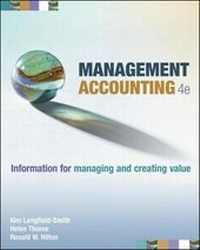
Management Accounting: Information for Managing and Creating Value
4th Edition
Published on 16. November 2005
Book
Paperback/Softback
978-0-07-471481-2 (ISBN)
Description
"Management Accounting" offers information for managing and creating value. Written by highly respected author team Kim Langfield-Smith and Helen Thorne, "Management Accounting, 4e" explains the contemporary role of management accounting in organisations - supporting a company's quest for creating and enhancing value for its shareholders. This edition retains its strategic approach, a clear writing style, and a wealth of Australian and regional cases. From 2008, this title is also available with Homework Manager - a powerful and flexible assignment and course management tool for lecturers. This text is suitable for the one- or two-semester undergraduate course, as well as the MBA management accounting course.
More details
Edition
4th edition
Language
English
Place of publication
London
United States
Publishing group
McGraw-Hill Education - Europe
Target group
College/higher education
Dimensions
Height: 98 mm
Width: 79 mm
Thickness: 15 mm
Weight
4 gr
ISBN-13
978-0-07-471481-2 (9780074714812)
Copyright in bibliographic data and cover images is held by Nielsen Book Services Limited or by the publishers or by their respective licensors: all rights reserved.
Schweitzer Classification
Persons
KIM LANGFIELD-SMITH Kim has a BEc from the University of Sydney, a MEc from Macquarie University and a PhD from Monash University, and is a fellow of CPA Australia and the Institute of Chartered Accountants in Australia (ICAA). She is Deputy Dean (Research) and Professor of Management Accounting in the Faculty of Business and Economics at Monash University, Australia and her prior appointments were at La Trobe University, the Universities of Melbourne and Tasmania, and the University of Technology, Sydney. Before entering academic life Kim worked as an accountant in several commercial organisations. Her research interests are in the area of management control systems. She has published articles in many referred journals in the accounting and management fields, including Accounting, Organizations and Society; Journal of Management Accounting Research; Management Accounting Research; Behavioral Research in Accounting; Journal of Accounting Literature; and Journal of Management Studies. Kim sits on several editorial boards and was President (Australia) of the Accounting Association of Australia and New Zealand (AAANZ), now known as the Accounting and Finance Association of Australia and New Zealand (AFAANZ), from 1999 to 2001. Kim continues to play an active role in the profession. She is chair of the Professional Qualifications Advisory Committee of CPA Australia, and a member of the International Accounting Education Standards Board (IAESB), representing the ICAA and CPA Australia. HELEN
HELEN THORNE Helen has a BEc and DipAcc from Flinders University, and a PhD from the University of Adelaide. She is an adjunct professor in the International Graduate School of Business at the University of South Australia. Helen has also held appointments in the Graduate School of Management and the Commerce Department at the University of Adelaide. Her research focuses on contemporary approaches to management accounting, including activity-based costing and strategic performance measurement systems, and she has published in referred journals in these areas, including Journal of Accounting Literature; Journal of Cost Management; Advances in Management Accounting; and Australian Accounting Review. Before commencing her academic career, Helen worked as a management accountant with a major international company. Since then she has maintained her interests in the real world. She is a member of CPA Australia and has undertaken consulting work in management accounting for a number of organisations in the manufacturing and service industries.
HELEN THORNE Helen has a BEc and DipAcc from Flinders University, and a PhD from the University of Adelaide. She is an adjunct professor in the International Graduate School of Business at the University of South Australia. Helen has also held appointments in the Graduate School of Management and the Commerce Department at the University of Adelaide. Her research focuses on contemporary approaches to management accounting, including activity-based costing and strategic performance measurement systems, and she has published in referred journals in these areas, including Journal of Accounting Literature; Journal of Cost Management; Advances in Management Accounting; and Australian Accounting Review. Before commencing her academic career, Helen worked as a management accountant with a major international company. Since then she has maintained her interests in the real world. She is a member of CPA Australia and has undertaken consulting work in management accounting for a number of organisations in the manufacturing and service industries.
Content
Part 1 - Introduction to Management Accounting1. Management Accounting: Information for Managing Resources and Creating Value2. Management Accounting: Cost Terms and ConceptsPart 2 - Costs and Costing Systems3. Cost Behaviour, Cost Drivers and Cost Estimation4. Product Costing Systems5. Process Costing and Operation Costing6. Service Costing7. A Closer Look at Overheads Costs8. Activity-based CostingPart 3 - Information for Managing Resources9. Budgeting Systems10. Standard Costs for Control: Direct Material and Direct Labour11. Standard Costs for Control: Flexible Budgets and Manufacturing Overhead12. Financial Performance Reports and Transfer Pricing13. Financial Performance Measures for Investment Centres, and Reward Systems14. Contemporary Approaches to Measuring and Managing Performance15. Managing Costs and Time for Customer Value16. Managing Suppliers, Customers and Quality17. Environmental and Social Managment AccountingPart 4 - Information for Creating Value18. Cost Volume Profit Analysis19. Information for Tactical Decisions20. Pricing and Product Mix Decisions21. Capital Expenditure Decisions: An Introduction22. Further Aspects of Capital Expenditure Decisions