

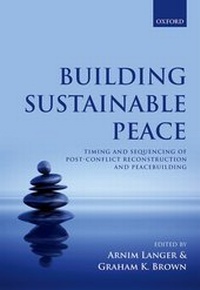
Building Sustainable Peace
Timing and Sequencing of Post-Conflict Reconstruction and Peacebuilding
Published on 23. August 2016
Book
Hardback
496 pages
978-0-19-875727-6 (ISBN)
Description
Countries emerging from civil war or protracted violence often face the daunting challenge of rebuilding their economy while simultaneously creating the political and social conditions for a stable peace. The implicit assumption in the international community that rapid political democratisation along with economic liberalisation holds the key to sustainable peace is belied by the experiences of countries such as Iraq and Afghanistan. Often, the challenges of
post-conflict reconstruction revolve around the timing and sequencing of different reform that may have contradictory implications. Drawing on a range of thematic studies and empirical cases, this book examines how post-conflict reconstruction policies can be better sequenced in order to promote sustainable
peace. The book provides evidence that many reforms that are often thought to be imperative in post-conflict societies may be better considered as long-term objectives, and that the immediate imperative for such societies should be 'people-centred' policies.
post-conflict reconstruction revolve around the timing and sequencing of different reform that may have contradictory implications. Drawing on a range of thematic studies and empirical cases, this book examines how post-conflict reconstruction policies can be better sequenced in order to promote sustainable
peace. The book provides evidence that many reforms that are often thought to be imperative in post-conflict societies may be better considered as long-term objectives, and that the immediate imperative for such societies should be 'people-centred' policies.
More details
Other editions
Additional editions
Arnim Langer | Graham K. Brown
Building Sustainable Peace
Timing and Sequencing of Post-Conflict Reconstruction and Peacebuilding
E-Book
06/2016
1st Edition
OUP eBook
€118.99
Available for download
Arnim Langer | Graham K. Brown
Building Sustainable Peace
Timing and Sequencing of Post-Conflict Reconstruction and Peacebuilding
E-Book
06/2016
1st Edition
OUP eBook
€119.99
Available for download
Persons
Arnim Langer is Director of the Centre for Research on Peace and Development (CRPD), Associate Professor in International Relations and Chair Holder of the UNESCO Chair in Building Sustainable Peace at the University of Leuven (KU Leuven) in Belgium. He is also a Research Associate at the Oxford Department of International Development (ODID) at the University of Oxford and a Visiting Fellow at the Centre for Development Studies (CDS) at the University of Bath. His
research focuses on group behaviour and identity formation, the causes and consequences of violent conflict, the dynamics and persistence of horizontal inequalities, post-conflict economic reconstruction, DDR processes, and sustainable peace building and peace education in post-conflict countries. He
has conducted extensive field research and is running large research projects on these topics in a range of African countries, in particular in Côte d'Ivoire, Ghana, Nigeria, Uganda, Kenya, and DR Congo.
Graham K. Brown is Professor of International Development and Head of School at the School of Social Sciences, UWA. Trained as a political scientist, Professor Brown works at the intersection of political science and development economics, with key interests in inequality, identity, and political mobilisation. He has worked extensively in Southeast Asia, particularly in Malaysia and Indonesia. He is Research Associate at the Universities of Oxford, Leuven, and Auckland, and has held visiting
research positions at Stanford University and the National University of Singapore.
research focuses on group behaviour and identity formation, the causes and consequences of violent conflict, the dynamics and persistence of horizontal inequalities, post-conflict economic reconstruction, DDR processes, and sustainable peace building and peace education in post-conflict countries. He
has conducted extensive field research and is running large research projects on these topics in a range of African countries, in particular in Côte d'Ivoire, Ghana, Nigeria, Uganda, Kenya, and DR Congo.
Graham K. Brown is Professor of International Development and Head of School at the School of Social Sciences, UWA. Trained as a political scientist, Professor Brown works at the intersection of political science and development economics, with key interests in inequality, identity, and political mobilisation. He has worked extensively in Southeast Asia, particularly in Malaysia and Indonesia. He is Research Associate at the Universities of Oxford, Leuven, and Auckland, and has held visiting
research positions at Stanford University and the National University of Singapore.
Content
PART I: ISSUES AND DYNAMICS; PART II: COUNTRY EXPERIENCES; PART III: CONCLUSIONS AND POLICY RECOMMENDATIONS