

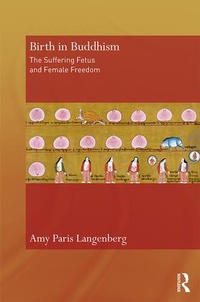
Birth in Buddhism
The Suffering Fetus and Female Freedom
1st Edition
Published on 16. May 2017
Book
Hardback
224 pages
978-1-138-20123-1 (ISBN)
Description
Recent decades have seen a groundswell in the Buddhist world, a transnational agitation for better opportunities for Buddhist women. Many of the main players in the transnational nuns movement self-identify as feminists but other participants in this movement may not know or use the language of feminism. In fact, many ordained Buddhist women say they seek higher ordination so that they might be better Buddhist practitioners, not for the sake of gender equality.
Eschewing the backward projection of secular liberal feminist categories, this book describes the basic features of the Buddhist discourse of the female body, held more or less in common across sectarian lines, and still pertinent to ordained Buddhist women today. The textual focus of the study is an early-first-millennium Sanskrit Buddhist work, "Descent into the Womb scripture" or Garbhavakranti-sutra. Drawing out the implications of this text, the author offers innovative arguments about the significance of childbirth and fertility in Buddhism, namely that birth is a master metaphor in Indian Buddhism; that Buddhist gender constructions are centrally shaped by Buddhist birth discourse; and that, by undermining the religious importance of female fertility, the Buddhist construction of an inauspicious, chronically impure, and disgusting femininity constituted a portal to a new, liberated, feminine life for Buddhist monastic women. Thus, this study of the Buddhist discourse of birth is also a genealogy of gender in middle period Indian Buddhism.
Offering a new critical perspective on the issues of gender, bodies and suffering, this book will be of interest to an interdisciplinary audience, including researchers in the field of Buddhism, South Asian history and religion, gender and religion, theory and method in the study of religion, and Buddhist medicine.
Eschewing the backward projection of secular liberal feminist categories, this book describes the basic features of the Buddhist discourse of the female body, held more or less in common across sectarian lines, and still pertinent to ordained Buddhist women today. The textual focus of the study is an early-first-millennium Sanskrit Buddhist work, "Descent into the Womb scripture" or Garbhavakranti-sutra. Drawing out the implications of this text, the author offers innovative arguments about the significance of childbirth and fertility in Buddhism, namely that birth is a master metaphor in Indian Buddhism; that Buddhist gender constructions are centrally shaped by Buddhist birth discourse; and that, by undermining the religious importance of female fertility, the Buddhist construction of an inauspicious, chronically impure, and disgusting femininity constituted a portal to a new, liberated, feminine life for Buddhist monastic women. Thus, this study of the Buddhist discourse of birth is also a genealogy of gender in middle period Indian Buddhism.
Offering a new critical perspective on the issues of gender, bodies and suffering, this book will be of interest to an interdisciplinary audience, including researchers in the field of Buddhism, South Asian history and religion, gender and religion, theory and method in the study of religion, and Buddhist medicine.
Reviews / Votes
"Brilliant analysis of suffering in early Indian Buddhist literature, highlighting its basic connection with birth and the impact of this connection on the lives of Buddhist men and women. With suffering and birth equated, woman were cast as sources of suffering, which in turn gave away to Buddhist literature of disgust that transformed 'the beautiful sexualized and fertile female form into something ugly and repugant."-Rory Lindsay, Buddhadharma: The Practitioner's Quarterly
More details
Series
Language
English
Place of publication
London
United Kingdom
Publishing group
Taylor & Francis Ltd
Target group
College/higher education
Illustrations
4 s/w Abbildungen, 4 s/w Photographien bzw. Rasterbilder
4 Halftones, black and white; 4 Illustrations, black and white
Dimensions
Height: 234 mm
Width: 156 mm
Weight
570 gr
ISBN-13
978-1-138-20123-1 (9781138201231)
Copyright in bibliographic data and cover images is held by Nielsen Book Services Limited or by the publishers or by their respective licensors: all rights reserved.
Schweitzer Classification
Other editions
Additional editions
Book
12/2019
1st Edition
Routledge
€54.46
Shipment within 15-20 days
E-Book
06/2017
Routledge
€61.99
Available for download
E-Book
06/2017
Routledge
€61.99
Available for download
Person
Amy Paris Langenberg is Assistant Professor of Religious Studies at Eckerd College, US.
Content
Reconceptions
1: Suffering is Birth
2: Birth Narratives and Gender Identity
3: Disgust for the Abject Mother
4: The Inauspicious Mother
5: Fertile Ascetics
6: Female Impurity and the Female Buddhist Ascetic
Postpartum
1: Suffering is Birth
2: Birth Narratives and Gender Identity
3: Disgust for the Abject Mother
4: The Inauspicious Mother
5: Fertile Ascetics
6: Female Impurity and the Female Buddhist Ascetic
Postpartum