

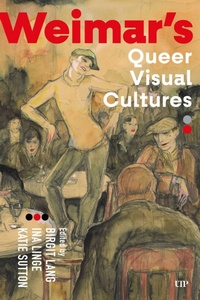
Weimar's Queer Visual Cultures
Will be published approx. on 23. June 2026
Book
Hardback
368 pages
978-1-4875-6080-5 (ISBN)
Description
Why do we keep returning to the Weimar Republic as a focal point for queer and trans histories, and why are images so crucial to our understanding of this period? This volume brings together research from disciplines including history, art history, literature, film, performance, and gender studies to explore the ongoing resonances of visual and narrative queer mythologies from Weimar Germany, often considered a "golden age" for queer culture and a period of relative rights and freedoms.
Chapters contribute new readings of classic Weimar art and film while significantly expanding the archive of queer Weimar by examining new or previously overlooked visual materials and relations: from occult practices to the vagaries of human-animal love, and from trans representations on film to the ambiguous tensions of forbidden intergenerational desire. Taken together, this volume generates a deep understanding of the twentieth-century emergence of queer and trans subjects through visual media; it develops methods that give prominence to the voices and perspectives of the historical subjects of sexual science; and it critically interrogates past practices of sexual knowledge production for understandings of LGBTQI lives today.
Chapters contribute new readings of classic Weimar art and film while significantly expanding the archive of queer Weimar by examining new or previously overlooked visual materials and relations: from occult practices to the vagaries of human-animal love, and from trans representations on film to the ambiguous tensions of forbidden intergenerational desire. Taken together, this volume generates a deep understanding of the twentieth-century emergence of queer and trans subjects through visual media; it develops methods that give prominence to the voices and perspectives of the historical subjects of sexual science; and it critically interrogates past practices of sexual knowledge production for understandings of LGBTQI lives today.
More details
Series
Language
English
Place of publication
Toronto
Canada
Target group
College/higher education
Professional and scholarly
Illustrations
58 illustrations
Dimensions
Height: 229 mm
Width: 152 mm
Thickness: 25 mm
Weight
1 gr
ISBN-13
978-1-4875-6080-5 (9781487560805)
Copyright in bibliographic data and cover images is held by Nielsen Book Services Limited or by the publishers or by their respective licensors: all rights reserved.
Schweitzer Classification
Persons
Birgit Lang is a professor of German at the University of Melbourne.
Ina Linge is an associate professor of German, and gender and sexuality studies at the University of Exeter.
Katie Sutton is an associate professor of German and gender studies at the Australian National University.
Ina Linge is an associate professor of German, and gender and sexuality studies at the University of Exeter.
Katie Sutton is an associate professor of German and gender studies at the Australian National University.
Content
1. Introduction: Weimar's Queer Visual Cultures
Birgit Lang, Ina Linge, and Katie Sutton
2. Virtual Witnessing: Weimar Cinema's pre-Weimar roots in Anders als die Andern (Different from the Others, 1919)
Sara Friedman
3. Beyond Open Bookshelves: Knabenliebe, Homoerotica, and Publishing in Weimar Germany
Camilla Smith
4. Taxonomies of Venus: Curt Moreck, Gerda Wegener, and the Queer Aesthetics of Cultural-Sexological Print
Eliza Coyle
5. Ambivalent Images: Revisiting Magnus Hirschfeld's Photo Wall of Sexual Intermediaries
Rainer Herrn
6. Weimar Tarot and the Queer Sensuous Knowledge of Ernst Tristan Kurtzahn
Ervin Malakaj
7. Self-Portrait with a Cat: Weimar's Queer History Beyond the Human
Heike Bauer
8. In the Closet: Codified Queerness in G.W. Pabst's Pandora's Box (1929)
Molly Harrabin
9. Erotic Pedagogy, Power Play, and Suspended Pleasure in Maedchen in Uniform (1931)
Cedar Lensing-Sharp
10. Between the Bar and the Clinic: Trans* Visual Histories in Mysterium des Geschlechtes
Jonah I. Garde
11. My Own I: Transgender Presentation and "Doing" Gender in Weimar Germany
Bodie A. Ashton
12. Queer Nostalgia: Ernst Hildebrand, Homoerotica, and Post-war Memories of Weimar Berlin
Ty Vanover
13. "=Queer Futurist Performance Aesthetics in Babylon Berlin (2017-2025)
Wesley Lim
14. Photographing Transness and Weimar Berlin: Transparent on Television and on the Stage, and Hirschfeld's Photography
Laurie Marhoefer
Birgit Lang, Ina Linge, and Katie Sutton
2. Virtual Witnessing: Weimar Cinema's pre-Weimar roots in Anders als die Andern (Different from the Others, 1919)
Sara Friedman
3. Beyond Open Bookshelves: Knabenliebe, Homoerotica, and Publishing in Weimar Germany
Camilla Smith
4. Taxonomies of Venus: Curt Moreck, Gerda Wegener, and the Queer Aesthetics of Cultural-Sexological Print
Eliza Coyle
5. Ambivalent Images: Revisiting Magnus Hirschfeld's Photo Wall of Sexual Intermediaries
Rainer Herrn
6. Weimar Tarot and the Queer Sensuous Knowledge of Ernst Tristan Kurtzahn
Ervin Malakaj
7. Self-Portrait with a Cat: Weimar's Queer History Beyond the Human
Heike Bauer
8. In the Closet: Codified Queerness in G.W. Pabst's Pandora's Box (1929)
Molly Harrabin
9. Erotic Pedagogy, Power Play, and Suspended Pleasure in Maedchen in Uniform (1931)
Cedar Lensing-Sharp
10. Between the Bar and the Clinic: Trans* Visual Histories in Mysterium des Geschlechtes
Jonah I. Garde
11. My Own I: Transgender Presentation and "Doing" Gender in Weimar Germany
Bodie A. Ashton
12. Queer Nostalgia: Ernst Hildebrand, Homoerotica, and Post-war Memories of Weimar Berlin
Ty Vanover
13. "=Queer Futurist Performance Aesthetics in Babylon Berlin (2017-2025)
Wesley Lim
14. Photographing Transness and Weimar Berlin: Transparent on Television and on the Stage, and Hirschfeld's Photography
Laurie Marhoefer