

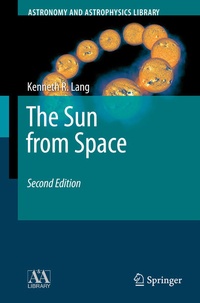
The Sun from Space
2nd Edition
Published on 4. November 2008
Book
Hardback
XXX, 558 pages
978-3-540-76952-1 (ISBN)
Description
The First Edition of The Sun from Space, completed in 1999, focused on the early accomplishments of three solar spacecraft, SOHO, Ulysses, and Yohkoh, primarily during a minimum in the Sun's 11-year cycle of magnetic activity. The comp- hensive Second Edition includes the main ndings of these three spacecraft over an entire activity cycle, including two minima and a maximum, and discusses the signi cant results of six more solar missions. Four of these, the Hinode, RHESSI, STEREO, and TRACE missions were launched after the First Edition was either nished or nearly so, and the other two, the ACE and Wind spacecraft, extend our investigations from the Sun to its varying input to the Earth. The Second Edition does not contain simple updates or cosmetic patch ups to the material in the First Edition. It instead contains the relevant discoveries of the past decade, integrated into chapters completely rewritten for the purpose. This provides a fresh perspective to the major topics of solar enquiry, written in an enjoyable, easily understood text accessible to all readers, from the interested layperson to the student or professional.
More details
Series
Edition
2nd ed. 2009
Language
English
Place of publication
Berlin
Germany
Publishing group
Springer Berlin
Target group
Primary & secondary/elementary & high school
Graduate
Edition type
Revised edition
Illustrations
XXX, 558 p.
Dimensions
Height: 241 mm
Width: 160 mm
Thickness: 38 mm
Weight
1045 gr
ISBN-13
978-3-540-76952-1 (9783540769521)
DOI
10.1007/978-3-540-76953-8
Schweitzer Classification
Other editions
Additional editions
Previous edition
Person
Lang - Astrophysical Formulae Volume I
Astrophysical Formulae is a comprehensive, widely-used reference to the fundamental formulae employed in astronomy, astrophysics and general physics. All the basic formulae in a particular field are given, with references to both the original work and recent research papers. Where possible the formulae have been developed from basic principles. If you want to know something about a given area, or find the formula that you need or know might exist, the first step is to look for it in Astrophysical Formulae or its references, rather than searching through a library or journals.
Over the past two decades, Astrophysical Formulae has become a standard reference found on numerous individual bookshelves and in all libraries that deal with astronomy, astrophysics and physics. This third, enlarged and revised edition will be similarly used by current and future generations of students and scientists in these fields.
The new editionof Astrophysical Formulae has been divided into two books - Volume I. Radiation, Gas Processes and High Energy Astrophysics and Volume II. Space, Time, Matter and Cosmology. They together contain over 4000 formulae and 5000 references, more than doubling the number found in previous versions. Past editions have also been improved upon by collecting all the references together in one alphabetical bibliography, instead of listing by chapter, and numerous references have been added for papers published during the past three decades.
This Volume I. Radiation, Gas Processes and High Energy Astrophysics includes electromagnetic radiation, scattering and scintillation, atomic and molecular spectra with the various broadening and shifting effects, statistical mechanics and thermodynamics of gases, hydrodynamics and magnetohydrodynamics, and particle physics as far as it is applicable to astrophysics, including nucleosynthesis of the elements and energetic particles or radiation in the cosmos.
The material in Volume I has been updated with references to important review articles and books, and new formulae, data and references have been added for contemporary topics such as accretion, brown dwarfs, cosmic rays, spallation reactions, equations of state for degenerate gases, gamma ray bursts, gamma ray lines, interstellar gas and dust, molecular clouds, molecular masers, origin and abundance of the elements, particle acceleration by shock waves, star formation, supernovae explosions and remnants, supernova SN 1987A, and thermonuclear reactions. Entirely new sections include those on helioseismology, solar neutrinos, neutrino oscillations, neutrino emission from stellar collapse and supernovae, and energetic particles and radiation from solar flares.
Content
Instruments for a Revolution.- Discovering Space.- Exploring Unseen Depths of the Sun.- Solving the Sun's Heating Crisis.- Winds Across the Void.- Our Violent Sun.- Space Weather.- References.