

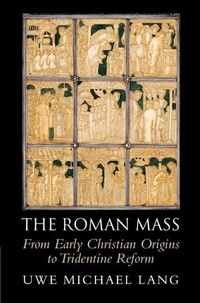
The Roman Mass
From Early Christian Origins to Tridentine Reform
Published on 29. September 2022
Book
Hardback
456 pages
978-1-108-83245-8 (ISBN)
Description
This volume offers a new, synthetic overview of the structure and ritual shape of the Roman Mass from its formative period in late antiquity to its post-Tridentine standarisation. Starting with the Last Supper and the origins of the Eucharist, Uwe Michael Lang constructs a narrative that explores the intense religious, social, and cultural transformations that shaped the Roman Mass. Lang unites classical liturgical history with insights from a variety of other disciplines that have drawn attention to the ritual performance and reception of the mass. He also presents liturgical developments within the broader historical and theological contexts that affected the celebration and experience of the sacramental rite that is still at the heart of Catholic Christianity. Aimed at scholars from a broad swathe of subjects, including religious studies, history, art history, literature, and music, Lang's volume serves as a comprehensive history of the Roman Mass over the course of a millenium.
Reviews / Votes
'A bibliographer's dream come true ... scholars in the field will appreciate this expert, disciplined work of agenda-setting.' Piotr H. Kosicki, Times Literary Supplement 'Students of liturgy will immediately recognize the name of our author. Father Lang is a highly respected scholar, who does not disappoint this time around. ... it should be in the library of every priest and seminarian and, of course, in Catholic libraries.' Reverend Pete M. J. Stravinskas, The Catholic Response 'Both scholars and more casual readers who pick up this volume will find themselves at the feet of a fair and patient magister who is a trustworthy guide and deftly stewards his readers through 1,600 years of history in just 366 pages.' Matthew S. C. Olver, The Living Church 'I can imagine it is gratifying to an author when his accumulated scholarship can come together in one splendid volume. I know it is gratifying to a reader when he discovers a 1500-year history of the 'Ordo Missae', written with a new, synthetic approach, that attends to classic texts of liturgical history, gently questions shortcomings, explains the current issues, attends to new methodologies in order to nuance current opinion, and interweaves topical concerns into historical narrative. A history must be more than a simple concatenation of dates and facts. These must be woven into a narrative tapestry if they are to command interest, and this is Fr. Michael Lang's masterful accomplishment.' David W. Fagerberg, The ThomistMore details
Language
English
Place of publication
Cambridge
United Kingdom
Illustrations
Worked examples or Exercises
Dimensions
Height: 232 mm
Width: 153 mm
Thickness: 32 mm
Weight
796 gr
ISBN-13
978-1-108-83245-8 (9781108832458)
Copyright in bibliographic data and cover images is held by Nielsen Book Services Limited or by the publishers or by their respective licensors: all rights reserved.
Schweitzer Classification
Other editions
Additional editions
Book
approx. 02/2026
Cambridge University Press
€42.00
Not yet published
E-Book
09/2022
Cambridge University Press
€95.49
Available for download
E-Book
07/2022
Cambridge University Press
€95.49
Available for download
Person
Uwe Michael Lang is an adjunct faculty member at the Institute of Theology and Liberal Arts at St. Mary's University, Twickenham and Allen Hall Seminary. A priest of the Oratory of St. Philip Neri in London, he is the author of Turning Towards the Lord: Orientation in Liturgical Prayer and Signs of the Holy One: Liturgy, Ritual and Expression of the Sacred. He is the editor of Antiphon: A Journal for Liturgical Renewal.
Content
Introduction; 1. The last supper; 2. The Eucharist in the early church; 3. Development of Eucharistic prayers in the third and fourth century; 4. The formative period of Latin liturgy; 5. Roman stational liturgy; 5. The expansion and adaptation of the Roman liturgy in the Carolingian Age; 7. From the Ottonian Revival to the High Middle Ages; 8. Decline and vitality in the later Middle Ages; 9. The Tridentine Reform; Epilogue.