

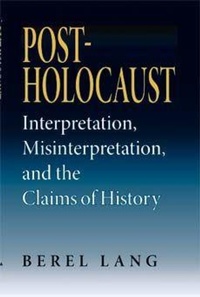
Post-Holocaust
Interpretation, Misinterpretation, and the Claims of History
Published on 18. January 2005
Book
Paperback/Softback
224 pages
978-0-253-21728-8 (ISBN)
Description
"These essays are extremely well written, with the clarity and accessibility that one has come to expect from Berel Lang, one of the most respected and significant philosophers writing about the Holocaust and its impact." -Michael L. Morgan
In these trenchant essays, philosopher Berel Lang examines post-Holocaust intepretations-and misinterpretations-showing the ways in which rhetoric and ideology have affected historical discourse about the Holocaust and how these accounts can be deconstructed. Why didn't the Jews resist? How could the Germans have done what they did? Why didn't more bystanders join in the rescue? In Lang's view, these questions become mischievous when the circumstances in which victims, perpetrators, and bystanders played their roles are omitted or obscured. To confront such issues adequately requires comparative and contextual evidence. Post-Holocaust addresses such questions as the place of the Holocaust in the Nazi project as a whole, the roles of revenge and forgiveness in post-Holocaust Jewish thinking, Holocaust commemoration as artifice or "business," and the relationship of the Holocaust to traditional antisemitism. Lang's analysis provides an incisive and fruitful basis for confronting these critical subjects.
Jewish Literature and Culture-Alvin H. Rosenfeld, editor
In these trenchant essays, philosopher Berel Lang examines post-Holocaust intepretations-and misinterpretations-showing the ways in which rhetoric and ideology have affected historical discourse about the Holocaust and how these accounts can be deconstructed. Why didn't the Jews resist? How could the Germans have done what they did? Why didn't more bystanders join in the rescue? In Lang's view, these questions become mischievous when the circumstances in which victims, perpetrators, and bystanders played their roles are omitted or obscured. To confront such issues adequately requires comparative and contextual evidence. Post-Holocaust addresses such questions as the place of the Holocaust in the Nazi project as a whole, the roles of revenge and forgiveness in post-Holocaust Jewish thinking, Holocaust commemoration as artifice or "business," and the relationship of the Holocaust to traditional antisemitism. Lang's analysis provides an incisive and fruitful basis for confronting these critical subjects.
Jewish Literature and Culture-Alvin H. Rosenfeld, editor
Reviews / Votes
"These essays are extremely well written, with the clarity and accessibility that one has come to expect from Berel Lang, one of the most respected and significant philosophers writing about the Holocaust and its impact." Michael L. MorganMore details
Series
Language
English
Place of publication
Bloomington, IN
United States
Target group
Professional and scholarly
Product notice
Paperback (trade)
Dimensions
Height: 234 mm
Width: 156 mm
Thickness: 12 mm
Weight
319 gr
ISBN-13
978-0-253-21728-8 (9780253217288)
Copyright in bibliographic data and cover images is held by Nielsen Book Services Limited or by the publishers or by their respective licensors: all rights reserved.
Schweitzer Classification
Person
Berel Lang is Professor of Humanities at Trinity College in Hartford, Connecticut. He is author of Act and Idea in the Nazi Genocide; Holocaust Representation: Art within the Limits of History and Ethics; and The Future of the Holocaust: Between History and Memory.
Content
Acknowledgments
Introduction
Part I. In the Matter of Justice
1. The Nazi as Criminal: Inside and Outside the Holocaust
2. Forgiveness, Revenge, and the Limits of Holocaust Justice
3. Evil, Suffering, and the Holocaust
4. Comparative Evil: Measuring Numbers, Degrees, People
Part II. Language and Lessons
5. The Grammar of Antisemitism
6. The Unspeakable vs. the Testimonial: Holocaust Trauma in Holocaust History
7. Undoing Certain Mischievous Questions about the Holocaust
8. From the Particular to the Universal, and Forward: Representations and Lessons
Part III. For and Against Interpretation
9. Oskar Rosenfeld and Historiographic Realism (in Sex, Shit, and Status)
10. Lachrymose without Tears: Misreading the Holocaust in American Life
11. "Not Enough" vs. "Plenty": Which Did Pius XII?
12. The Evil in Genocide
13. Misinterpretation as the Author's Responsibility (Nietzsche's Fascism, for Instance)
Afterword: Philosophy and/of the Holocaust
Notes
Index
Introduction
Part I. In the Matter of Justice
1. The Nazi as Criminal: Inside and Outside the Holocaust
2. Forgiveness, Revenge, and the Limits of Holocaust Justice
3. Evil, Suffering, and the Holocaust
4. Comparative Evil: Measuring Numbers, Degrees, People
Part II. Language and Lessons
5. The Grammar of Antisemitism
6. The Unspeakable vs. the Testimonial: Holocaust Trauma in Holocaust History
7. Undoing Certain Mischievous Questions about the Holocaust
8. From the Particular to the Universal, and Forward: Representations and Lessons
Part III. For and Against Interpretation
9. Oskar Rosenfeld and Historiographic Realism (in Sex, Shit, and Status)
10. Lachrymose without Tears: Misreading the Holocaust in American Life
11. "Not Enough" vs. "Plenty": Which Did Pius XII?
12. The Evil in Genocide
13. Misinterpretation as the Author's Responsibility (Nietzsche's Fascism, for Instance)
Afterword: Philosophy and/of the Holocaust
Notes
Index