

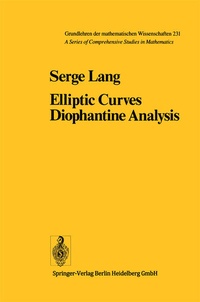
Elliptic Curves
Diophantine Analysis
Published on 19. October 2010
Book
Paperback/Softback
XI, 264 pages
978-3-642-05717-5 (ISBN)
Description
It is possible to write endlessly on elliptic curves. (This is not a threat.) We deal here with diophantine problems, and we lay the foundations, especially for the theory of integral points. We review briefly the analytic theory of the Weierstrass function, and then deal with the arithmetic aspects of the addition formula, over complete fields and over number fields, giving rise to the theory of the height and its quadraticity. We apply this to integral points, covering the inequalities of diophantine approximation both on the multiplicative group and on the elliptic curve directly. Thus the book splits naturally in two parts. The first part deals with the ordinary arithmetic of the elliptic curve: The transcendental parametrization, the p-adic parametrization, points of finite order and the group of rational points, and the reduction of certain diophantine problems by the theory of heights to diophantine inequalities involving logarithms. The second part deals with the proofs of selected inequalities, at least strong enough to obtain the finiteness of integral points.
More details
Series
Edition
Softcover reprint of the original 1st ed. 1978
Language
English
Place of publication
Berlin
Germany
Publishing group
Springer Berlin
Target group
Professional and scholarly
Research
Illustrations
XI, 264 p.
Dimensions
Height: 235 mm
Width: 155 mm
Thickness: 16 mm
Weight
429 gr
ISBN-13
978-3-642-05717-5 (9783642057175)
DOI
10.1007/978-3-662-07010-9
Schweitzer Classification
Other editions
Additional editions
Content
I. General Algebraic Theory.- I. Elliptic Functions.- II. The Division Equation.- III. p-Adic Addition.- IV. Heights.- V. Kummer Theory.- V1. Integral Points.- II. Approximation of Logarithms.- VII. Auxiliary Results.- VIII. The Baker-Feldman Theorem.- IX. Linear Combinations of Elliptic Logarithms.- X. The Baker-Tijdeman Theorem.- XI. Refined Inequalities.