

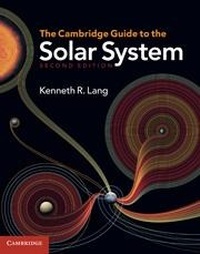
The Cambridge Guide to the Solar System
2nd Edition
Published on 3. March 2011
Book
Hardback
502 pages
978-0-521-19857-8 (ISBN)
Description
Richly illustrated with full-color images, this book is a comprehensive, up-to-date description of the planets, their moons, and recent exoplanet discoveries. This second edition of a now classic reference is brought up to date with fascinating new discoveries from 12 recent Solar System missions. Examples include water on the Moon, volcanism on Mercury's previously unseen half, vast buried glaciers on Mars, geysers on Saturn's moon Enceladus, lakes of hydrocarbons on Titan, encounter with asteroid Itokawa, and sample return from comet Wild 2. The book is further enhanced by hundreds of striking new images of the planets and moons. Written at an introductory level appropriate for undergraduate and high-school students, it provides fresh insights that appeal to anyone with an interest in planetary science. A website hosted by the author contains all the images in the book with an overview of their importance. A link to this can be found at www.cambridge.org/solarsystem.
Reviews / Votes
'Journeys deep into space have revealed dozens of distinctive worlds of unexpected diversity. Ken Lang presents a richly illustrated and remarkably thorough guide to the new view of the Solar System that has emerged, a view that beckons us on further journeys of discovery.' Edward Stone, NASA Jet Propulsion Laboratory '... exceptionally good ... so clearly written that it is within the cope of even the complete newcomer to astronomy, but there are also sections, usually in boxes, that will be useful to the serious student ... this is a well-written and splendidly illustrated book, suitable for readers of all kinds. it may be recommended without hesitation and will be a welcome addition to any astronomical library.' Patrick Moore, The Times Higher Education Supplement 'In Ken Lang's brilliant guide, he shows us how to read the character of the worlds of our solar system and how to understand not only the distinctive nature of each one but how they relate as families. I came away from the book with my mind liberated from gravity and the bounds of a human lifespan, images of the development of other worlds over their 4 billion year history crowding through my imagination.' Paul Murdin, University of Cambridge '... a very readable and informative volume ... it is a fascinating read because the author focuses on the development of ideas about the planets, on the basis of observations available at the time. This gives a strong narrative quality to the text, which enlivens the arguments and allows the reader to appreciate the significance of key new observations.' Astronomy Geophysics 'Competitively priced in hardback, the book should be a best seller.' The Observatory '... very browseable ... for those wishing for a well documented guide to our present knowledge of the Solar system this is very good value ... Recommended ...'. Astronomy NowMore details
Edition
2nd Revised edition
Language
English
Place of publication
Cambridge
United Kingdom
Target group
College/higher education
Edition type
Revised edition
Product notice
sewn/stitched
Cloth over boards
Illustrations
62 Tables, black and white; 225 Halftones, color; 200 Halftones, black and white
Dimensions
Height: 283 mm
Width: 228 mm
Thickness: 45 mm
Weight
1986 gr
ISBN-13
978-0-521-19857-8 (9780521198578)
Copyright in bibliographic data and cover images is held by Nielsen Book Services Limited or by the publishers or by their respective licensors: all rights reserved.
Schweitzer Classification
Other editions
Additional editions
Kenneth R. Lang
The Cambridge Guide to the Solar System
E-Book
05/2011
2nd Edition
Cambridge University Press
€64.99
Available for download
Kenneth R. Lang
Cambridge Guide to the Solar System
E-Book
03/2011
Cambridge University Press
€55.49
Available for download
Previous edition
Kenneth R. Lang
The Cambridge Guide to the Solar System
Book
09/2003
Cambridge University Press
€52.00
Article exhausted; check for reprint
Person
Kenneth R. Lang is a Professor of Astronomy at Tufts University. He is a well-known author and has published 25 books. The Cambridge Encyclopedia of the Sun (Cambridge University Press, 2001) was recommended by the Library Journal as one of the best reference books published that year. He has extensive teaching experience, and has served as a Visiting Senior Scientist at NASA headquarters.
Content
Part I. Changing Views and Fundamental Concepts: 1. Evolving perspectives: a historical prologue; 2. The new, close-up view from space; 3. The invisible buffer zone with space: atmospheres, magnetospheres and the solar wind; Part II. The Inner System - Rocky Worlds: 4. Third rock from the Sun: restless Earth; 5. The Moon: stepping stone to the planets; 6. Mercury: a dense battered world; 7. Venus: the veiled planet; 8. Mars: the red planet; Part III. The Giant Planets, Their Satellites and Their Rings - Worlds of Liquid, Ice and Gas: 9. Jupiter: a giant primitive planet; 10. Saturn: lord of the rings; 11. Uranus and Neptune; Part IV. Remnants of Creation - Small Worlds in the Solar System: 12. Asteroids and meteorites; 13. Colliding worlds; 14. Comets; 15. Beyond Neptune; Part V. Origin of the Solar System and Extrasolar Planets: 16. Brave new worlds; Index.