

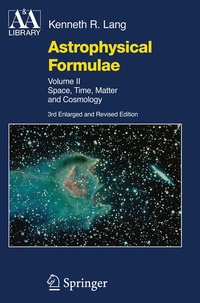
Astrophysical Formulae
Space, Time, Matter and Cosmology
3rd Edition
Published on 23. August 2014
Book
Paperback/Softback
XX, 438 pages
978-3-662-21641-5 (ISBN)
Description
This volume is a reference source of fundamental formulae in physics and astrophysics. In contrast to most of the usual compendia it carefully explains the physical assumptions entering the formulae. All the important results of physical theories are covered: electrodynamics, hydrodynamics, general relativity, atomic and nuclear physics, and so on. Over 2100 formulae are included, and the original papers for the formulae are cited together with papers on modern applications in a bibliography of over 1900 entries. For this new edition, a chapter on space, time, matter and cosmology has been included and the other chapters have been carefully revised.
Reviews / Votes
From the reviews"This latest up-date remains an essential source book for every student and every researcher in astrophysics, as well as in physics."
Irish Astronomical Journal, 2000
From reviews of the second edition
"a magnificent compendium without which no astronomer's library would be complete."
Optica Acta
More details
Series
Edition
Third Edition 1999
Language
English
Place of publication
Berlin
Germany
Publishing group
Springer Berlin
Target group
Professional and scholarly
Research
Illustrations
XX, 438 p.
Dimensions
Height: 235 mm
Width: 155 mm
Thickness: 25 mm
Weight
698 gr
ISBN-13
978-3-662-21641-5 (9783662216415)
DOI
10.1007/978-3-662-21639-2
Schweitzer Classification
Other editions
Additional editions
Book
06/1999
3rd Edition
Springer
€85.59
Article exhausted; check different version
Person
Lang - Astrophysical Formulae Volume I
Astrophysical Formulae is a comprehensive, widely-used reference to the fundamental formulae employed in astronomy, astrophysics and general physics. All the basic formulae in a particular field are given, with references to both the original work and recent research papers. Where possible the formulae have been developed from basic principles. If you want to know something about a given area, or find the formula that you need or know might exist, the first step is to look for it in Astrophysical Formulae or its references, rather than searching through a library or journals.
Over the past two decades, Astrophysical Formulae has become a standard reference found on numerous individual bookshelves and in all libraries that deal with astronomy, astrophysics and physics. This third, enlarged and revised edition will be similarly used by current and future generations of students and scientists in these fields.
The new editionof Astrophysical Formulae has been divided into two books - Volume I. Radiation, Gas Processes and High Energy Astrophysics and Volume II. Space, Time, Matter and Cosmology. They together contain over 4000 formulae and 5000 references, more than doubling the number found in previous versions. Past editions have also been improved upon by collecting all the references together in one alphabetical bibliography, instead of listing by chapter, and numerous references have been added for papers published during the past three decades.
This Volume I. Radiation, Gas Processes and High Energy Astrophysics includes electromagnetic radiation, scattering and scintillation, atomic and molecular spectra with the various broadening and shifting effects, statistical mechanics and thermodynamics of gases, hydrodynamics and magnetohydrodynamics, and particle physics as far as it is applicable to astrophysics, including nucleosynthesis of the elements and energetic particles or radiation in the cosmos.
The material in Volume I has been updated with references to important review articles and books, and new formulae, data and references have been added for contemporary topics such as accretion, brown dwarfs, cosmic rays, spallation reactions, equations of state for degenerate gases, gamma ray bursts, gamma ray lines, interstellar gas and dust, molecular clouds, molecular masers, origin and abundance of the elements, particle acceleration by shock waves, star formation, supernovae explosions and remnants, supernova SN 1987A, and thermonuclear reactions. Entirely new sections include those on helioseismology, solar neutrinos, neutrino oscillations, neutrino emission from stellar collapse and supernovae, and energetic particles and radiation from solar flares.
Content
5. Space, Time, Matter and Cosmology.- References Volume II.- Author Index Volume II.- Subject Index Volume II.