

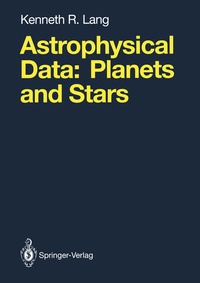
Astrophysical Data
Planets and Stars
Published on 30. March 2012
Book
Paperback/Softback
X, 937 pages
978-1-4684-0642-9 (ISBN)
Description
This volume of Astrophysical Data deals with Planets and Stars; a second volume, Part II, will give data for Galaxies and the Universe. They both pro vide basic data for use by all scientists, from the amateur astronomer to the professional astrophysicist. In this first volume, we not only provide physical parameters of planets, stars and their environment, but we also provide the celestial coordinates required to observe them. Here we use c.g.s. units, for they are the most commonly used in astron omy and astrophysics; but our volume begins with astronomical and physical constants and the conversion factors needed for other units. The next section concerns the planets and their satellites; it singles out the Earth and Moon for special treatment. Spacecraft rendezvous with the planets and satellites have led to improved values for their atmospheric compositions, orbital parameters, magnetic fields, masses, radii, rotation periods, and surface pressures and temperatures. This section also contains data for the asteroids, comets and their debris. We then discuss everyday stars, beginning with the Sun, and continuing with basic stellar data, the brightest stars and nearby stars. Special categories of stars, such as the Wolf-Rayet stars, magnetic stars, flare stars, and RS CVn binary stars, are included.
More details
Edition
Softcover reprint of the original 1st ed. 1992
Language
English
Place of publication
New York
United States
Target group
Professional and scholarly
Research
Illustrations
X, 937 p.
Dimensions
Height: 254 mm
Width: 178 mm
Thickness: 51 mm
Weight
1765 gr
ISBN-13
978-1-4684-0642-9 (9781468406429)
DOI
10.1007/978-1-4684-0640-5
Schweitzer Classification
Other editions
Additional editions
E-Book
12/2012
Springer
€53.49
Available for download
Book
10/1990
Springer
€85.55
Article exhausted; check different version
Content
I. Constants and Conversion Factors.- 1. Constants and Units.- II. Planets and their Satellites.- 2. Planet Earth.- 3. The Planets.- 4. The Moon.- 5. Satellites of the Planets.- 6. Asteroids and their Debris.- 7. Comets and their Debris.- III. The Stars.- 8. The Sun.- 9. Basic Stellar Data.- 10. Bright and Nearby Stars.- 11. Wolf-Rayet Stars.- 12. Magnetic Stars.- 13. Stellar Activity.- IV. Star Clusters and Associations.- 14. Globular Clusters.- 15. Open Clusters.- 16. OB Associations.- V. The Stellar Environment.- 17. Regions of Star Formation.- 18. Diffuse Emission Nebulae or H II Regions.- 19. Reflection Nebulae.- 20. Planetary Nebulae.- VI. Dying Stars.- 21. White Dwarf Stars.- 22. Pulsars.- 23. Candidate Black Holes.- VII. Interacting Binary Systems.- 24. Cataclysmic Binary Systems.- 25. Symbiotic Stars.- VIII. Supernovae Explosions and their Remnants.- 26. Supernovae.- 27. Supernova Remnants.- IX. High Energy Radiation From Stars.- 28. X-Ray and Gamma Ray Sources.- 29. Appendix.- References.