

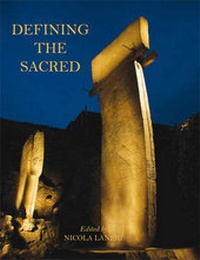
Defining the Sacred
Approaches to the Archaeology of Religion in the Near East
Published on 8. May 2015
Book
Paperback/Softback
200 pages
978-1-78297-679-0 (ISBN)
Description
Religion is a phenomenon that is inseparable from human society. It brings about a set of emotional, ideological and practical elements that are pervasive in the social fabric of any society and characterizable by a number of features. these include the establishment of intermediaries in the relationship between humans and the divine; the construction of ceremonial places for worshipping the gods and practicing ritual performances; and the creation ritual paraphernalia. Investigating the religious dimensions of ancient societies encounters problems in defining such elements, especially with regard to societies that lack textual evidences and has tended to lead towards the identification of differentiation between the mental dimension, related to religious beliefs, and the material one associated with religious practices, resulting in a separation between scholars able to investigate, and possibly reconstruct, ritual practices (i.e., archaeologists), and those interested in defining the realm of ancient beliefs (i.e., philologists and religious historians).
The aim of this collection of papers is to attempt to bridge these two dimensions by breaking down existing boundaries in order to form a more comprehensive vision of religion among ancient Near Eastern societies. This approach requires that a higher consideration be given to those elements (either artificial -- buildings, objects, texts, etc. -- or natural -- landscapes, animals, trees, etc.) that are created through a materialization of religious beliefs and practices enacted by members of communities. These issues are addressed in a series of specific case-studies covering a broad chronological framework that from the Pre-pottery Neolithic to the Iron Age.
The aim of this collection of papers is to attempt to bridge these two dimensions by breaking down existing boundaries in order to form a more comprehensive vision of religion among ancient Near Eastern societies. This approach requires that a higher consideration be given to those elements (either artificial -- buildings, objects, texts, etc. -- or natural -- landscapes, animals, trees, etc.) that are created through a materialization of religious beliefs and practices enacted by members of communities. These issues are addressed in a series of specific case-studies covering a broad chronological framework that from the Pre-pottery Neolithic to the Iron Age.
Reviews / Votes
Overall, the Laneri volume will engage those scholars looking for specific case studies addressing their own period- or region-based interests, particularly Near Eastern specialists. * Antiquity * ...the approaches presented by the papers are varied and often innovative, sometimes raising as many questions as they answer, and they offer significant insights into the archaeology of religion in the ancient Near East. * American Journal Of Archaeology * All told, this is a very useful and interesting volume, which collects a diverse group of studies on various cultures, periods and issues, and from, at times, very different perspectives, on the archaeology of religion in the ancient Near East. The editor and the contributors are to be thanked for this important collection. * Bryn Mawr Classical Review *More details
Language
English
Place of publication
Oxford
United Kingdom
Target group
Professional and scholarly
Illustrations
b/w illustrations
Dimensions
Height: 280 mm
Width: 216 mm
ISBN-13
978-1-78297-679-0 (9781782976790)
Copyright in bibliographic data and cover images is held by Nielsen Book Services Limited or by the publishers or by their respective licensors: all rights reserved.
Schweitzer Classification
Other editions
Additional editions
Person
Nicola Laneri is Director of the School of Religious Studies at CAMNES/Lorenzo de' Medici (Florence). He taught Archaeology of the Ancient Near East at the University of Catania, the University of Chicago, the Middle Eastern Technical University of Ankara and the Oriental Institute of Naples. From 2003 until 2016, he has been the director of the Hirbemerdon Tepe Archaeological Project (southeastern Turkey). He has published more than 80 scientific articles in journals and books.
Content
Introduction: Investigating archaeological approaches to the study of religious practices and beliefs
Nicola Laneri
I. Sacred Nature
Animal Burials and Cult of them in Margiana
Nadezah Dubova
Identifying sacrifice in Bronze Age Near Eastern iconography
Laerke Recht
Cult and the Rise of Desert Pastoralism
Steve Rosen
Standing Stone Monuments of Early Bronze Age Jordan
Ann Andersson
Late Chalcolithic Mesopotamia: towards a definition of sacred space and its evolution.
Pascal Butterlin
II. Housing the God
A sanctuary, or so fair a house? In defense of an archaeology of cult at Pre-Pottery Neolithic Goebekli Tepe
Oliver Dietrich and Jens Notroff
Where to Worship? Religion in Iron II Israel and Judah
Beth Alpert Nakhai
The Jezirah communal places of worship. Ritual activities and social memory during the Early Bronze Age
Stefano Valentini
Open spaces around the temples and their ritual use: archaeological evidence from the Bronze and Iron Age Levant
Stefania Mazzoni
Ritual Circumambulations in the Cuneiform Texts. An Overview
Amalia Catagnoti
A Temple Lifecycle: Rituals of Construction, Restoration, and Destruction of Some ED Mesopotamian and Syrian Sacred Buildings
Licia Romano
III. The Materialization of Religious Beliefs and Practices
Religion as practice in Neolithic societies
Trevor Watkins
Casting the sacred: Chalcolithic metallurgy in the southern Levant
Isaac Gilead& Milena Gosic
How better understanding of ritual practices can help the comprehension of religious feelings ?
Laura Battini
Archaeological Correlates of Pious Societies
Daniel Snell
Nicola Laneri
I. Sacred Nature
Animal Burials and Cult of them in Margiana
Nadezah Dubova
Identifying sacrifice in Bronze Age Near Eastern iconography
Laerke Recht
Cult and the Rise of Desert Pastoralism
Steve Rosen
Standing Stone Monuments of Early Bronze Age Jordan
Ann Andersson
Late Chalcolithic Mesopotamia: towards a definition of sacred space and its evolution.
Pascal Butterlin
II. Housing the God
A sanctuary, or so fair a house? In defense of an archaeology of cult at Pre-Pottery Neolithic Goebekli Tepe
Oliver Dietrich and Jens Notroff
Where to Worship? Religion in Iron II Israel and Judah
Beth Alpert Nakhai
The Jezirah communal places of worship. Ritual activities and social memory during the Early Bronze Age
Stefano Valentini
Open spaces around the temples and their ritual use: archaeological evidence from the Bronze and Iron Age Levant
Stefania Mazzoni
Ritual Circumambulations in the Cuneiform Texts. An Overview
Amalia Catagnoti
A Temple Lifecycle: Rituals of Construction, Restoration, and Destruction of Some ED Mesopotamian and Syrian Sacred Buildings
Licia Romano
III. The Materialization of Religious Beliefs and Practices
Religion as practice in Neolithic societies
Trevor Watkins
Casting the sacred: Chalcolithic metallurgy in the southern Levant
Isaac Gilead& Milena Gosic
How better understanding of ritual practices can help the comprehension of religious feelings ?
Laura Battini
Archaeological Correlates of Pious Societies
Daniel Snell