

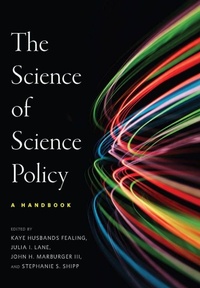
The Science of Science Policy
A Handbook
Published on 18. March 2011
Book
Hardback
400 pages
978-0-8047-7078-1 (ISBN)
Description
Basic scientific research and technological development have had an enormous impact on innovation, economic growth, and social well-being. Yet science policy debates have long been dominated by advocates for particular scientific fields or missions. In the absence of a deeper understanding of the changing framework in which innovation occurs, policymakers cannot predict how best to make and manage investments to exploit our most promising and important opportunities.
Since 2005, a science of science policy has developed rapidly in response to policymakers' increased demands for better tools and the social sciences' capacity to provide them. The Science of Science Policy: A Handbook brings together some of the best and brightest minds working in science policy to explore the foundations of an evidence-based platform for the field.
The contributions in this book provide an overview of the current state of the science of science policy from three angles: theoretical, empirical, and policy in practice. They offer perspectives from the broader social science, behavioral science, and policy communities on the fascinating challenges and prospects in this evolving arena. Drawing on domestic and international experiences, the text delivers insights about the critical questions that create a demand for a science of science policy.
Since 2005, a science of science policy has developed rapidly in response to policymakers' increased demands for better tools and the social sciences' capacity to provide them. The Science of Science Policy: A Handbook brings together some of the best and brightest minds working in science policy to explore the foundations of an evidence-based platform for the field.
The contributions in this book provide an overview of the current state of the science of science policy from three angles: theoretical, empirical, and policy in practice. They offer perspectives from the broader social science, behavioral science, and policy communities on the fascinating challenges and prospects in this evolving arena. Drawing on domestic and international experiences, the text delivers insights about the critical questions that create a demand for a science of science policy.
Reviews / Votes
"The handbook is designed for policy planners and business school students. Recommended."-J. S. Schwartz, CHOICE "The editors have assembled a distinguished, interdisciplinary group of scholars who carefully and expertly map out a broader research agenda on this important topic. The end result is a lucid and insightful volume. This is a 'must read' for anyone interested in the public policy implications of innovation."-Donald S. Siegel, Dean and Professor, School of Business, University at Albany, SUNY "Interested in the 'science' of science policy? Read this Handbook. Contributing academicians and practitioners provide their perspectives, questions, and considerations on the theoretical underpinnings; data required; budget process; political design rules; policy analogues; and international context of this emerging field of study. It'll get you thinking."-Connie K. N. Chang, former Chief of Staff and Research Director to the Under Secretary for Technology, former Technology Administration, U.S. Department of Commerce "In this volume, many of the nation's foremost science policy scholars make the case for a more rational decision process to guide federal research funding, arguing that 'science for science policy' is a prerequisite. It is not clear that all federal policymakers are open to a rational process. But, the arguments in this book are, indeed, compelling and will certainly propel discussions on this matter."-Neal Lane, Rice University, Former Director of the Office of Science and Technology Policy and of the National Science FoundationMore details
Series
Edition
New edition
Language
English
Place of publication
Palo Alto
United States
Publishing group
Stanford University Press
Target group
Professional and scholarly
Edition type
New edition
Product notice
Cloth
Illustrations
12 tables, 13 figures
Dimensions
Height: 264 mm
Width: 184 mm
Thickness: 29 mm
Weight
881 gr
ISBN-13
978-0-8047-7078-1 (9780804770781)
Copyright in bibliographic data and cover images is held by Nielsen Book Services Limited or by the publishers or by their respective licensors: all rights reserved.
Schweitzer Classification
Persons
Kaye Husbands Fealing is Professor at the Hubert H. Humphrey Institute of Public Affairs, University of Minnesota. She was the founding National Science Foundation Program Director of the Science of Science and Innovation Policy.
Julia Lane is the Program Director of Science of Science & Innovation Policy at the National Science Foundation. She is a former Professor of Economics at the American University, an American Statistical Association Fellow, and a Research Associate of IZA, the Institute for the Study of Labor.
John H. Marburger III is Professor at State University of New York, Stony Brook. He is a former Presidential Science Advisor and Director of the Office of Science and Technology Policy.
Stephanie Shipp is a Senior Research Analyst at the Science and Technology Policy Institute. She is a former Director of the Economic Assessment Office in the Advanced Technology Program at the National Institute of Standards and Technology.
Julia Lane is the Program Director of Science of Science & Innovation Policy at the National Science Foundation. She is a former Professor of Economics at the American University, an American Statistical Association Fellow, and a Research Associate of IZA, the Institute for the Study of Labor.
John H. Marburger III is Professor at State University of New York, Stony Brook. He is a former Presidential Science Advisor and Director of the Office of Science and Technology Policy.
Stephanie Shipp is a Senior Research Analyst at the Science and Technology Policy Institute. She is a former Director of the Economic Assessment Office in the Advanced Technology Program at the National Institute of Standards and Technology.