

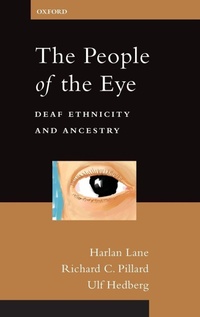
The People of the Eye
Deaf Ethnicity and Ancestry
Published on 20. January 2011
Book
Hardback
296 pages
978-0-19-975929-3 (ISBN)
Description
What are ethnic groups? Are Deaf people who sign American Sign Language (ASL) an ethnic group? In The People of the Eye, Deaf studies, history, cultural anthropology, genetics, sociology, and disability studies are brought to bear as the authors compare the vales, customs and social organization of the Deaf World to those in ethnic groups. Arguing against the common representation of ASL signers as a disability group, the authors discuss the many challenges to Deaf ethnicity, in this first book-length examination of these issues.
Stepping deeper into the debate around ethnicity status, The People of the Eye also describes in a compelling narrative the story of the founding families of the Deaf World in the US. Tracing ancestry back hundreds of years, the authors reveal that Deaf people's preference to marry other Deaf people led to the creation of Deaf clans, and thus to shared ancestry and the discovery that most ASL signers are born into the Deaf World, and many are kin.
In a major contribution to the historical record of Deaf people in the US, The People of the Eye portrays how Deaf people-and hearing people, too-lived in early America. For those curious about their own ancestry in relation to the Deaf World, the figures and an associated website present pedigrees for over two hundred lineages that extend as many as three hundred years and are unique in genealogy research. The book contains an every-name index to the pedigrees, providing a rich resource for anyone who is interested in Deaf culture.
Stepping deeper into the debate around ethnicity status, The People of the Eye also describes in a compelling narrative the story of the founding families of the Deaf World in the US. Tracing ancestry back hundreds of years, the authors reveal that Deaf people's preference to marry other Deaf people led to the creation of Deaf clans, and thus to shared ancestry and the discovery that most ASL signers are born into the Deaf World, and many are kin.
In a major contribution to the historical record of Deaf people in the US, The People of the Eye portrays how Deaf people-and hearing people, too-lived in early America. For those curious about their own ancestry in relation to the Deaf World, the figures and an associated website present pedigrees for over two hundred lineages that extend as many as three hundred years and are unique in genealogy research. The book contains an every-name index to the pedigrees, providing a rich resource for anyone who is interested in Deaf culture.
Reviews / Votes
thought provoking, analytical and an excellent reference point for anyone engaging in this field. * Sara Louise Wheeler, British Sociological Association * Readers will benefit from the data-driven and extensive coverage of hereditary deafness and understanding the roots of ethnic-like qualities concerning deaf people who live in a predominantly speaking society. * Samuel J. Supalla College of Education, Disability & Psychoeducational Studies, University of Arizona *More details
Language
English
Place of publication
New York
United States
Target group
Professional and scholarly
Dimensions
Height: 240 mm
Width: 161 mm
Thickness: 36 mm
Weight
1039 gr
ISBN-13
978-0-19-975929-3 (9780199759293)
Copyright in bibliographic data and cover images is held by Nielsen Book Services Limited or by the publishers or by their respective licensors: all rights reserved.
Schweitzer Classification
Other editions
Additional editions
E-Book
01/2011
1st Edition
OUP eBook
€55.49
Available for download
E-Book
01/2011
1st Edition
OUP eBook
€55.49
Available for download
Persons
HL is Distinguished University Professor of Psychology, Northeastern University. RCP is Professor of Psychiatry, Boston University. UH is Director, Deaf Library Collections and Archives, Gallaudet University.
Author
Distinguished University Professor of PsychologyDistinguished University Professor of Psychology, Northeastern University, Boston, MA
Professor of PsychiatryProfessor of Psychiatry, Boston University, Boston, MA
Director, Deaf Library Collections and ArchivesDirector, Deaf Library Collections and Archives, Gallaudet University, Washington, DC
Content
List of Illustrations
Introduction
Part I. Ethnicity and the Deaf-World
Chapter 1. Cultural Cohesive Forces
Chapter 2. Ethnic Boundaries
Chapter 3.Yes, But
Part II: Deaf Ancestry: Henniker, N. H., and Martha's Vineyard, Mass.
Chapter 4. Settling the New World
Chapter 5. The Brown family of Henniker, N. H.
Chapter 6. Martha's Vineyard, Mass
Chapter 7. Assimilating and Differentiating Societies
Part III: Deaf Ancestry in Maine: Northern Cluster
Chapter 8. Migration from the Vineyard to Maine
Chapter 9. Other Northern Settlers
Part IV: Deaf Ancestry in Maine: Southern Cluster
Chapter 10. Southern Cluster
Part V. Deaf Ancestry: Summary and Reflections
Appendices
Appendix A. Briefly Noted Lineages
Appendix B. What the Pedigrees Reveal about Genetic Transmission
Appendix C. Pedigree Methods
Appendix D. Every Name Index to Pedigrees at our Website
Index
Introduction
Part I. Ethnicity and the Deaf-World
Chapter 1. Cultural Cohesive Forces
Chapter 2. Ethnic Boundaries
Chapter 3.Yes, But
Part II: Deaf Ancestry: Henniker, N. H., and Martha's Vineyard, Mass.
Chapter 4. Settling the New World
Chapter 5. The Brown family of Henniker, N. H.
Chapter 6. Martha's Vineyard, Mass
Chapter 7. Assimilating and Differentiating Societies
Part III: Deaf Ancestry in Maine: Northern Cluster
Chapter 8. Migration from the Vineyard to Maine
Chapter 9. Other Northern Settlers
Part IV: Deaf Ancestry in Maine: Southern Cluster
Chapter 10. Southern Cluster
Part V. Deaf Ancestry: Summary and Reflections
Appendices
Appendix A. Briefly Noted Lineages
Appendix B. What the Pedigrees Reveal about Genetic Transmission
Appendix C. Pedigree Methods
Appendix D. Every Name Index to Pedigrees at our Website
Index