

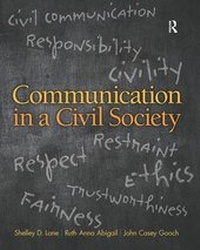
Communication in a Civil Society
1st Edition
Published on 9. October 2013
Book
Paperback/Softback
384 pages
978-0-205-77021-2 (ISBN)
Description
Teaches students to communicate civilly and ethically
Uncivil acts and messages too often color our experience with others. Communication in a Civil Society, 1/e, offers an alternative way to teach and learn about communication. Every chapter focuses on communication based on respect, restraint, and ethical choices.
MyCommunicationLab is an integral part of the Lane/Abigail/Gooch program that will help students communicate better. With MediaShare, students can post and share videos of their presentations. Also, interactive videos provide students with the opportunity to evaluate speeches. Online self-assessments and pre- and post-tests help students assess their comfort level with course concepts and their knowledge of the material.
Uncivil acts and messages too often color our experience with others. Communication in a Civil Society, 1/e, offers an alternative way to teach and learn about communication. Every chapter focuses on communication based on respect, restraint, and ethical choices.
MyCommunicationLab is an integral part of the Lane/Abigail/Gooch program that will help students communicate better. With MediaShare, students can post and share videos of their presentations. Also, interactive videos provide students with the opportunity to evaluate speeches. Online self-assessments and pre- and post-tests help students assess their comfort level with course concepts and their knowledge of the material.
More details
Language
English
Place of publication
United States
Publishing group
Taylor & Francis Inc
Target group
Adult education
Dimensions
Height: 254 mm
Width: 203 mm
Weight
930 gr
ISBN-13
978-0-205-77021-2 (9780205770212)
Copyright in bibliographic data and cover images is held by Nielsen Book Services Limited or by the publishers or by their respective licensors: all rights reserved.
Schweitzer Classification
Other editions
Additional editions
Shelley D. Lane | Ruth Anna Abigail | John Casey Gooch
Communication in a Civil Society
Book
04/2019
1st Edition
Routledge
€79.41
Article exhausted; check for reprint
Persons
Shelley D. Lane (Ph.D., University of Southern California, 1982) is the Associate Dean for Undergraduate Education in the School of Arts and Humanities at the University of Texas at Dallas. She has approximately 35 years of university and college experience that combines publication, teaching and administration. She is the author of Interpersonal Communication: Competence and Contexts, 2nd Edition, also published by Pearson Education,and a memoir, A Stirling Diary: An intercultural Story of Communication, Connection, and Coming-of-Age. Lane was selected as a Minnie Stevens Piper Professor, which is themost distinguished higher education teaching award in Texas.
Ruth Anna Abigail (Ph.D., University of Southern California, 1982) taught at Azusa Pacific University for 30 years, retiring in 2012 as faculty emeritus. She is the author (with Dudley D. Cahn) of Managing Conflict through Communication, 5th Edition, also published by Pearson Education. In addition to her research in the area of communication, Abigail is an artist whose textile work has been displayed both in the US and abroad. She recently accepted a position with the State of New Mexico as a trainer. One of her most frequently taught classes is on civility and ethics in the workplace.
John Casey Gooch (Ph.D., Texas Tech University, 2002) is Director of Rhetoric and Writing and Assistant Professor of Literary Studies at the University of Texas at Dallas. For almost 20 years, he has taught courses in professional speaking, technical writing, and rhetoric. He has published articles in IEEE Transactions on Professional Communication and Rhetor: Journal of the Canadian Society for the Study of Rhetoric; his piece on rhetoric pedagogy will appear in the forthcoming Oxford Studies in Rhetoric: A Report from the Interactive Seminar on Rhetoric and the 21st Century from Cambridge Scholars Press.
Ruth Anna Abigail (Ph.D., University of Southern California, 1982) taught at Azusa Pacific University for 30 years, retiring in 2012 as faculty emeritus. She is the author (with Dudley D. Cahn) of Managing Conflict through Communication, 5th Edition, also published by Pearson Education. In addition to her research in the area of communication, Abigail is an artist whose textile work has been displayed both in the US and abroad. She recently accepted a position with the State of New Mexico as a trainer. One of her most frequently taught classes is on civility and ethics in the workplace.
John Casey Gooch (Ph.D., Texas Tech University, 2002) is Director of Rhetoric and Writing and Assistant Professor of Literary Studies at the University of Texas at Dallas. For almost 20 years, he has taught courses in professional speaking, technical writing, and rhetoric. He has published articles in IEEE Transactions on Professional Communication and Rhetor: Journal of the Canadian Society for the Study of Rhetoric; his piece on rhetoric pedagogy will appear in the forthcoming Oxford Studies in Rhetoric: A Report from the Interactive Seminar on Rhetoric and the 21st Century from Cambridge Scholars Press.
Content
1.) Brief Table of Contents
2.) Full Table of Contents
1.) Brief Table of Contents
Part I: Foundations of Communication
Chapter 1: A First Look at Civil Communication
Chapter 2: Perceiving the Self and Others
Chapter 3: Civil Verbal Communication
Chapter 4: Civil Nonverbal Communication
Chapter 5: Civil Listening and Responding with Confirmation 90
Part II: Civil Interpersonal Communication?
Chapter 6: Interpersonal Relationships and Civil Communication
Chapter 7: Intimate Relationships, Romantic Relationships, and Civil Communication
Chapter 8: Civil Communication in Conflicts
Part III: Civil Small Group Communication?
Chapter 9: Civil Communication in Groups
Chapter 10: Group Processes and Civil Communication
Part IV: Civil Public Speaking
Chapter 11: Preparing Civil Public Speeches
Chapter 12: Delivering Public Speeches with Civility
Chapter 13: Giving Civil Informative and Special Occasion Speeches
Chapter 14: Giving Persuasive Speeches with Civility
2.) Full Table of Contents
Part I: Foundations of Communication?
Chapter 1: A First Look at Civil Communication
Civil and Ethical Communication
Defining Communication
Types of Communication
Models of Communication
Contexts of Communication
Improving Our Ability to Communicate Civilly and Effectively: Principles of Communication
Chapter 2: Perceiving the Self and Others
Definition of Perception and Self-Concept
Perception, Self-Concept, and Civility
Stages in the Perception Process?
Theoretical Perspectives about Perception
Characteristics of the Self-Concept
Improving Our Ability to Communicate Civilly and Effectively About our Perceptions?
Chapter 3: Civil Verbal Communication
Definition of Verbal Communication
Verbal Communication and Meaning?
Verbal Communication and Thought
Improving Our Ability to Engage in Civil and Effective Verbal Communication
Uncivil Language: Profanity and Cursing?
Chapter 4: Civil Nonverbal Communication
Definition of Nonverbal Communication
Functions of Nonverbal Communication
Types of Nonverbal Communication
Road Rage: Nonverbal Communication and Incivility
Deception and Nonverbal Communication
Improving our Ability to Communicate with Civil and Effective Nonverbal Immediacy Behaviors?
Chapter 5: Civil Listening and Responding with Confirmation
Definition of Listening?
Listening, Civility, and Ethics?
Stages and Types of Listening?
Improving our Ability to Engage in Civil and Effective Listening?
Confirming Listening Response Styles?
Listening, Confirming Responses, and Contexts?
Part II: Civil Interpersonal Communication?
Chapter 6: Interpersonal Relationships and Civil Communication
Definition and Types of Interpersonal Relationships?
Interpersonal Relationships and Civility
Theoretical Perspectives about Interpersonal Relationships?
Relational Communication
Improving our Ability to Communicate Civilly and Effectively with Metacommunication
Chapter 7: Intimate Relationships, Romantic Relationships, and Civil Communication
Definition of Intimate and Romantic Relationships?
Communication in Intimate and Romantic Relationships?
Self-Disclosure and Social Penetration Theory
Stage Models
Dialectical Tensions Model?
Intimate Relationships, Romantic Relationships, and Civility
Chapter 8: Civil Communication in Conflicts
Definition of Conflict
Theoretical Perspectives on Conflict Behavior?
Causes of Conflict
Options in Conflict Management
Improving our Ability to Communicate in Conflict Situations?
Avoiding Violence in Conflicts?
Improving our Ability to Come Together After Conflict
Part III: Civil Small Group Communication
Chapter 9: Civil Communication in Groups
Group Communication and Civility
What Characterizes Groups?
How Groups Develop?
Creating Group Climate?
Power and Leadership in Groups?
Chapter 10: Group Processes and Civil Communication
Group Problem Solving, Civility, and Ethics?
Communication and Decision Making in Groups?
Introduction to Group Processes?
Problem-Solving: The Heart of Group Processes?
Improving Our Ability to Engage in Civil and Effective Problem Solving?
Barriers to Effective Problem Solving?
Handling Conflict in Groups?
Improving Our Ability to Create Civil and Effective Group Meetings?
Part IV: Civil Public Speaking
Chapter 11: Preparing Civil Public Speeches
Engaging Your Audience with Civility
Planning Your Speech Topic?
Organizing Your Information
Writing a Speech Outline?
Formulating the Introduction, Transitions, and Conclusion
Gathering and Using Supporting Material?
Chapter 12: Delivering Public Speeches with Civility
Delivery, Civility, and Ethics?
Controlling Anxiety
Methods of Delivery
Techniques for Effective Delivery
Planning, Preparing, and Using Presentation Aids?
Practicing Your Speech
Chapter 13: Giving Civil Informative and Special Occasion Speeches
What Is Information?
Informative Speech Purposes?
The Process of Informing Audiences?
Composing an Informative Speech
Special Occasion Speeches?
Informative Speeches, Special Occasion Speeches, and Civility: Avoiding Plagiarism
Chapter 14: Giving Persuasive Speeches with Civility
What Is Persuasion?
Persuasive Speech Purposes?
The Process of Persuading Audiences?
Composing a Persuasive Speech
Persuasive Speaking and Incivility: Logical Fallacies?
Persuasive Speaking and Civility: Invitational Rhetoric?
2.) Full Table of Contents
1.) Brief Table of Contents
Part I: Foundations of Communication
Chapter 1: A First Look at Civil Communication
Chapter 2: Perceiving the Self and Others
Chapter 3: Civil Verbal Communication
Chapter 4: Civil Nonverbal Communication
Chapter 5: Civil Listening and Responding with Confirmation 90
Part II: Civil Interpersonal Communication?
Chapter 6: Interpersonal Relationships and Civil Communication
Chapter 7: Intimate Relationships, Romantic Relationships, and Civil Communication
Chapter 8: Civil Communication in Conflicts
Part III: Civil Small Group Communication?
Chapter 9: Civil Communication in Groups
Chapter 10: Group Processes and Civil Communication
Part IV: Civil Public Speaking
Chapter 11: Preparing Civil Public Speeches
Chapter 12: Delivering Public Speeches with Civility
Chapter 13: Giving Civil Informative and Special Occasion Speeches
Chapter 14: Giving Persuasive Speeches with Civility
2.) Full Table of Contents
Part I: Foundations of Communication?
Chapter 1: A First Look at Civil Communication
Civil and Ethical Communication
Defining Communication
Types of Communication
Models of Communication
Contexts of Communication
Improving Our Ability to Communicate Civilly and Effectively: Principles of Communication
Chapter 2: Perceiving the Self and Others
Definition of Perception and Self-Concept
Perception, Self-Concept, and Civility
Stages in the Perception Process?
Theoretical Perspectives about Perception
Characteristics of the Self-Concept
Improving Our Ability to Communicate Civilly and Effectively About our Perceptions?
Chapter 3: Civil Verbal Communication
Definition of Verbal Communication
Verbal Communication and Meaning?
Verbal Communication and Thought
Improving Our Ability to Engage in Civil and Effective Verbal Communication
Uncivil Language: Profanity and Cursing?
Chapter 4: Civil Nonverbal Communication
Definition of Nonverbal Communication
Functions of Nonverbal Communication
Types of Nonverbal Communication
Road Rage: Nonverbal Communication and Incivility
Deception and Nonverbal Communication
Improving our Ability to Communicate with Civil and Effective Nonverbal Immediacy Behaviors?
Chapter 5: Civil Listening and Responding with Confirmation
Definition of Listening?
Listening, Civility, and Ethics?
Stages and Types of Listening?
Improving our Ability to Engage in Civil and Effective Listening?
Confirming Listening Response Styles?
Listening, Confirming Responses, and Contexts?
Part II: Civil Interpersonal Communication?
Chapter 6: Interpersonal Relationships and Civil Communication
Definition and Types of Interpersonal Relationships?
Interpersonal Relationships and Civility
Theoretical Perspectives about Interpersonal Relationships?
Relational Communication
Improving our Ability to Communicate Civilly and Effectively with Metacommunication
Chapter 7: Intimate Relationships, Romantic Relationships, and Civil Communication
Definition of Intimate and Romantic Relationships?
Communication in Intimate and Romantic Relationships?
Self-Disclosure and Social Penetration Theory
Stage Models
Dialectical Tensions Model?
Intimate Relationships, Romantic Relationships, and Civility
Chapter 8: Civil Communication in Conflicts
Definition of Conflict
Theoretical Perspectives on Conflict Behavior?
Causes of Conflict
Options in Conflict Management
Improving our Ability to Communicate in Conflict Situations?
Avoiding Violence in Conflicts?
Improving our Ability to Come Together After Conflict
Part III: Civil Small Group Communication
Chapter 9: Civil Communication in Groups
Group Communication and Civility
What Characterizes Groups?
How Groups Develop?
Creating Group Climate?
Power and Leadership in Groups?
Chapter 10: Group Processes and Civil Communication
Group Problem Solving, Civility, and Ethics?
Communication and Decision Making in Groups?
Introduction to Group Processes?
Problem-Solving: The Heart of Group Processes?
Improving Our Ability to Engage in Civil and Effective Problem Solving?
Barriers to Effective Problem Solving?
Handling Conflict in Groups?
Improving Our Ability to Create Civil and Effective Group Meetings?
Part IV: Civil Public Speaking
Chapter 11: Preparing Civil Public Speeches
Engaging Your Audience with Civility
Planning Your Speech Topic?
Organizing Your Information
Writing a Speech Outline?
Formulating the Introduction, Transitions, and Conclusion
Gathering and Using Supporting Material?
Chapter 12: Delivering Public Speeches with Civility
Delivery, Civility, and Ethics?
Controlling Anxiety
Methods of Delivery
Techniques for Effective Delivery
Planning, Preparing, and Using Presentation Aids?
Practicing Your Speech
Chapter 13: Giving Civil Informative and Special Occasion Speeches
What Is Information?
Informative Speech Purposes?
The Process of Informing Audiences?
Composing an Informative Speech
Special Occasion Speeches?
Informative Speeches, Special Occasion Speeches, and Civility: Avoiding Plagiarism
Chapter 14: Giving Persuasive Speeches with Civility
What Is Persuasion?
Persuasive Speech Purposes?
The Process of Persuading Audiences?
Composing a Persuasive Speech
Persuasive Speaking and Incivility: Logical Fallacies?
Persuasive Speaking and Civility: Invitational Rhetoric?