


The New Politics of Public Policy
Published on 26. June 1995
Book
Hardback
360 pages
978-0-8018-4877-3 (ISBN)
Description
In The New Politics of Public Policy, Marc Landy and Martin Levin bring together a group of leading experts to challenge the view of the Bush-Reagan era as one characterised by policy gridlock. They demonstrate that there were a surprising number of impressive policy outcomes and that many were not in the least "conservative." The number and scope of these innovations, they argue, refute the conventional wisdom that the policy process in those years was biased against change, dominated by obstructionary interests, and characterised by incrementalism. The authors examine the most important arenas of modem domestic policy reform - health, entitlements, environment, and taxation as well as the changes that have taken place in the key policy-making institutions of Congress, the executive branch, the states, and the courts. They provide in-depth investigations of the 1986 and 1990 immigration Reforrn Acts, the 1986 Tax Reform Act, Aid to Children with Special Needs, the Superfund, and the Clean Air Act.
They show how changes in Congressional structure affect the representation of interests, deliberation, and the resolution of conflict and how these effects, in turn, influence the passage of legislation. They explain how the replacement of on-budget funding by mandates requiring others to pay has made it easier to enact expensive laws and regulations. Most importantly, they demonstrate that a new politics of public policy has emerged - one characterised by a competition for novel ideas, a lowering of the legitimacy barrier regarding governmental intervention, and a broader understanding of rights.
They show how changes in Congressional structure affect the representation of interests, deliberation, and the resolution of conflict and how these effects, in turn, influence the passage of legislation. They explain how the replacement of on-budget funding by mandates requiring others to pay has made it easier to enact expensive laws and regulations. Most importantly, they demonstrate that a new politics of public policy has emerged - one characterised by a competition for novel ideas, a lowering of the legitimacy barrier regarding governmental intervention, and a broader understanding of rights.
Reviews / Votes
"Leading political scientists [argue that] national politicians, far from being gridlocked, have acted with alacrity to implement fundamental and often surprising reforms in fields as diverse as education, immigration, and tax reform. In some of these areas the powerful lobbyists have been, literally, banished from the Congressional committee rooms, confounding most text books on American politics. This is an important book, which teaches the value of ideas in the post-utilitarian world of modern America."'--Political Studies'More details
Language
English
Place of publication
Baltimore, MD
United States
Target group
College/higher education
Professional and scholarly
Dimensions
Height: 229 mm
Width: 152 mm
Weight
652 gr
ISBN-13
978-0-8018-4877-3 (9780801848773)
DOI
10.56021/9780801848773
Copyright in bibliographic data is held by Nielsen Book Services Limited or its licensors: all rights reserved.
Schweitzer Classification
Other editions
Additional editions
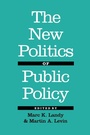
Marc K. Landy | Martin A. Levin
The New Politics of Public Policy
Book
06/1995
Johns Hopkins University Press
€35.90
Article not available for order
Persons
Marc K. Landy is professor of political science at Boston College and a senior fellow of the Gordon Public Policy Center at Brandeis University.
Content
Part I. Introduction
Chapter 1. Of Interests and Values: The New Politics and the New Political Science
Part II. Adversarial Legalism and the Rights Revolution
Chapter 2. Separation of Powers and the Strategy of Rights: The Expansion of Special Education
Chapter 3. The Politics of Rapid Legal Change: Immigration Policy in the 1980s
Chapter 4. Adversarial Legalism and American Government
Part III. Taxing and Spending
Chapter 5. Policy Models and Political Change: Insights from the Passage of Tax Reform
Chapter 6. The Politics of the Entitlement Process
Chapter 7. Elusive Community: Democracy, Deliberation, and the Reconstruction of Health Policy
Part IV. Regulation and Deregulation
Chapter 8. The New Politics of Environmental Policy
Chapter 9. Policy making in the Contemporary Congress: Three Dimensions of Performance
Part V. Conclusion
Chapter 10. New Politics, New Elites, Old Publics
Chapter 11. Two-Tier Politics and the Problem of Public Policy
Chapter 12. The new Politics of Public Policy
Notes
List of Contirbutors
Index
Chapter 1. Of Interests and Values: The New Politics and the New Political Science
Part II. Adversarial Legalism and the Rights Revolution
Chapter 2. Separation of Powers and the Strategy of Rights: The Expansion of Special Education
Chapter 3. The Politics of Rapid Legal Change: Immigration Policy in the 1980s
Chapter 4. Adversarial Legalism and American Government
Part III. Taxing and Spending
Chapter 5. Policy Models and Political Change: Insights from the Passage of Tax Reform
Chapter 6. The Politics of the Entitlement Process
Chapter 7. Elusive Community: Democracy, Deliberation, and the Reconstruction of Health Policy
Part IV. Regulation and Deregulation
Chapter 8. The New Politics of Environmental Policy
Chapter 9. Policy making in the Contemporary Congress: Three Dimensions of Performance
Part V. Conclusion
Chapter 10. New Politics, New Elites, Old Publics
Chapter 11. Two-Tier Politics and the Problem of Public Policy
Chapter 12. The new Politics of Public Policy
Notes
List of Contirbutors
Index