

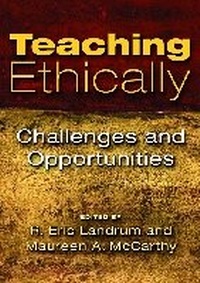
Teaching Ethically
Challenges and Opportunities
Will be published approx. on 15. January 2012
Book
Hardback
214 pages
978-1-4338-1086-2 (ISBN)
Description
In this book, editors R. Eric Landrum and Maureen A. McCarthy identify four broad areas of concern in the ethical teaching of undergraduate psychology: pedagogy, student behavior, faculty behavior toward students, and considerations in the diverse classroom. Together with their team of experts, they provide evidence-based advice and case studies that illustrate the application of relevant ethical principles.
Readers will find a host of practical suggestions for approaching ethics proactively in both traditional and virtual classrooms. This book will become an instant resource for all teachers in the social and behavioral sciences who care about ethical interactions between faculty members and students.
Readers will find a host of practical suggestions for approaching ethics proactively in both traditional and virtual classrooms. This book will become an instant resource for all teachers in the social and behavioral sciences who care about ethical interactions between faculty members and students.
More details
Language
English
Place of publication
Washington DC
United States
Target group
Professional and scholarly
Dimensions
Height: 254 mm
Width: 178 mm
ISBN-13
978-1-4338-1086-2 (9781433810862)
Copyright in bibliographic data and cover images is held by Nielsen Book Services Limited or by the publishers or by their respective licensors: all rights reserved.
Schweitzer Classification
Persons
R. Eric Landrum, PhD, is a professor of psychology at Boise State University he received his doctorate in cognitive psychology (with an emphasis in quantitative methodology) from Southern Illinois University at Carbondale in 989. His research interests center on the study of educational issues, identifying those conditions that best facilitate student success (broadly defined).
He has given over 28 professional presentations at conferences and has authored 7 books or book chapters and over 7 professional articles in peer-reviewed journals, such as Teaching of Psychology, College Teaching, and the Journal of College Student Development.
He has worked with over 275 undergraduate research assistants and taught more than 2, students in 9 years at Boise State. During summer 2 8, he led a working group at the National Conference for Undergraduate Education in Psychology concerned with the desired results of an undergraduate psychology education.
Maureen A. McCarthy, PhD, is a professor of psychology at Kennesaw State University she earned her doctorate from Missouri State University in research and evaluation. She previously served as president of Division 2 (Society for the Teaching of Psychology) of APA and is currently a member of APA Divisions 35 (Society for the Psychology of Women), 5 (Evaluation, Measurement, and Statistics), and 2 (Society for the History of Psychology).
She has authored and coauthored numerous publications, including article in the American Psychologist titled amp quot Quality Benchmarks in Undergraduate Psychology Programs. amp quot An extension of this work was published in 2 as a book titled Using Quality Benchmarks for Assessing and Developing Undergraduate Programs. This volume offers a comprehensive approach to program assessment and evaluation for to help programs and departments in the humanities, social sciences, and natural sciences use assessment data to improve undergraduate education.
Dr. McCarthy has authored numerous articles and edited several volumes addressing pedagogical issues, and she continues to pursue scholarship in pedagogical techniques, assessment of student learning, and program evaluation.
He has given over 28 professional presentations at conferences and has authored 7 books or book chapters and over 7 professional articles in peer-reviewed journals, such as Teaching of Psychology, College Teaching, and the Journal of College Student Development.
He has worked with over 275 undergraduate research assistants and taught more than 2, students in 9 years at Boise State. During summer 2 8, he led a working group at the National Conference for Undergraduate Education in Psychology concerned with the desired results of an undergraduate psychology education.
Maureen A. McCarthy, PhD, is a professor of psychology at Kennesaw State University she earned her doctorate from Missouri State University in research and evaluation. She previously served as president of Division 2 (Society for the Teaching of Psychology) of APA and is currently a member of APA Divisions 35 (Society for the Psychology of Women), 5 (Evaluation, Measurement, and Statistics), and 2 (Society for the History of Psychology).
She has authored and coauthored numerous publications, including article in the American Psychologist titled amp quot Quality Benchmarks in Undergraduate Psychology Programs. amp quot An extension of this work was published in 2 as a book titled Using Quality Benchmarks for Assessing and Developing Undergraduate Programs. This volume offers a comprehensive approach to program assessment and evaluation for to help programs and departments in the humanities, social sciences, and natural sciences use assessment data to improve undergraduate education.
Dr. McCarthy has authored numerous articles and edited several volumes addressing pedagogical issues, and she continues to pursue scholarship in pedagogical techniques, assessment of student learning, and program evaluation.
Content
Contributors
Acknowledgments
Introduction
R. Eric Landrum and Maureen A. McCarthy
I. Pedagogical Concerns
Teaching Ethically: Ongoing Improvement, Collaboration, and Academic Freedom
Thomas P. Pusateri
Ethically Conducting the Scholarship of Teaching and Learning Research
Elizabeth V. Swenson and Maureen A. McCarthy
The Ethics of Grading
Bryan K. Saville
A Textbook Case of Textbook Ethics
Wayne Weiten, Diane F. Halpern, and Douglas A. Bernstein
Ethical Challenges of Online Teaching
Patt Elison-Bowers and Chareen Snelson
Consuming Scholarship of Teaching and Learning: Using Evidence-Based Pedagogy Ethically
Regan A. R. Gurung
II. Student Behaviors
Strategies for Encouraging Ethical Student Behavior
Vincent Prohaska
The Honor System: Influences on Attitudes, Behaviors, and Pedagogy
Beth M. Schwartz, Holly E. Tatum, and Jerry W. Wells
III. Considerations in the Diverse Classroom
Aspiring to Ethical Treatment of Diverse Student Populations
Melanie M. Domenech Rodr amp iacute guez and Scott C. Bates
Challenging Students' Core Beliefs and Values
Stephen L. Chew
Ethical Considerations in Providing Accommodations for Students With Disabilities
David W. Carroll
IV. Faculty Behavior
Building Relationships With Students and Maintaining Professional Boundaries
Janie H. Wilson, K. Bryant Smalley, and C. Thresa Yancey
What and When Should Undergraduates Learn About Research Ethics?
Blaine F. Peden and Allen H. Keniston
Supervising Undergraduates in Community-Based Learning Experiences: An Ethical Approach
Karen Brakke and Phylicia Thompson
Cultivating a Positive Collaborative Experience With Undergraduates
Scott VanderStoep and Sonja Trent-Brown
Toward a More Equitable Model of Authorship
Maureen A. McCarthy
Preparing to Teach: Becoming Part of an Ethical Culture
Meera Komarraju and Mitchell M. Handlesman
Index
About the Editors
Acknowledgments
Introduction
R. Eric Landrum and Maureen A. McCarthy
I. Pedagogical Concerns
Teaching Ethically: Ongoing Improvement, Collaboration, and Academic Freedom
Thomas P. Pusateri
Ethically Conducting the Scholarship of Teaching and Learning Research
Elizabeth V. Swenson and Maureen A. McCarthy
The Ethics of Grading
Bryan K. Saville
A Textbook Case of Textbook Ethics
Wayne Weiten, Diane F. Halpern, and Douglas A. Bernstein
Ethical Challenges of Online Teaching
Patt Elison-Bowers and Chareen Snelson
Consuming Scholarship of Teaching and Learning: Using Evidence-Based Pedagogy Ethically
Regan A. R. Gurung
II. Student Behaviors
Strategies for Encouraging Ethical Student Behavior
Vincent Prohaska
The Honor System: Influences on Attitudes, Behaviors, and Pedagogy
Beth M. Schwartz, Holly E. Tatum, and Jerry W. Wells
III. Considerations in the Diverse Classroom
Aspiring to Ethical Treatment of Diverse Student Populations
Melanie M. Domenech Rodr amp iacute guez and Scott C. Bates
Challenging Students' Core Beliefs and Values
Stephen L. Chew
Ethical Considerations in Providing Accommodations for Students With Disabilities
David W. Carroll
IV. Faculty Behavior
Building Relationships With Students and Maintaining Professional Boundaries
Janie H. Wilson, K. Bryant Smalley, and C. Thresa Yancey
What and When Should Undergraduates Learn About Research Ethics?
Blaine F. Peden and Allen H. Keniston
Supervising Undergraduates in Community-Based Learning Experiences: An Ethical Approach
Karen Brakke and Phylicia Thompson
Cultivating a Positive Collaborative Experience With Undergraduates
Scott VanderStoep and Sonja Trent-Brown
Toward a More Equitable Model of Authorship
Maureen A. McCarthy
Preparing to Teach: Becoming Part of an Ethical Culture
Meera Komarraju and Mitchell M. Handlesman
Index
About the Editors