

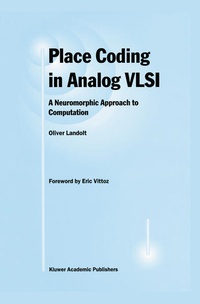
Place Coding in Analog VLSI
A Neuromorphic Approach to Computation
Published on 22. March 2013
Book
Paperback/Softback
XII, 215 pages
978-1-4613-7610-1 (ISBN)
Description
Neurobiology research suggests that information can be represented by the location of an activity spot in a population of cells (`place coding'), and that this information can be processed by means of networks of interconnections.
Place Coding in Analog VLSI
defines a representation convention of similar flavor intended for analog-integrated circuit design. It investigates its properties and suggests ways to build circuits on the basis of this coding scheme.
In this electronic version of place coding, numbers are represented by the state of an array of nodes called a map, and computation is carried out by a network of links. In the simplest case, a link is just a wire connecting a node of an input map to a node of an output map. In other cases, a link is an elementary circuit cell. Networks of links are somewhat reminiscent of look-up tables in that they hardwire an arbitrary function of one or several variables. Interestingly, these structures are also related to fuzzy rules, as well as some types of artificial neural networks. The place coding approach provides several substantial benefits over conventional analog design:
The place coding approach is illustrated by three integrated circuits computing non-linear functions of several variables. The simplest one is made up of 80 links and achieves submicrowatt power consumption in continuous operation. The most complex one incorporates about 1800 links for a power consumption of 6 milliwatts, and controls the operation of an active vision system with a moving field of view.
Place Coding in Analog VLSI is primarily intended for researchers and practicing engineers involved in analog and digital hardware design (especially bio-inspired circuits). The book is also a valuable reference for researchers and students in neurobiology, neuroscience, robotics, fuzzy logic and fuzzy control.
In this electronic version of place coding, numbers are represented by the state of an array of nodes called a map, and computation is carried out by a network of links. In the simplest case, a link is just a wire connecting a node of an input map to a node of an output map. In other cases, a link is an elementary circuit cell. Networks of links are somewhat reminiscent of look-up tables in that they hardwire an arbitrary function of one or several variables. Interestingly, these structures are also related to fuzzy rules, as well as some types of artificial neural networks. The place coding approach provides several substantial benefits over conventional analog design:
- Networks of links can be synthesized by a simple procedure whatever the function to be computed.
- Place coding is tolerant to perturbations and noise in current-mode implementations.
- Tolerance to noise implies that the fundamental power dissipation limits of conventional analog circuits can be overcome by using place coding.
The place coding approach is illustrated by three integrated circuits computing non-linear functions of several variables. The simplest one is made up of 80 links and achieves submicrowatt power consumption in continuous operation. The most complex one incorporates about 1800 links for a power consumption of 6 milliwatts, and controls the operation of an active vision system with a moving field of view.
Place Coding in Analog VLSI is primarily intended for researchers and practicing engineers involved in analog and digital hardware design (especially bio-inspired circuits). The book is also a valuable reference for researchers and students in neurobiology, neuroscience, robotics, fuzzy logic and fuzzy control.
Reviews / Votes
` It will interest people who are working with neural networks. ... the book is very concise. I recommend the book, but only for those with previous experience in the field. 'Computing Reviews (April 1999)
More details
Edition
Softcover reprint of the original 1st ed. 1998
Language
English
Place of publication
New York
United States
Target group
Professional and scholarly
Research
Illustrations
XII, 215 p.
Dimensions
Height: 240 mm
Width: 160 mm
Thickness: 13 mm
Weight
378 gr
ISBN-13
978-1-4613-7610-1 (9781461376101)
DOI
10.1007/978-1-4615-5701-2
Schweitzer Classification
Other editions
Additional editions
E-Book
12/2012
Springer
€149.79
Available for download
Book
07/1998
Kluwer Academic Publishers
€160.49
Shipment within 15-20 days
Content
I: Concepts.- Discrete place coding.- Continuous place coding.- II: Circuits.- Fuzzy rule chip.- Incremental oculo-motor control chip.- Saccadic oculo-motor control chip.- III: Perspectives.- Extensions.- Conclusion.- References.