

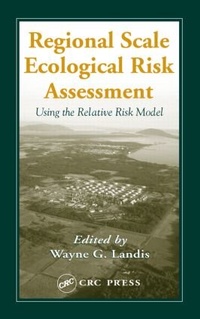
Regional Scale Ecological Risk Assessment
Using the Relative Risk Model
1st Edition
Published on 15. November 2004
Book
Hardback
324 pages
978-1-56670-655-1 (ISBN)
Description
As debates over how relative risk can be used to shape landscape-scale environmental management intensify, Regional-Scale Risk Assessment demonstrates the capabilities of RRM using nine case studies in the Pacific Northwest, Pennsylvania, Brazil, and Tasmania. The authors use a process of ranking and filters to interrelate different kinds of risks and illustrates how these relative risks are defined, mapped, and analyzed to determine remediation and management priorities. This book provides detailed descriptions for each step of RRM-from the determination of assessment goals to documentation, evaluation, and communication with decision-makers-that can benefit practitioners in environmental risk assessment and related fields worldwide.
More details
Language
English
Place of publication
Bosa Roca
United States
Publishing group
Taylor & Francis Inc
Target group
Professional
Illustrations
80 s/w Abbildungen
80 Illustrations, black and white
Dimensions
Height: 234 mm
Width: 156 mm
Weight
602 gr
ISBN-13
978-1-56670-655-1 (9781566706551)
Copyright in bibliographic data and cover images is held by Nielsen Book Services Limited or by the publishers or by their respective licensors: all rights reserved.
Schweitzer Classification
Other editions
Additional editions
Book
06/2020
1st Edition
CRC Press
€74.70
Shipment within 15-20 days
E-Book
11/2004
1st Edition
CRC Press
€68.49
Available for download
E-Book
11/2004
1st Edition
CRC Press
€68.49
Available for download
Person
Wayne G. Landis
Content
As debates over how relative risk can be used to shape landscape-scale environmental management intensify, Regional-Scale Risk Assessment demonstrates the capabilities of RRM using nine case studies in the Pacific Northwest, Pennsylvania, Brazil, and Tasmania. The authors use a process of ranking and filters to interrelate different kinds of risks and illustrates how these relative risks are defined, mapped, and analyzed to determine remediation and management priorities. This book provides detailed descriptions for each step of RRM-from the determination of assessment goals to documentation, evaluation, and communication with decision-makers-that can benefit practitioners in environmental risk assessment and related fields worldwide.