

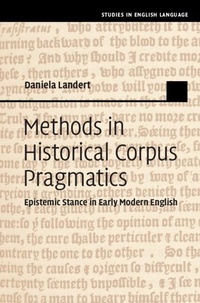
Methods in Historical Corpus Pragmatics
Epistemic Stance in Early Modern English
Published on 29. February 2024
Book
Hardback
332 pages
978-1-009-23741-3 (ISBN)
Description
Based on an extensive corpus-based study, this revealing book explores how epistemic stance is expressed in the early modern period, and in doing so, presents new methodologies for using corpora to investigate issues in historical pragmatics. It provides a new, corpus-driven method for the analysis of pragmatic functions that rely on context-dependent interpretations. By retrieving passages that include a high-density of the pragmatic function under investigation, the subsequent analysis can reveal previously neglected forms and context-dependent factors. It includes four empirical studies that apply the method to the analysis of epistemic stance in four Early Modern English corpora, the result of which emphasise the importance of context for the expression of stance. It also includes an appendix with inventories of Early Modern English stance expressions, offering starting points for further research studies. It is essential reading for researchers and students in historical pragmatics and corpus pragmatics.
Reviews / Votes
'Earlier research has often assumed that Early Modern English is relatively poor in epistemic stance markers. This outstanding monograph demonstrates that appropriate, innovative corpus methods reveal a much richer picture of the many creative ways in which Early Modern English conveyed degrees of certainty and reliability of information.' Andreas H. Jucker, Professor Emeritus of English Linguistics, University of Zurich 'Landert's Methods in Historical Corpus Pragmatics succeeds convincingly in showing two things: the necessary combination of the qualitative with the quantitative dimension and the insoluble interdependence of a linguistic phenomenon with its generic contexts. Its methodological implications are thought-provoking for both corpus users and compilers.' Claudia Claridge, Chair of English Linguistics, University of Augsburg '... offers a comprehensive and innovative approach to understanding epistemic stance in Early Modern English, bridging the gap between corpus linguistics and pragmatics. ... By integrating quantitative corpus analysis with qualitative interpretation, the book sets a new benchmark for historical corpus pragmatics, making it an indispensable resource for both scholars and students. With its practical tools and forward-thinking methodologies, this work not only paves the way for deeper exploration but also opens unprecedented avenues for future research in corpus pragmatics.' Jialiang Chen and Zhiyi Zhou, Corpus Pragmatics 'Daniela Landert's monograph is an important piece of original research, beautifully organised and carefully expressed, with significant implications for how research in historical pragmatics can be pursued in the future.... I have certainly learned a great deal from it and can recommend it wholeheartedly.' Jeremy J. Smith, ICAME JournalMore details
Series
Language
English
Place of publication
Cambridge
United Kingdom
Edition type
New edition
Product notice
sewn/stitched
Cloth over boards
Illustrations
Worked examples or Exercises
Dimensions
Height: 229 mm
Width: 152 mm
Thickness: 19 mm
Weight
612 gr
ISBN-13
978-1-009-23741-3 (9781009237413)
Copyright in bibliographic data and cover images is held by Nielsen Book Services Limited or by the publishers or by their respective licensors: all rights reserved.
Schweitzer Classification
Other editions
Additional editions
E-Book
02/2024
Cambridge University Press
€117.99
Available for download
Person
Daniela Landert is Professor of English Linguistics at Heidelberg University. Her research interests include historical pragmatics, corpus pragmatics, the study of (spontaneous) spoken language, pragmatics of fiction, and modality. She is the author of Personalisation in Mass Media Communication (John Benjamins, 2014) and Editor of the Journal of Historical Pragmatics.
Content
Preface; 1. Introduction; Part 1. Theoretical Background: 2. Historical corpus pragmatics; 3. Stance in Early Modern English; Part II. Methodology: 4. Compiling inventories of lexical stance markers; 5. Retrieving high-density passages; Part III. Empirical Studies: 6. Lexical stance markers in high-density passages; 7. Contextual factors and rhetorical strategies; 8. Meta-communicative expressions and stance: I say and I tell (you); 9. Expressing certainty in different genres; 10. Conclusion; Data; Appendix A: List of high-density passages; Appendix B: Stance inventory.