

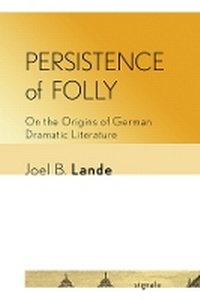
Persistence of Folly
On the Origins of German Dramatic Literature
Published on 15. December 2018
Book
Hardback
366 pages
978-1-5017-2710-8 (ISBN)
Description
Joel B. Lande's Persistence of Folly challenges the accepted account of the origins of German theater by focusing on the misunderstood figure of the fool, whose spontaneous and impish jest captivated audiences, critics, and playwrights from the late sixteenth through the early nineteenth century. Lande radically expands the scope of literary historical inquiry, showing that the fool was not a distraction from attempts to establish a serious dramatic tradition in the German language. Instead, the fool was both a fixture on the stage and a nearly ubiquitous theme in an array of literary critical, governmental, moral-philosophical, and medical discourses, figuring centrally in broad-based efforts to assign laughter a proper time, place, and proportion in society.
Persistence of Folly reveals the fool as a cornerstone of the dynamic process that culminated in the works of Lessing, Goethe, and Kleist. By reorienting the history of German theater, Lande's work conclusively shows that the highpoint of German literature around 1800 did not eliminate irreverent jest in the name of serious drama, but instead developed highly refined techniques for integrating the comic tradition of the stage fool.
Persistence of Folly reveals the fool as a cornerstone of the dynamic process that culminated in the works of Lessing, Goethe, and Kleist. By reorienting the history of German theater, Lande's work conclusively shows that the highpoint of German literature around 1800 did not eliminate irreverent jest in the name of serious drama, but instead developed highly refined techniques for integrating the comic tradition of the stage fool.
Reviews / Votes
In Persistence of Folly, Lande... provides a well-researched study of the fool in German literature from the time of the English comedians to the great Faust dramas and Heinrich von Kleist's Broken Jug.... This is a valuable resource on a significant topic.(Choice) Persistence of Folly shows Lande's skill in implementing a large amount of historical and theoretical research to produce fascinating contributions to the way we read these plays. The book takes the reader on a journey along the fool's trajectory with carefully chosen examples that render his conclusions convincing and insightful, and pro- vides indispensable insights for any Goethe or Kleist scholar, or for those interested in German literary history in general.
(European Romanitc Review) Photographic Literacy certainly offers a new way to think about the relationship between text and image in Russian modern culture. For this reason, it will doubtless be valuable not only to literary scholars and historians of photography, but also specialists in Russian cultural, social and intellectual history.
(Europe-Asia Studies) It is the mark of a good teacher to present new knowledge in a way that inspires students to do their own thinking. Lande's book is an excellent seminar room-or traveling stage-for this kind of learning. Fittingly, he directs the fool to do this maieutic work, and the result is both entertaining and edifying
(Goethe Yearbook) More than a literary history of German comedy or a study of the figure of the fool in dramatic texts, the analyses carried out in The Persistence of Folly exemplify and point to key methodological and theoretical reorientations of broader relevance
(Modern Language Review) Lande's book is a complex and interesting investigation into the role of the comic in the development of German theatre from its popular origins in the 17th century to its 'classical' phase around 1800
(Monatshefte) Lande's Persistence of Folly is one of the best works on German comedies in the Anglophone world in recent decades. It is an essential read for anyone interested in comedy studies and German literary history, and will appeal to scholars interested in form and genre theory as much as to scholars interested theories of performance
(Athenaeum: Jahrbuch der Friedrich Schlegel-Gesellschaft)
More details
Series
Language
English
Place of publication
Ithaca
United States
Publishing group
Cornell University Press
Product notice
Paper over boards
Illustrations
4 b&w halftones - 4 Halftones, black and white
Dimensions
Height: 229 mm
Width: 152 mm
Thickness: 30 mm
Weight
907 gr
ISBN-13
978-1-5017-2710-8 (9781501727108)
Copyright in bibliographic data and cover images is held by Nielsen Book Services Limited or by the publishers or by their respective licensors: all rights reserved.
Schweitzer Classification
Other editions
Additional editions
E-Book
09/2018
Cornell University Press and Cornell University Library
€4.49
Available for download
E-Book
09/2018
1st Edition
Cornell University Press and Cornell University Library
€4.49
Available for download
Person
Joel Lande is an Assistant Professor in the Department of German at Princeton University.
Content
Acknowledgments
Introduction
Part I The Fool at Play: Comic Practice and the Strolling Players
1. Birth of a Comic Form
2. Strolling Players and the Advent of the Fool
3. Practice of Stage Interaction
4. The Fool's Space and Time
Part II Fabricating Comedy and the Fate of the Foolin the Age of Reform
5. Making Comedy Whole
6. Biases in Precedent
7. Sanitation and Unity
8. Comedic Plot, Comic Time, Dramatic Time
Part III Life, Theater, and the Restoration of the Fool
9. Policey and the Legitimacy of Delight
10. The Place of Laughter in Life
11. National Literature I: Improvement
12. National Literature II: Custom
Part IV The Vitality of Folly in Goethe's Faustand Kleist's Jug
13. Faust I: Setting the Stage
14. Faust II: Mirroring and Framing in the Form of Faust
15. Faust III: The Diabolical Comic
16. Antinomies of the Classical: On Kleist's Broken Jug
Postlude
Bibliography
Index
Introduction
Part I The Fool at Play: Comic Practice and the Strolling Players
1. Birth of a Comic Form
2. Strolling Players and the Advent of the Fool
3. Practice of Stage Interaction
4. The Fool's Space and Time
Part II Fabricating Comedy and the Fate of the Foolin the Age of Reform
5. Making Comedy Whole
6. Biases in Precedent
7. Sanitation and Unity
8. Comedic Plot, Comic Time, Dramatic Time
Part III Life, Theater, and the Restoration of the Fool
9. Policey and the Legitimacy of Delight
10. The Place of Laughter in Life
11. National Literature I: Improvement
12. National Literature II: Custom
Part IV The Vitality of Folly in Goethe's Faustand Kleist's Jug
13. Faust I: Setting the Stage
14. Faust II: Mirroring and Framing in the Form of Faust
15. Faust III: The Diabolical Comic
16. Antinomies of the Classical: On Kleist's Broken Jug
Postlude
Bibliography
Index