

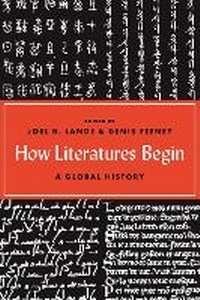
How Literatures Begin
A Global History
Published on 20. July 2021
Book
Hardback
448 pages
978-0-691-18653-5 (ISBN)
Description
A comparative history of the practices, technologies, institutions, and people that created distinct literary traditions around the world, from ancient to modern times
Literature is such a familiar and widespread form of imaginative expression today that its existence can seem inevitable. But in fact very few languages ever developed the full-fledged literary cultures we take for granted. Challenging basic assumptions about literatures by uncovering both the distinct and common factors that led to their improbable invention, How Literatures Begin is a global, comparative history of literary origins that spans the ancient and modern world and stretches from Asia and Europe to Africa and the Americas.
The book brings together a group of leading literary historians to examine the practices, technologies, institutions, and individuals that created seventeen literary traditions: Chinese, Japanese, Korean, Indian, Greek, Latin, Hebrew, Syriac, Arabic, English, Romance languages, German, Russian, Latin American, African, African American, and world literature. In these accessible accounts, which are framed by general and section introductions and a conclusion by the editors, literatures emerge as complex weaves of phenomena, unique and deeply rooted in particular times and places but also displaying surprising similarities. Again and again, new literatures arise out of old, come into being through interactions across national and linguistic borders, take inspiration from translation and cultural cross-fertilization, and provide new ways for groups to imagine themselves in relation to their moment in history.
Renewing our sense of wonder for the unlikely and strange thing we call literature, How Literatures Begin offers fresh opportunities for comparison between the individual traditions that make up the rich mosaic of the world's literatures.
The book is organized in four sections, with seventeen literatures covered by individual contributors: Part I: East and South Asia: Chinese (Martin Kern), Japanese (Wiebke Denecke), Korean (Ksenia Chizhova), and Indian (Sheldon Pollock); Part II: The Mediterranean: Greek (Deborah Steiner), Latin (Joseph Farrell), Hebrew (Jacqueline Vayntrub), Syriac (Alberto Rigolio), and Arabic (Gregor Schoeler); Part III: European Vernaculars: English (Ingrid Nelson), Romance languages (Simon Gaunt), German (Joel Lande), and Russian (Michael Wachtel); Part IV: Modern Geographies: Latin American (Rolena Adorno), African (Simon Gikandi), African American (Douglas Jones), and world literature (Jane O. Newman).
Literature is such a familiar and widespread form of imaginative expression today that its existence can seem inevitable. But in fact very few languages ever developed the full-fledged literary cultures we take for granted. Challenging basic assumptions about literatures by uncovering both the distinct and common factors that led to their improbable invention, How Literatures Begin is a global, comparative history of literary origins that spans the ancient and modern world and stretches from Asia and Europe to Africa and the Americas.
The book brings together a group of leading literary historians to examine the practices, technologies, institutions, and individuals that created seventeen literary traditions: Chinese, Japanese, Korean, Indian, Greek, Latin, Hebrew, Syriac, Arabic, English, Romance languages, German, Russian, Latin American, African, African American, and world literature. In these accessible accounts, which are framed by general and section introductions and a conclusion by the editors, literatures emerge as complex weaves of phenomena, unique and deeply rooted in particular times and places but also displaying surprising similarities. Again and again, new literatures arise out of old, come into being through interactions across national and linguistic borders, take inspiration from translation and cultural cross-fertilization, and provide new ways for groups to imagine themselves in relation to their moment in history.
Renewing our sense of wonder for the unlikely and strange thing we call literature, How Literatures Begin offers fresh opportunities for comparison between the individual traditions that make up the rich mosaic of the world's literatures.
The book is organized in four sections, with seventeen literatures covered by individual contributors: Part I: East and South Asia: Chinese (Martin Kern), Japanese (Wiebke Denecke), Korean (Ksenia Chizhova), and Indian (Sheldon Pollock); Part II: The Mediterranean: Greek (Deborah Steiner), Latin (Joseph Farrell), Hebrew (Jacqueline Vayntrub), Syriac (Alberto Rigolio), and Arabic (Gregor Schoeler); Part III: European Vernaculars: English (Ingrid Nelson), Romance languages (Simon Gaunt), German (Joel Lande), and Russian (Michael Wachtel); Part IV: Modern Geographies: Latin American (Rolena Adorno), African (Simon Gikandi), African American (Douglas Jones), and world literature (Jane O. Newman).
Reviews / Votes
"[What] is so wonderful about reading How Literatures Begin is the sense one comes away with, that it is somehow both inevitable and truly miraculous that any of these literatures should have come into being-and just how many more are out there for us readers to discover and explore in-depth."---Jeffrey Zuckerman, World Literature Today "[A] remarkable book."---Michael Wood, Journal of Interdisciplinary HistoryMore details
Language
English
Place of publication
New Jersey
United States
Target group
College/higher education
Professional and scholarly
Interest Age: From 16 years
Product notice
Trade binding
Illustrations
10 color + 34 b/w illus. 2 maps.
Dimensions
Height: 235 mm
Width: 156 mm
ISBN-13
978-0-691-18653-5 (9780691186535)
Copyright in bibliographic data and cover images is held by Nielsen Book Services Limited or by the publishers or by their respective licensors: all rights reserved.
Schweitzer Classification
Other editions
Additional editions
E-Book
07/2021
1st Edition
Princeton University Press
€39.99
Available for download
Persons
Joel B. Lande is assistant professor of German at Princeton University and the author of Persistence of Folly: On the Origins of German Dramatic Literature. Denis Feeney is the Giger Professor of Latin at Princeton University. His books include Beyond Greek: The Beginnings of Latin Literature.