

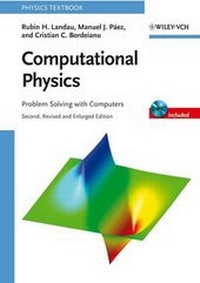
Computational Physics
Problem Solving with Computers
2nd Edition
Published on 25. July 2007
Book
Paperback/Softback
XXII, 594 pages
978-3-527-40626-5 (ISBN)
Description
This second edition increases the universality of the previous edition by providing all its codes in the Java language, whose compiler and development kit are available for free for essentially all operating systems. In addition, the accompanying CD provides many of the same codes in Fortran 95, Fortran 77, and C, for even more universal application, as well as MPI codes for parallel applications. The book also includes new materials on trial-and-error search techniques, IEEE floating point arithmetic, probability and statistics, optimization and tuning in multiple languages, parallel computing with MPI, JAMA the Java matrix library, the solution of simultaneous nonlinear equations, cubic splines, ODE eigenvalue problems, and Java plotting programs.
From the reviews of the first edition:
"Landau and Paez's book would be an excellent choice for a course on computational physics which emphasizes computational methods and programming." - American Journal of Physics
Mit diesem praxisbewährten Band in überarbeiteter, erweiterter Neuauflage erarbeiten Sie sich moderne Ansätze der Computerphysik. Neue Kapitel befassen sich mit Visualisierung, Wavelet-Analyse, Datenkompression, Moleküldynamik und Fluiddynamik.
From the reviews of the first edition:
"Landau and Paez's book would be an excellent choice for a course on computational physics which emphasizes computational methods and programming." - American Journal of Physics
Mit diesem praxisbewährten Band in überarbeiteter, erweiterter Neuauflage erarbeiten Sie sich moderne Ansätze der Computerphysik. Neue Kapitel befassen sich mit Visualisierung, Wavelet-Analyse, Datenkompression, Moleküldynamik und Fluiddynamik.
Reviews / Votes
"This is an excellent book for a course in computational studies and can be useful for those who need to solve numerical solutions using a computer." (IEEE Electrical Insulation Magazine, November/December 2008) "Landau and Paez's book would be an excellent choice for a course on computational physics which emphasizes computational methods and programming." (American Journal of Physics)More details
Edition
2. überarb. u. erw. Auflage
Language
English
Place of publication
Weinheim
Germany
Target group
Professional and scholarly
Edition type
New edition
Illustrations
125
19 s/w Tabellen, 125 s/w Abbildungen
Dimensions
Height: 24 cm
Width: 17 cm
Thickness: 3.2 cm
Weight
1165 gr
ISBN-13
978-3-527-40626-5 (9783527406265)
Schweitzer Classification
Other editions
New editions
Rubin H. Landau | Manuel J. Páez | Cristian C. Bordeianu
Computational Physics
Problem Solving with Python
Book
07/2015
3rd Edition
Wiley-VCH
€109.00
Article exhausted; check for reprint
Previous edition

Book
08/1997
1st Edition
Wiley
€115.00
Article exhausted; check for reprint
Persons
Rubin H. Landau, PhD, is a professor in the Department of Physics at Oregon State University in Corvallis. He teaches courses in computational physics, helps direct the Northwest Alliance for Computational Science and Engineering, and has been using computers in theoretical physics research for the past 30 years. The author of more than 70 refereed publications, he has also authored the books Quantum Mechanics II, A Scientist's and Engineer's Guide to Workstations and Supercomputers, and the first edition of Computational Physics, all of them available from Wiley.
Manuel J. Páez, PhD, is a professor in the Department of Physics at the University of Antioquia in Medellín, Colombia. He teaches courses in computational physics, programming, and nuclear physics. He and Professor Landau have conducted pioneering computational investigations in the interactions of mesons and nucleons with nuclei.
Cristian C. Bordeianu received his physics degree from Bucharest University, Romania, and his M.Sc. degree in Computer Science from "A.I.Cuza" University in Jassy, Romania. He is currently completing work towards a Ph.D. degree in Nuclear Physics at Bucharest University. He has over ten years of experience in developing Computational Physics educational software for high schools and University curricula. His current research interests include chaotic dynamics in nuclear multifragmentation and plasma of quarks and gluons.
Manuel J. Páez, PhD, is a professor in the Department of Physics at the University of Antioquia in Medellín, Colombia. He teaches courses in computational physics, programming, and nuclear physics. He and Professor Landau have conducted pioneering computational investigations in the interactions of mesons and nucleons with nuclei.
Cristian C. Bordeianu received his physics degree from Bucharest University, Romania, and his M.Sc. degree in Computer Science from "A.I.Cuza" University in Jassy, Romania. He is currently completing work towards a Ph.D. degree in Nuclear Physics at Bucharest University. He has over ten years of experience in developing Computational Physics educational software for high schools and University curricula. His current research interests include chaotic dynamics in nuclear multifragmentation and plasma of quarks and gluons.
Content
- Computational Software Basics
- Errors and Uncertainties in Computations
- Object-Oriented Programming: Kinematics
- Integration
- Differentiation
- Trial & Error Searching
- Matrix Computing and N-D Newton Raphson
- Data Fitting
- Deterministic Randomness
- Monte Carlo Applications
- Thermodynamic Simulations: Ising Model
- Computer Hardware Basics: Memory and CPU
- High Performance Computing: Profiling and Tuning
- Differential Equation Applications
- Quantum Eigenvalues via ODE Matching
- Fourier Analysis of Linear and Nonlinear Signals
- Unusual Dynamics of Nonlinear Systems
- Differential Chaos in Phase Space
- Fractals
- Parallel Computing
- Parallel Computing with MPI
- Electrostatics Potentials via Finite Differences (PDEs)
- Heat Flow
- PDE Waves on Strings and Membranes
- Solitons; KdeV and Sine-Gordon
- Quantum Wave Packets
- Quantum Paths for Functional Integration
- Quantum Bound States via Integral Equations
- Quantum Scattering via Integral Equations
Appendices:
PtPlot: 2D Graphs within Java
Glossary
Fortran 95 Codes
Fortran 77 Codes
C Language Codes
- Errors and Uncertainties in Computations
- Object-Oriented Programming: Kinematics
- Integration
- Differentiation
- Trial & Error Searching
- Matrix Computing and N-D Newton Raphson
- Data Fitting
- Deterministic Randomness
- Monte Carlo Applications
- Thermodynamic Simulations: Ising Model
- Computer Hardware Basics: Memory and CPU
- High Performance Computing: Profiling and Tuning
- Differential Equation Applications
- Quantum Eigenvalues via ODE Matching
- Fourier Analysis of Linear and Nonlinear Signals
- Unusual Dynamics of Nonlinear Systems
- Differential Chaos in Phase Space
- Fractals
- Parallel Computing
- Parallel Computing with MPI
- Electrostatics Potentials via Finite Differences (PDEs)
- Heat Flow
- PDE Waves on Strings and Membranes
- Solitons; KdeV and Sine-Gordon
- Quantum Wave Packets
- Quantum Paths for Functional Integration
- Quantum Bound States via Integral Equations
- Quantum Scattering via Integral Equations
Appendices:
PtPlot: 2D Graphs within Java
Glossary
Fortran 95 Codes
Fortran 77 Codes
C Language Codes