

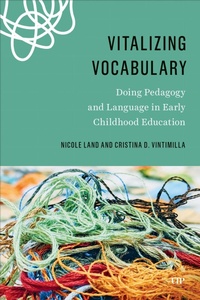
Vitalizing Vocabulary
Doing Pedagogy and Language in Early Childhood Education
Published on 3. October 2024
Book
Paperback/Softback
154 pages
978-1-4875-5939-7 (ISBN)
Description
Thinking with language as a complex practice for educators, advocates, and researchers in early childhood education is a necessary gesture for countering the anti-intellectualism that designates early childhood education as a service providing custodial care. Vitalizing Vocabulary insists that early childhood education in Canada must unsettle our inherited demand for technocratic, instrumental, and accessible relations with language.
At the collision of research and practice, Nicole Land and Cristina D. Vintimilla propose that cultivating playful, speculative, inventive, accountable, and answerable relations with words, concepts, and language is a critical move toward broadening early childhood education's intellectual and interdisciplinary horizons. The book is organized into four actions that activate pedagogical grammars: reading, writing, citing, and speaking. Each section plays with the purposes of a glossary by proposing language that we would work to erase, reclaim, and introduce. This situates language as an ethical, political, and creative pedagogical process that puts specific relations, curricula, and subjectivities into motion.
Vitalizing Vocabulary ultimately envisions a project of early childhood education where students, educators, pedagogists, researchers, community, and others share a common commitment to creating responsive, meaningful, ethical, and political pedagogies.
At the collision of research and practice, Nicole Land and Cristina D. Vintimilla propose that cultivating playful, speculative, inventive, accountable, and answerable relations with words, concepts, and language is a critical move toward broadening early childhood education's intellectual and interdisciplinary horizons. The book is organized into four actions that activate pedagogical grammars: reading, writing, citing, and speaking. Each section plays with the purposes of a glossary by proposing language that we would work to erase, reclaim, and introduce. This situates language as an ethical, political, and creative pedagogical process that puts specific relations, curricula, and subjectivities into motion.
Vitalizing Vocabulary ultimately envisions a project of early childhood education where students, educators, pedagogists, researchers, community, and others share a common commitment to creating responsive, meaningful, ethical, and political pedagogies.
More details
Language
English
Place of publication
Toronto
Canada
Target group
College/higher education
Professional and scholarly
Product notice
Paperback (trade)
Dimensions
Height: 212 mm
Width: 138 mm
Thickness: 10 mm
Weight
181 gr
ISBN-13
978-1-4875-5939-7 (9781487559397)
Copyright in bibliographic data and cover images is held by Nielsen Book Services Limited or by the publishers or by their respective licensors: all rights reserved.
Schweitzer Classification
Persons
Nicole Land is an assistant professor in the School of Early Childhood Studies at Toronto Metropolitan University.
Cristina D. Vintimilla is an associate professor of Early Childhood in the Faculty of Education at York University.
Cristina D. Vintimilla is an associate professor of Early Childhood in the Faculty of Education at York University.
Content
Introduction
Section 1. On Reading Practices
On Reading Practices
Inheriting Reading Practices
Reading with Ongoing Settler Colonialism: Settler Futurities
Reading with Neoliberalism: Truth, Comprehension, and Individualism
Re-Reading Reading Practices
Propositions Toward Re-inventing and Doing Reading
Erase: Extraction
Reclaim: Collaboration
Introduce: Contamination
Reading Forward
Section 2. On Writing Practices
Inheriting Writing Practices
Writing as/with Reproduction
Writing with Validity, Universalizing, and Expertise
Re-Writing Writing Practices
Propositions: Toward Re-inventing and Doing Writing
Erase: Accessibility
Reclaim: Argument
Introduce: Willful
Writing Forward
Section 3. On Citing Practices
On Citing Practices
Inheriting Citing Practices
Citing with Mastery
Citing with Temporality
Re-citing Citing Practices
Propositions Toward Re-inventing and Doing Citing
Erase: Assimilation
Reclaim: Up to Date
Introduce: Agonism
Citing Forward
Section 4. On Speaking Practices
On Speaking Practices
Inheriting Speaking Practices
Speaking with Authority
Speaking with Charisma
Re-Speaking Speaking Practices
Propositions Toward Re-Inventing and Doing Speaking
Erase: Use Your Words
Reclaim: Risk
Introduce: Problem
Speaking Forward
Conclusion: Toward Otherwise Lively Vocabularies
References?
Index
Section 1. On Reading Practices
On Reading Practices
Inheriting Reading Practices
Reading with Ongoing Settler Colonialism: Settler Futurities
Reading with Neoliberalism: Truth, Comprehension, and Individualism
Re-Reading Reading Practices
Propositions Toward Re-inventing and Doing Reading
Erase: Extraction
Reclaim: Collaboration
Introduce: Contamination
Reading Forward
Section 2. On Writing Practices
Inheriting Writing Practices
Writing as/with Reproduction
Writing with Validity, Universalizing, and Expertise
Re-Writing Writing Practices
Propositions: Toward Re-inventing and Doing Writing
Erase: Accessibility
Reclaim: Argument
Introduce: Willful
Writing Forward
Section 3. On Citing Practices
On Citing Practices
Inheriting Citing Practices
Citing with Mastery
Citing with Temporality
Re-citing Citing Practices
Propositions Toward Re-inventing and Doing Citing
Erase: Assimilation
Reclaim: Up to Date
Introduce: Agonism
Citing Forward
Section 4. On Speaking Practices
On Speaking Practices
Inheriting Speaking Practices
Speaking with Authority
Speaking with Charisma
Re-Speaking Speaking Practices
Propositions Toward Re-Inventing and Doing Speaking
Erase: Use Your Words
Reclaim: Risk
Introduce: Problem
Speaking Forward
Conclusion: Toward Otherwise Lively Vocabularies
References?
Index