

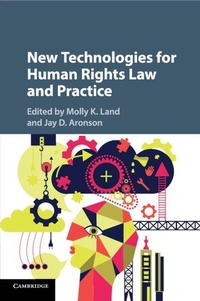
New Technologies for Human Rights Law and Practice
Published on 16. April 2020
Book
Paperback/Softback
332 pages
978-1-316-63141-6 (ISBN)
Description
New technological innovations offer significant opportunities to promote and protect human rights. At the same time, they also pose undeniable risks. In some areas, they may even be changing what we mean by human rights. The fact that new technologies are often privately controlled raises further questions about accountability and transparency and the role of human rights in regulating these actors. This volume - edited by Molly K. Land and Jay D. Aronson - provides an essential roadmap for understanding the relationship between technology and human rights law and practice. It offers cutting-edge analysis and practical strategies in contexts as diverse as autonomous lethal weapons, climate change technology, the Internet and social media, and water meters. This title is also available as Open Access.
More details
Language
English
Place of publication
Cambridge
United Kingdom
Target group
College/higher education
Professional and scholarly
Product notice
Paperback (trade)
Illustrations
Worked examples or Exercises; 1 Line drawings, black and white
Dimensions
Height: 229 mm
Width: 152 mm
Thickness: 18 mm
Weight
485 gr
ISBN-13
978-1-316-63141-6 (9781316631416)
Copyright in bibliographic data and cover images is held by Nielsen Book Services Limited or by the publishers or by their respective licensors: all rights reserved.
Schweitzer Classification
Other editions
Additional editions
Molly K. Land | Jay D. Aronson
New Technologies for Human Rights Law and Practice
Book
04/2018
Cambridge University Press
€141.20
Shipment within 15-20 days
Persons
Content
1. The promise and peril of human rights technology Molly K. Land and Jay D. Aronson; Part I. Normative Approaches to Technology and Human Rights: 2. Safeguarding human rights from problematic technologies Lea Shaver; 3. Climate change, human rights, and technology transfer: normative challenges and technical opportunities Dalindyebo Shabalala; 4. Judging bioethics and human rights Therese Murphy; 5. Drones, automated weapons, and private military contractors: challenges to domestic and international legal regimes governing armed conflict Laura A. Dickinson; Part II. Technology and Human Rights Enforcement: 6. The utility of user generated content in human rights investigations Jay D. Aronson; 7. Big data analytics and human rights: privacy considerations in context Mark Latonero; 8. The challenging power of data visualization for human rights advocacy John Emerson, Margaret L. Satterthwaite and Anshul Vikram Pandey; 9. Risk and the pluralism of digital human rights fact-finding and advocacy Ella McPherson; Part III. Beyond Public/Private: States, Companies, and Citizens: 10. Digital communications and the evolving right to privacy Lisl Brunner; 11. Human rights and private actors in the online domain Rikke Frank Jorgensen; 12. Technology, self-inflicted vulnerability, and human rights G. Alex Sinha; 13. The future of human rights technology: a practitioner's view Enrique Piraces; Index.