

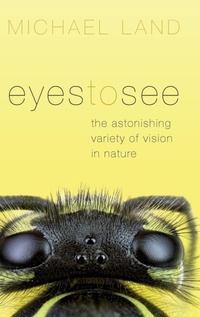
Eyes to See
The Astonishing Variety of Vision in Nature
Published on 22. November 2018
Book
Hardback
214 pages
978-0-19-874771-0 (ISBN)
Description
Vision is the sense by which we and other animals obtain most of our information about the world around us. Darwin appreciated that at first sight it seems absurd that the human eye could have evolved by natural selection. But we now know far more about vision, the many times it has independently evolved in nature, and the astonishing variety of ways to see. The human eye, with a lens forming an image on a sensitive retina, represents just one. Scallops, shrimps, and lobsters all use mirrors in different ways. Jumping spiders scan with their front-facing eyes to check whether the object in front is an insect to eat, another spider to mate with, or a predator to avoid. Mantis shrimps can even measure the polarization of light.
Animal eyes are amazing structures, often involving precision optics and impressive information processing, mainly using wet protein - not the substance an engineer would choose for such tasks. In Eyes to See, Michael Land, one of the leading world experts on vision, explores the varied ways in which sight has evolved and is used in the natural world, and describes some of the ingenious experiments researchers have used to uncover its secrets. He also discusses human vision, including his experiments on how our eye movements help us to do everyday tasks, as well as skilled ones such as sight-reading music or driving. He ends by considering the fascinating problem of how the constantly shifting images from our eyes are converted in the brain into the steady and integrated conscious view of the world we experience.
Animal eyes are amazing structures, often involving precision optics and impressive information processing, mainly using wet protein - not the substance an engineer would choose for such tasks. In Eyes to See, Michael Land, one of the leading world experts on vision, explores the varied ways in which sight has evolved and is used in the natural world, and describes some of the ingenious experiments researchers have used to uncover its secrets. He also discusses human vision, including his experiments on how our eye movements help us to do everyday tasks, as well as skilled ones such as sight-reading music or driving. He ends by considering the fascinating problem of how the constantly shifting images from our eyes are converted in the brain into the steady and integrated conscious view of the world we experience.
Reviews / Votes
[A] captivating book. * GrrlScientist, Twelve Of The Best Books About Biology Of 2018, Forbes * Land has produced an intriguing and accessibly written little book on vision. * Leon Vlieger, Inquisitive Biologist * Simply written with a clarity that betrays a profound understanding of vision, this delightful journey from scallops to human perception shows what a great biologist can discover when he has the eyes to see. * Professor Simon Laughlin, Department of Zoology, University of Cambridge * This little book is a treasure which deserves the attention of anyone who has ever wondered whether other animals see the world like us. Combining lucid scientific explanations with engaging personal anecdotes and salient histories, Eyes to See is the best single book I can recommend to a curious student, and certainly to a seasoned biologist looking for an introduction to how eyes work. * Ron Hoy, Merksamer Professor of Neurobiology and Behavior, Cornell University *More details
Language
English
Place of publication
Oxford
United Kingdom
Illustrations
94 black and white images and 8pp colour plate section
Dimensions
Height: 240 mm
Width: 161 mm
Thickness: 16 mm
Weight
490 gr
ISBN-13
978-0-19-874771-0 (9780198747710)
Copyright in bibliographic data and cover images is held by Nielsen Book Services Limited or by the publishers or by their respective licensors: all rights reserved.
Schweitzer Classification
Other editions
Additional editions
E-Book
11/2018
1st Edition
OUP eBook
€18.49
Available for download
E-Book
11/2018
1st Edition
OUP eBook
€17.99
Available for download
Person
Michael Land is Emeritus Professor of Neurobiology at the University of Sussex and is a world-renowned authority on animal vision. He co-authored the text Animal Eyes (OUP, 2002, 2nd edition 2012), with Dan-Eric Nilsson, and another on human eye movements, Looking and Acting (OUP, 2009), with Ben Tatler. He is a Fellow of the Royal Society.
Content
1: Early eyes 2: Compound eyes and insect vision 3: Vision in the ocean 4: Establishing identity 5: Where do people look? 6: The world out there and the world in your head 7: ConclusionsEndnotesIndex