


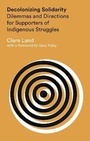
Decolonizing Solidarity
Dilemmas and Directions for Supporters of Indigenous Struggles
2nd Edition
Will be published approx. on 25. June 2026
Book
Hardback
368 pages
978-1-913441-02-9 (ISBN)
Description
In this updated and revised version of the highly original and much-needed book, Clare Land interrogates the often fraught endeavours of activists from colonial backgrounds seeking to be politically supportive of Indigenous struggles. Blending key theoretical and practical questions, Land argues that the predominant impulses which drive middle-class settler activists to support Indigenous people cannot lead to successful alliances and meaningful social change unless they are significantly transformed through a process of both public political action and critical self-reflection.
This edition explores an explicit definition of decolonization, along with a discussion of the development of Indigenous philosophies of decolonization; a discussion of fragility and settler futurity; and a more substantive discussion of solidarity by people of colour. It also includes a reflection on the pedagogy of solidarity politics; the book's authorship; and the ways in which Decolonizing Solidarity has enabled a further and deeper set of concerns to be raised.
Based on a wealth of in-depth, original research, and focussing in particular on Australia, where - despite strident challenges - the vestiges of British law and cultural power have restrained the nation's emergence out of colonizing dynamics, this book provides a vital resource for those involved in Indigenous activism and scholarship.
This edition explores an explicit definition of decolonization, along with a discussion of the development of Indigenous philosophies of decolonization; a discussion of fragility and settler futurity; and a more substantive discussion of solidarity by people of colour. It also includes a reflection on the pedagogy of solidarity politics; the book's authorship; and the ways in which Decolonizing Solidarity has enabled a further and deeper set of concerns to be raised.
Based on a wealth of in-depth, original research, and focussing in particular on Australia, where - despite strident challenges - the vestiges of British law and cultural power have restrained the nation's emergence out of colonizing dynamics, this book provides a vital resource for those involved in Indigenous activism and scholarship.
Reviews / Votes
Excellent... The book is written in a way that is accessible to a range of allies outside academic circles and speaks to real case studies. * Linda Tuhiwai Smith, author of Decolonizing Methodologies: Research and Indigenous Peoples * A nuanced and insightful examination of the complexity and challenges of being an ally to Indigenous struggles. It serves as an excellent and much-needed guide for all of us working for, with, or on behalf of marginalized and disenfranchised communities. * Paul Kivel, educator, activist and author of Uprooting Racism * A thoughtful and thought-provoking book. Both profound and practical, Land poses vital questions to the reader interested in solidarity and social change. * Patta Scott-Villiers, Institute of Development Studies * In this excellent book, Land covers an exceptional breadth of issues with considerable aplomb. It is a provocative and lively read, rich with data that brings indigenous voices to the fore. * Damien Short, School of Advanced Study * [T]his book should be compulsory reading for non-Indigenous scholars, including postgraduate students, whose research interests revolve around Indigenous communities. * State Crime * An ambitious and important book that comes at a pivotal time ... I recommend reading it, reflecting, and reading it again. * Canadian Journal of Education * Land provides meaningful and insightful accounts of community-based education initiatives necessary for solidarity movements. * McGill Journal of Education * This timely and important book by Clare Land offers a critical resource to assist a new generation of activists ... provides urgently needed and critically important reflections on the practices of solidarity activism that push beyond liberal models of solidarity politics. * E3W Review of Books * Land's book is an important contribution to an emergent "non-Indigenous progressive research agenda" ... provides an opportunity to reflect on the nature of solidarity work more generally, posing broader questions of involvement and self-interest in solidarity politics and intersectional work for activists. * Overland Literary Journal *More details
Edition
2nd edition
Language
English
Place of publication
United Kingdom
Publishing group
Bloomsbury Publishing PLC
Target group
College/higher education
Dimensions
Height: 216 mm
Width: 138 mm
ISBN-13
978-1-913441-02-9 (9781913441029)
Copyright in bibliographic data and cover images is held by Nielsen Book Services Limited or by the publishers or by their respective licensors: all rights reserved.
Schweitzer Classification
Other editions
Previous edition
Book
07/2015
Zed Books Ltd
€126.48
Shipment within 3-4 weeks
Person
Clare Land is a Researcher at the Moondani Balluk Indigenous Academic Unit, Victoria University, Australia. Clare has been engaged since 1998 with the history and present of settler colonialism.
Content
Preface
Introduction
1. Land Rights, Sovereignty and Black Power in Southeast Australia
2. A Political Genealogy for Contemporary Non-Indigenous Activism
3. Identity Categories: How Activists both Use and Refuse Them
4. Collaboration, Dialogue and Friendship: Always a Good Thing?
5. Acting Politically with Self-Understanding
6. A Moral and Political Framework for Non-Indigenous People's Solidarity
7. Reckoning with Complicity
Conclusion
Epilogue
Timeline
Biographies
Bibliography
Appendix: Book Club Resource Kit
Index
Introduction
1. Land Rights, Sovereignty and Black Power in Southeast Australia
2. A Political Genealogy for Contemporary Non-Indigenous Activism
3. Identity Categories: How Activists both Use and Refuse Them
4. Collaboration, Dialogue and Friendship: Always a Good Thing?
5. Acting Politically with Self-Understanding
6. A Moral and Political Framework for Non-Indigenous People's Solidarity
7. Reckoning with Complicity
Conclusion
Epilogue
Timeline
Biographies
Bibliography
Appendix: Book Club Resource Kit
Index