

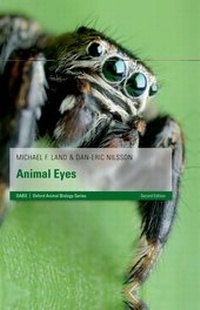
Animal Eyes
2nd Edition
Published on 1. March 2012
Book
Hardback
288 pages
978-0-19-958113-9 (ISBN)
Description
Animal Eyes provides a comparative account of all known types of eye in the animal kingdom, outlining their structure and function with an emphasis on the nature of the optical systems and the physical principles involved in image formation. A universal theme throughout the book is the evolution and taxonomic distribution of each type of eye, and the roles of different eye types in the behaviour and ecology of the animals that possess them. In comparing the specific capabilities of eyes, it considers the factors that lead to good resolution of detail and the ability to function under a wide range of light conditions. This new edition is fully updated throughout, incorporating more than a decade of new discoveries and research.
Reviews / Votes
Animal Eyes is written in a vivid and clear style which will be understandable to both physicists and biologists. I highly recommend it to anyone, including amateurs, students and experienced researchers. * Optics & Photonics News * fascinating and useful. * Pat Morris, Zoological Journal *More details
Series
Edition
2nd Revised edition
Language
English
Place of publication
Oxford
United Kingdom
Target group
College/higher education
Professional and scholarly
Undergraduate students on courses that involve vision and sensory physiology, graduates and research biologists with an interest in vision, ophthalmologists and optometrists, and physicists and engineers with interests in optical mechanisms.
Edition type
Revised edition
Illustrations
Numerous illustrations, plus a 4 page colour plate section
Numerous illustrations, plus a 4 page colour plate section
Dimensions
Height: 241 mm
Width: 161 mm
Thickness: 20 mm
Weight
640 gr
ISBN-13
978-0-19-958113-9 (9780199581139)
Copyright in bibliographic data and cover images is held by Nielsen Book Services Limited or by the publishers or by their respective licensors: all rights reserved.
Schweitzer Classification
Other editions
Additional editions
Michael F. Land | Dan-Eric Nilsson
Animal Eyes
Book
03/2012
2nd Edition
Oxford University Press
€85.50
Shipment within 15-20 days
Michael F. Land | Dan-Eric Nilsson
Animal Eyes
E-Book
03/2012
2nd Edition
OUP eBook
€63.49
Available for download
Previous edition
Michael F. Land
Animal Eyes
Book
12/2001
Oxford University Press
€99.04
Article exhausted; check for reprint
Persons
Michael F. Land obtained a BA in Zoology from Cambridge his PhD in Neurophysiology from University College London. He was Research Fellow at University of California, Berkeley (1967-1971), before moving to the University of Sussex where he was a Lecturer and then Professor of Neurobiology (from 1984 to present (now Emeritus)). He also held Visiting Fellowships in Eugene Oregon (1980), Australian Nation University Canberra (1982-84), and Duke University Marine Laboratory in Beaufort, NC (1993). He was elected to the Royal Society of London in 1982.
Dan-Eric Nilsson obtained his BSc in Biological Sciences from Goteborg University and his PhD in Structural Biology from University of Lund. He was Research Fellow at the Australian National University Canberra (1983-4) and then the University of Lund (1984-1989). He stayed at Lund as a Lecturer (1989-1995) then Professor of Zoology (from 1995). He was elected to the Swedish Academy of Sciences, Stockholm in 2002, and to the German Academy of Natural Sciences, Leopoldina in 2005.
Dan-Eric Nilsson obtained his BSc in Biological Sciences from Goteborg University and his PhD in Structural Biology from University of Lund. He was Research Fellow at the Australian National University Canberra (1983-4) and then the University of Lund (1984-1989). He stayed at Lund as a Lecturer (1989-1995) then Professor of Zoology (from 1995). He was elected to the Swedish Academy of Sciences, Stockholm in 2002, and to the German Academy of Natural Sciences, Leopoldina in 2005.
Content
1. The origin of vision ; 2. Light and vision ; 3. What makes a good eye? ; 4. Aquatic eyes: the evolution of the lens ; 5. Lens eyes on land ; 6. Mirrors in animals ; 7. Apposition compound eyes ; 8. Superposition eyes ; 9. Movements of the eyes