

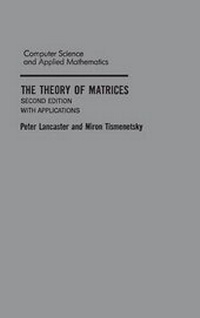
The Theory of Matrices
With Applications
2nd Edition
Published on 24. May 1985
Book
Hardback
586 pages
978-0-12-435560-6 (ISBN)
Description
In this book the authors try to bridge the gap between the treatments of matrix theory and linear algebra. It is aimed at graduate and advanced undergraduate students seeking a foundation in mathematics, computer science, or engineering. It will also be useful as a reference book for those working on matrices and linear algebra for use in their scientific work.
More details
Series
Edition
2nd edition
Language
English
Place of publication
San Diego
United States
Publishing group
Elsevier Science Publishing Co Inc
Target group
College/higher education
Undergraduate, and graduate students in a variety of possible programs where this subject matter is required.
Edition type
New edition
Product notice
Laminated cover
Dimensions
Height: 234 mm
Width: 158 mm
Thickness: 43 mm
Weight
1005 gr
ISBN-13
978-0-12-435560-6 (9780124355606)
Copyright in bibliographic data and cover images is held by Nielsen Book Services Limited or by the publishers or by their respective licensors: all rights reserved.
Schweitzer Classification
Other editions
Additional editions
Book
06/1985
2nd Edition
Academic Press
€189.50
Shipment within 15-20 days
E-Book
05/1985
2nd Edition
Academic Press
€135.00
Available for download
Persons
Content
Maxtrix Algebra. Determinants, Inverse Matrices, and Rank. Linear, Euclidean, and Unitary Spaces. Linear Transformations and Matrices. Linear Transformations in Unitary Spaces and Simple Matrices. The Jordan Canonical Form: A Geometric Approach. Matrix Polynomials and Normal Forms. The Variational Method. Functions of Matrices. Norms and Bounds for Eigenvalues. Perturbation Theory. Linear Matrix Equations and Generalized Inverses. Stability Problems. Matrix Polynomials. Nonnegative Matrices. Appendix 1. A Survey of Scalar Polynomials. Appendix 2. Some Theorems and Notions from Analysis. Appendix 3. Suggestions for Further Reading. Index.