

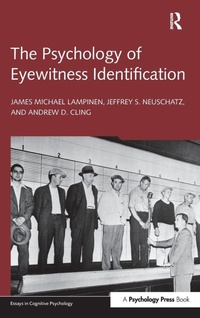
The Psychology of Eyewitness Identification
1st Edition
Published on 15. February 2012
Book
Hardback
346 pages
978-1-84872-883-7 (ISBN)
Description
This volume provides a tutorial review and evaluation of scientific research on the accuracy and reliability of eyewitness identification. The book starts with the perspective that there are a variety of conceptual and empirical problems with eyewitness identification as a form of forensic evidence, just as there are a variety of problems with other forms of forensic evidence. There is then an examination of the important results in the study of eyewitness memory and the implications of this research for psychological theory and for social and legal policy. The volume takes the perspective that research on eyewitness identification can be seen as the paradigmatic example of how psychological science can be successfully applied to real-world problems.
Reviews / Votes
"The authors have provided an exhaustive overview of the issues involved in eyewitness identification [including] previous and more recent research in the field. ... The'Essays in Cognitive Psychology' series always produce high quality books and 'The Psychology of Eyewitness Identification' continues that tradition. It is suitable for students and researchers alike as it is an accessible text that is very enjoyable to read and also very informative - two great qualities - and a book which is well worth reading for individuals interested in this kind of area." - Rhian Worth, Bangor University, UK, in Europe's Journal of Psychology"Despite the tragedies that have arisen from an overreliance on eyewitness evidence, the message of The Psychology of Eyewitness Identification is a positive one. Through consideration of the interplay of theory and research, the authors reveal the variables and practices that influence accuracy, and point to steps that can be taken to benefit the criminal justice system. Students of memory in the classroom or the courtroom will find The Psychology of Eyewitness Identification an essential guide." - Scott D. Gronlund, Ph.D., University of Oklahoma, USA
"The Psychology of Eyewitness Identification is a comprehensive and clear treatment of eyewitness identification science and its many productive connections to police practice and legal policy. The authors bring a careful, well-reasoned perspective, rigorous detail, and fresh examples that enliven their exploration of this significant research effort. The first chapter cleverly and compellingly draws the reader to the problem of eyewitness error. From that point, the book addresses the complexities of experimental and field research in a readable and engaging manner, with emphasis on the role of psychological research in helping the criminal justice system work more effectively." - Nancy K. Steblay, Professor of Psychology, Augsburg College, Minneapolis, MN
"In conception and execution, this book does something that is both original and needed. Instead of taking a single route into the topic, it mixes complementary perspectives - from research on perception, memory, social reasoning, and philosophy to arrangements in a police lineup and the confidence of jurors in a trial. It is immensely helpful and illuminating." - George Graham, Professor of Philosophy and Neuroscience, Georgia State University, Atlanta, GA "The authors have provided an exhaustive overview of the issues involved in eyewitness identification [including] previous and more recent research in the field. ... The'Essays in Cognitive Psychology' series always produce high quality books and 'The Psychology of Eyewitness Identification' continues that tradition. It is suitable for students and researchers alike as it is an accessible text that is very enjoyable to read and also very informative - two great qualities - and a book which is well worth reading for individuals interested in this kind of area." - Rhian Worth, Bangor University, UK, in Europe's Journal of Psychology
"Despite the tragedies that have arisen from an overreliance on eyewitness evidence, the message of The Psychology of Eyewitness Identification is a positive one. Through consideration of the interplay of theory and research, the authors reveal the variables and practices that influence accuracy, and point to steps that can be taken to benefit the criminal justice system. Students of memory in the classroom or the courtroom will find The Psychology of Eyewitness Identification an essential guide." - Scott D. Gronlund, Ph.D., University of Oklahoma, USA
"The Psychology of Eyewitness Identification is a comprehensive and clear treatment of eyewitness identification science and its many productive connections to police practice and legal policy. The authors bring a careful, well-reasoned perspective, rigorous detail, and fresh examples that enliven their exploration of this significant research effort. The first chapter cleverly and compellingly draws the reader to the problem of eyewitness error. From that point, the book addresses the complexities of experimental and field research in a readable and engaging manner, with emphasis on the role of psychological research in helping the criminal justice system work more effectively." - Nancy K. Steblay, Professor of Psychology, Augsburg College, Minneapolis, MN
"In conception and execution, this book does something that is both original and needed. Instead of taking a single route into the topic, it mixes complementary perspectives - from research on perception, memory, social reasoning, and philosophy to arrangements in a police lineup and the confidence of jurors in a trial. It is immensely helpful and illuminating." - George Graham, Professor of Philosophy and Neuroscience, Georgia State University, Atlanta, GA
More details
Series
Language
English
Place of publication
Hove
United Kingdom
Publishing group
Taylor & Francis Ltd
Target group
College/higher education
Illustrations
46 s/w Abbildungen, 4 s/w Tabellen
4 Tables, black and white; 46 Illustrations, black and white
Dimensions
Height: 235 mm
Width: 157 mm
Thickness: 23 mm
Weight
655 gr
ISBN-13
978-1-84872-883-7 (9781848728837)
Copyright in bibliographic data and cover images is held by Nielsen Book Services Limited or by the publishers or by their respective licensors: all rights reserved.
Schweitzer Classification
Other editions
New editions

James Michael Lampinen | Jeffrey S. Neuschatz | Stacy A. Wetmore
The Psychology of Eyewitness Identification
Book
approx. 04/2026
2nd Edition
Routledge
€212.90
Not yet published
Additional editions
James Michael Lampinen | Jeffrey S. Neuschatz
The Psychology of Eyewitness Identification
Book
06/2017
1st Edition
Psychology Press Ltd
€79.20
Shipment within 10-20 days
James Michael Lampinen | Jeffrey S. Neuschatz
The Psychology of Eyewitness Identification
E-Book
04/2012
1st Edition
Psychology Press Ltd
€72.49
Available for download
James Michael Lampinen | Jeffrey S. Neuschatz
The Psychology of Eyewitness Identification
E-Book
04/2012
1st Edition
Psychology Press Ltd
€72.49
Available for download
Persons
Content
1. 27 Years. 2. Theoretical Approaches to Eyewitness Identification. 3. Estimator Variables. 4. System Variables. 5. Indicia of Reliability. 6. Field Studies of Eyewitness Identification. 7. Expert Testimony. 8. Conclusions and Thoughts. 9. Philosophical Afterword: Memory and Reasonable Belief.