

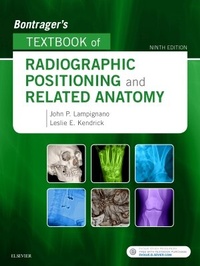
Bontrager's Textbook of Radiographic Positioning and Related Anatomy
9th Edition
Published on 5. May 2017
Book
Hardback
848 pages
978-0-323-39966-1 (ISBN)
Description
Master radiographic positioning with this comprehensive, user-friendly text. Focusing on one projection per page, Bontrager's Textbook of Radiographic Positioning and Related Anatomy, 9th Edition includes all of the positioning and projection information you need to know in a clear, bulleted format. Positioning photos, radiographic images, and radiographic overlays, presented side-by-side with the explanation of each procedure, show you how to visualize anatomy and produce the most accurate images. Updated to reflect the latest ARRT competencies and ASRT curriculum guidelines, it features more than 200 of the most commonly requested projections to prepare you for clinical practice.
Labeled radiographs (radiographic overlays) identify key radiographic anatomy and landmarks to help you recognize anatomy and determine if you have captured the correct diagnostic information on your images.
Positioning chapters, organized with one projection per page, present a manageable amount of information in an easily accessible format.
Unique page layout with positioning photos, radiographic images, and radiographic overlays presented side-by-side with the text explanation of each procedure to facilitate comprehension and retention.
Pathologic Indications list and define the pathologies most likely to be encountered during procedures covered in each chapter to help you understand the whole patient and improve your ability to produce radiographs that make diagnosis easy for the physician.
Pathology Demonstrated sections explain why a particular projection is needed, or what pathology might be demonstrated, to give you a larger frame of reference and a better understanding of the reasoning behind each projection.
Radiographic Criteria on positioning pages provide standards for evaluating the quality of each radiograph, helping you develop a routine for evaluating radiographic quality.
Pediatric Applications prepare students for clinical success - and prepare technologists to deal competently with the special needs of their pediatric patients.
Geriatric Applications include general information on positioning techniques and patient handling for geriatric patients, fostering an understanding of the challenges these patients present to the technologist.
Critique Radiographs demonstrate positioning errors and help you avoid similar errors in clinicals.
Instructor resources include an accompanying Evolve website with PowerPoint slides, an image collection, and a test bank to help instructors prepare for class.
Student resources include a workbook and handbook to help you better understand and retain complicated material.
NEW! Updated art visually demonstrates the latest digital technology used in radiography with approximately 250 new radiographs, positioning, and equipment images.
NEW and UPDATED! Increased emphasis on radiation safety practices arms you with the information you need to know to succeed in clinical practice.
NEW! Obese Patient Considerations include general information on positioning techniques and positioning modifications for obese patients to show you how to position this subset of patients accurately.
UPDATED! Reflects the latest ARRT competencies and ASRT curriculum guidelines to prepare you for boards and clinical practice.
UPDATED! Completely revamped surgical procedures chapter reflects current ARRT competencies and ASRT curriculum guidelines.
UPDATED! Routine and Special Procedures sections moved to an appendix so you can refer to this necessary material quickly and efficiently.
Labeled radiographs (radiographic overlays) identify key radiographic anatomy and landmarks to help you recognize anatomy and determine if you have captured the correct diagnostic information on your images.
Positioning chapters, organized with one projection per page, present a manageable amount of information in an easily accessible format.
Unique page layout with positioning photos, radiographic images, and radiographic overlays presented side-by-side with the text explanation of each procedure to facilitate comprehension and retention.
Pathologic Indications list and define the pathologies most likely to be encountered during procedures covered in each chapter to help you understand the whole patient and improve your ability to produce radiographs that make diagnosis easy for the physician.
Pathology Demonstrated sections explain why a particular projection is needed, or what pathology might be demonstrated, to give you a larger frame of reference and a better understanding of the reasoning behind each projection.
Radiographic Criteria on positioning pages provide standards for evaluating the quality of each radiograph, helping you develop a routine for evaluating radiographic quality.
Pediatric Applications prepare students for clinical success - and prepare technologists to deal competently with the special needs of their pediatric patients.
Geriatric Applications include general information on positioning techniques and patient handling for geriatric patients, fostering an understanding of the challenges these patients present to the technologist.
Critique Radiographs demonstrate positioning errors and help you avoid similar errors in clinicals.
Instructor resources include an accompanying Evolve website with PowerPoint slides, an image collection, and a test bank to help instructors prepare for class.
Student resources include a workbook and handbook to help you better understand and retain complicated material.
NEW! Updated art visually demonstrates the latest digital technology used in radiography with approximately 250 new radiographs, positioning, and equipment images.
NEW and UPDATED! Increased emphasis on radiation safety practices arms you with the information you need to know to succeed in clinical practice.
NEW! Obese Patient Considerations include general information on positioning techniques and positioning modifications for obese patients to show you how to position this subset of patients accurately.
UPDATED! Reflects the latest ARRT competencies and ASRT curriculum guidelines to prepare you for boards and clinical practice.
UPDATED! Completely revamped surgical procedures chapter reflects current ARRT competencies and ASRT curriculum guidelines.
UPDATED! Routine and Special Procedures sections moved to an appendix so you can refer to this necessary material quickly and efficiently.
More details
Edition
9th edition
Language
English
Place of publication
St Louis
United States
Publishing group
Elsevier - Health Sciences Division
Target group
College/higher education
Illustrations
Approx. 2730 illustrations (2730 in full color)
Dimensions
Height: 286 mm
Width: 221 mm
Weight
2850 gr
ISBN-13
978-0-323-39966-1 (9780323399661)
Copyright in bibliographic data and cover images is held by Nielsen Book Services Limited or by the publishers or by their respective licensors: all rights reserved.
Schweitzer Classification
Other editions
New editions
John Lampignano | Leslie E. Kendrick
Bontrager's Textbook of Radiographic Positioning and Related Anatomy
Book
12/2020
10th Edition
Mosby
€227.78
Article exhausted; check for reprint
John Lampignano | Leslie E. Kendrick
Bontrager's Textbook of Radiographic Positioning and Related Anatomy
Book
11/2020
10th Edition
Mosby
€1,237.98
Article exhausted; check for reprint
Previous edition
Kenneth L. Bontrager | John Lampignano
Textbook of Radiographic Positioning and Related Anatomy
Book
02/2013
8th Edition
Mosby
€169.59
Article exhausted; check for reprint
Persons
John Lampignano, MEd, RT(R) (CT), Gateway Community College, Phoenix, AZ
Content
1. Terminology, Imaging and Positioning Principles
2. Chest
3. Abdomen
4. Upper Limb
5. Humerus and Shoulder Girdle
6. Lower Limb
7. Femur and Pelvic Girdle
8. Cervical and Thoracic Spine
9. Lumbar Spine, Sacrum, and Coccyx
10. Bony Thorax - Sternum and Ribs
11. Cranium, Facial Bones, and Paranasal Sinuses
12. Biliary Tract and Upper Gastrointestinal System
13. Lower Gastrointestinal System
14. Urinary System and Venipuncture
15. Trauma, Mobile, and Surgical Radiography
16. Pediatric Radiography
17. Angiography and Interventional Procedures
18. Computed Tomography
19. Special Radiographic Procedures
20. Diagnostic and Therapeutic Modalities
Appendix A: Answer Key: Radiographs for Critique
Appendix B: Routine and Special Projections
2. Chest
3. Abdomen
4. Upper Limb
5. Humerus and Shoulder Girdle
6. Lower Limb
7. Femur and Pelvic Girdle
8. Cervical and Thoracic Spine
9. Lumbar Spine, Sacrum, and Coccyx
10. Bony Thorax - Sternum and Ribs
11. Cranium, Facial Bones, and Paranasal Sinuses
12. Biliary Tract and Upper Gastrointestinal System
13. Lower Gastrointestinal System
14. Urinary System and Venipuncture
15. Trauma, Mobile, and Surgical Radiography
16. Pediatric Radiography
17. Angiography and Interventional Procedures
18. Computed Tomography
19. Special Radiographic Procedures
20. Diagnostic and Therapeutic Modalities
Appendix A: Answer Key: Radiographs for Critique
Appendix B: Routine and Special Projections