

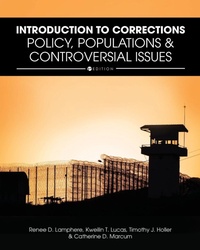
Introduction to Corrections
Policy, Populations, and Controversial Issues
Published on 30. August 2021
Book
Paperback/Softback
348 pages
978-1-5165-9611-9 (ISBN)
Description
Introduction to Corrections: Policy, Populations, and Controversial Issues provides students with a holistic introduction to contemporary corrections practice and the opportunities and challenges they are likely to face within their future professional careers.
The text is divided into three distinct units. Unit I examines the evolution of contemporary corrections and philosophies of punishment, correctional administration, probation and parole, and reentry and reintegration. In Unit II, students learn about the constitutional rights of incarcerated individuals, prison culture, and correctional programming. Dedicated chapters explore the characteristics of incarcerated female, juvenile, and vulnerable populations-including LGBTQ persons, elderly persons, and individuals who suffer from mental illness-as well as how these characteristics can impact their incarceration experiences. The final unit speaks to modern controversies in corrections such as racial equity, wrongful conviction, the death penalty, and the prison industrial complex. Throughout, case studies, discussion questions, and application exercises facilitate greater student learning and retention.
Written to provide students with a solid knowledge base within the discipline, Introduction to Corrections is an ideal textbook for courses in corrections, administration of justice, and criminal justice.
The text is divided into three distinct units. Unit I examines the evolution of contemporary corrections and philosophies of punishment, correctional administration, probation and parole, and reentry and reintegration. In Unit II, students learn about the constitutional rights of incarcerated individuals, prison culture, and correctional programming. Dedicated chapters explore the characteristics of incarcerated female, juvenile, and vulnerable populations-including LGBTQ persons, elderly persons, and individuals who suffer from mental illness-as well as how these characteristics can impact their incarceration experiences. The final unit speaks to modern controversies in corrections such as racial equity, wrongful conviction, the death penalty, and the prison industrial complex. Throughout, case studies, discussion questions, and application exercises facilitate greater student learning and retention.
Written to provide students with a solid knowledge base within the discipline, Introduction to Corrections is an ideal textbook for courses in corrections, administration of justice, and criminal justice.
Reviews / Votes
"This textbook provides a balanced presentation of historical and current correctional practices. The discussion includes groundbreaking policies having an impact on correctional facilities and community supervision. While some information is redundant across textbooks, this text offers a refreshing discussion that includes new content. The text is useful for students to intend to go directly into correctional careers as well as for those interested in pursuing graduate school. The exercises that end each chapter engage the students in the material, making the material applicable to the real-world."Dr. Tamara J. Lynn, Associate Professor, Chair of the Department of Criminal Justice, Fort Hays State University
"This text provides a comprehensive view of the complexities of the criminal justice system in a seamless and well-structured way."
Megan Stoneking, Social Services Program Manager, New Mexico State University Grants Branch
More details
Language
English
Place of publication
San Diego
United States
Target group
Professional and scholarly
Product notice
Paperback (trade)
Unsewn / adhesive bound
Dimensions
Height: 254 mm
Width: 203 mm
Thickness: 18 mm
Weight
689 gr
ISBN-13
978-1-5165-9611-9 (9781516596119)
Copyright in bibliographic data and cover images is held by Nielsen Book Services Limited or by the publishers or by their respective licensors: all rights reserved.
Schweitzer Classification
Persons
Renee D. Lamphere is an associate professor in the Department of Sociology & Criminal Justice at the University of North Carolina at Pembroke.
Kweilin T. Lucas is an assistant professor in the Department of Criminal Justice at Mars Hill University.
Timothy J. Holler is an associate professor of criminal justice and the director of the Community Arts and Reintegration Project at the University of Pittsburgh at Greensburg.
Catherine D. Marcum is the assistant chair and associate professor of justice studies in the Department of Government and Justice Studies at Appalachian State University. She has published over 50 peer-reviewed journals articles and authored and/or edited over 10 books. Her areas of expertise include cybercrime offending and victimization, correctional issues, and sexual victimization, and is currently the editor of Corrections: Policy, Practice, and Research.
Kweilin T. Lucas is an assistant professor in the Department of Criminal Justice at Mars Hill University.
Timothy J. Holler is an associate professor of criminal justice and the director of the Community Arts and Reintegration Project at the University of Pittsburgh at Greensburg.
Catherine D. Marcum is the assistant chair and associate professor of justice studies in the Department of Government and Justice Studies at Appalachian State University. She has published over 50 peer-reviewed journals articles and authored and/or edited over 10 books. Her areas of expertise include cybercrime offending and victimization, correctional issues, and sexual victimization, and is currently the editor of Corrections: Policy, Practice, and Research.