

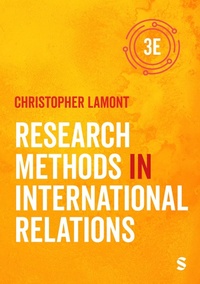
Research Methods in International Relations
3rd Edition
Will be published approx. on 12. December 2026
Book
Paperback/Softback
304 pages
978-1-0362-1608-5 (ISBN)
Description
The only textbook for designing and conducting research in IR.
Covering the full breadth of methods in IR with unrivalled clarity, this best-selling textbook takes you through the entire process of doing research, from honing your question to writing up the dissertation. The engaging and jargon-free style demystifies the entire process, and you'll gain a comprehensive understanding of the strengths and limitations of different methods and how to use them in your project.
This third edition comes with two new chapters on how to collect data and how to analyze data, plus a new troubleshooting feature in every chapter to offer top tips for addressing challenges. All the chapters have been fully revised and offer specific advice for using individual research methods. The methodology chapter has been updated to offer a sophisticated overview of the full spectrum of methodological approaches, including the most cutting-edge and popular methods used in IR, from social media to quasi-experimental research.
A practical introduction, this text is essential reading for anyone setting out on their International Relations research project for the first time, at undergraduate and postgraduate levels.
Christopher Lamont is Dean of E-Track International Relations, Vice Dean of the Graduate School of International Relations, and Professor of International Relations at Tokyo International University, Japan.
Covering the full breadth of methods in IR with unrivalled clarity, this best-selling textbook takes you through the entire process of doing research, from honing your question to writing up the dissertation. The engaging and jargon-free style demystifies the entire process, and you'll gain a comprehensive understanding of the strengths and limitations of different methods and how to use them in your project.
This third edition comes with two new chapters on how to collect data and how to analyze data, plus a new troubleshooting feature in every chapter to offer top tips for addressing challenges. All the chapters have been fully revised and offer specific advice for using individual research methods. The methodology chapter has been updated to offer a sophisticated overview of the full spectrum of methodological approaches, including the most cutting-edge and popular methods used in IR, from social media to quasi-experimental research.
A practical introduction, this text is essential reading for anyone setting out on their International Relations research project for the first time, at undergraduate and postgraduate levels.
Christopher Lamont is Dean of E-Track International Relations, Vice Dean of the Graduate School of International Relations, and Professor of International Relations at Tokyo International University, Japan.
More details
Edition
3rd Revised edition
Language
English
Place of publication
London
United Kingdom
Target group
College/higher education
Edition type
Revised edition
Product notice
Paperback (trade)
Dimensions
Height: 229 mm
Width: 152 mm
Weight
343 gr
ISBN-13
978-1-0362-1608-5 (9781036216085)
Copyright in bibliographic data and cover images is held by Nielsen Book Services Limited or by the publishers or by their respective licensors: all rights reserved.
Schweitzer Classification
Other editions
Previous edition
Christopher Lamont
Research Methods in International Relations
Book
11/2021
2nd Edition
SAGE Publications Ltd
€43.87
Shipment within 15-20 days
Person
Christopher Lamont is Dean of E-Track's International Relations program and Vice Dean of the Graduate School of International Relations at Tokyo International University in Japan. He holds a PhD in Politics from the University of Glasgow. He was also a Fulbright fellow at the University of Zagreb and an RCUK postdoctoral fellow at the University of Ulster. His research interests are at the intersection of global governance, technology, and international justice. He is the author of Research Methods in International Relations, now in its second edition, published by Sage. He is also co-editor (with Arnaud Kurze) of New Critical Spaces in Transitional Justice: Gender, Art, and Memory published by Indiana University Press in 2019, and Non-Western Visions of Democratization: Imagining Democracy after the Arab Spring (with Jan van der Harst and Frank Gaennsmantel), which was published by Routledge/Ashgate in 2015. His monograph, International Criminal Justice and the Politics of Compliance (Routledge/Ashgate 2010) explored the international and domestic politics of international criminal justice processes in the former Yugoslavia. In addition to his scholarly contributions, his writings have also featured in Foreign Affairs, Foreign Policy, and The Diplomat, among others.
Content
Chapter 1 Methodology and Philosophy of Science
Chapter 2 Getting Started: Your Literature Review
Chapter 3 Research Ethics
Chapter 4 Research Questions and Research Design
Chapter 5 Case Study Research in International Relations
Chapter 6 How to Collect Data
Chapter 7 Interview, Focus Group, and Survey Research
Chapter 8 Decoument, Text, and Digital archives
Chapter 9 How To Analyze Data
Chapter 10 Statistical Analysis
Chapter 11 Mixed Methods Research
Chapter 12 Discourse and Content Analysis
Chapter 13 Writing Up
Chapter 2 Getting Started: Your Literature Review
Chapter 3 Research Ethics
Chapter 4 Research Questions and Research Design
Chapter 5 Case Study Research in International Relations
Chapter 6 How to Collect Data
Chapter 7 Interview, Focus Group, and Survey Research
Chapter 8 Decoument, Text, and Digital archives
Chapter 9 How To Analyze Data
Chapter 10 Statistical Analysis
Chapter 11 Mixed Methods Research
Chapter 12 Discourse and Content Analysis
Chapter 13 Writing Up