

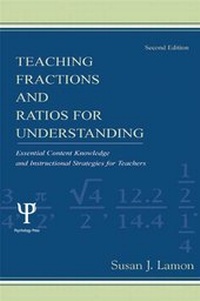
Teaching Fractions and Ratios for Understanding
Essential Content Knowledge and Instructional Strategies for Teachers
2nd Edition
Published on 26. October 2005
Book
Paperback/Softback
254 pages
978-0-8058-5210-3 (ISBN)
Description
This popular text addresses the urgent need for curriculum materials that cross traditional boundaries to include many of the elements that are integrated in the teaching/learning enterprise: mathematics content, teacher understanding, student thinking, teaching methods, instructional activities, and assessment. The book pushes readers beyond the limits of their current understanding of rational numbers, challenging them to refine and explain their thinking--without falling back on rules and procedures they have relied on throughout their lives.
Written in a conversational and easy to understand style, this is not a textbook as much as it is a resource book. An underlying assumption is that facilitating teacher understanding using the same questions and activities that may be used with children is one way to help teachers build the comfort and confidence they need to begin talking to children about complex ideas. Unlike a textbook that is used to study formal theory and then discarded when it comes to putting ideas into practice, the many problems and activities included to facilitate teacher learning are valuable resources for use in elementary and middle school classrooms.
Changes in the second edition include:
*even more student work incorporated in every chapter;
*discussion of the connectivity between the topics addressed in the book and the elementary and middle school mathematics curricula;
*an increased emphasis on measurement;
*expansion of some topics, including number sense, percent, scale factors, similarity, and linear graphs;
*clarification of the characteristics of ratio and proportions and how to use these to generate discussion with children; and
*content-related interview questions for exploring children's thinking.
This book is a valuable resource for researchers and curriculum developers in mathematics education, pre-service and in-service teachers of mathematics, those involved in the mathematical and pedagogical preparation of mathematics teachers, and graduate students in mathematics education. The methods and activities it includes have been tested with students in grades 3-8 and with pre-service and in-service teachers and other adults.
This text is accompanied by MORE--a supplement that is not merely an answer key but a resource that includes in-depth discussions of all the problems in the text; develops and extends discussion of the issues, teaching problems, and other considerations raised in the chapters; and contains additional problems--with and without solutions--that instructors may find helpful for assessment purposes.
Written in a conversational and easy to understand style, this is not a textbook as much as it is a resource book. An underlying assumption is that facilitating teacher understanding using the same questions and activities that may be used with children is one way to help teachers build the comfort and confidence they need to begin talking to children about complex ideas. Unlike a textbook that is used to study formal theory and then discarded when it comes to putting ideas into practice, the many problems and activities included to facilitate teacher learning are valuable resources for use in elementary and middle school classrooms.
Changes in the second edition include:
*even more student work incorporated in every chapter;
*discussion of the connectivity between the topics addressed in the book and the elementary and middle school mathematics curricula;
*an increased emphasis on measurement;
*expansion of some topics, including number sense, percent, scale factors, similarity, and linear graphs;
*clarification of the characteristics of ratio and proportions and how to use these to generate discussion with children; and
*content-related interview questions for exploring children's thinking.
This book is a valuable resource for researchers and curriculum developers in mathematics education, pre-service and in-service teachers of mathematics, those involved in the mathematical and pedagogical preparation of mathematics teachers, and graduate students in mathematics education. The methods and activities it includes have been tested with students in grades 3-8 and with pre-service and in-service teachers and other adults.
This text is accompanied by MORE--a supplement that is not merely an answer key but a resource that includes in-depth discussions of all the problems in the text; develops and extends discussion of the issues, teaching problems, and other considerations raised in the chapters; and contains additional problems--with and without solutions--that instructors may find helpful for assessment purposes.
More details
Edition
2nd New edition
Language
English
Place of publication
New York
United States
Publishing group
Taylor & Francis Inc
Target group
College/higher education
Professional and scholarly
Edition type
New edition
Dimensions
Height: 254 mm
Width: 178 mm
Weight
453 gr
ISBN-13
978-0-8058-5210-3 (9780805852103)
Copyright in bibliographic data and cover images is held by Nielsen Book Services Limited or by the publishers or by their respective licensors: all rights reserved.
Schweitzer Classification
Other editions
New editions
Susan J. Lamon
Teaching Fractions and Ratios for Understanding
Essential Content Knowledge and Instructional Strategies for Teachers
Book
10/2011
3rd Edition
Routledge
€85.60
Article exhausted; check for reprint
Previous edition

Susan J. Lamon
Teaching Fractions and Ratios for Understanding
Essential Content Knowledge and Instructional Strategies for Teachers
Book
02/1999
Lawrence Erlbaum Associates Inc
€54.65
Article exhausted; check for reprint
Person
Content
Contents: Preface. Fractions and Proportional Reasoning: An Overview. Fractions and Rational Numbers. Relative and Absolute Thinking. Measurement. Quantities and Covariation. Reasoning Up and Down. Unitizing. Sharing and Comparing. Proportional Reasoning. Reasoning With Fractions. Part-Whole Comparisons With Unitizing. Partitioning and Quotients. Rational Numbers as Operators. Rational Numbers as Measures. Ratios and Rates. Distance-Rate-Time Relationships. Similarity and Percents. Changing Fraction Instruction.