

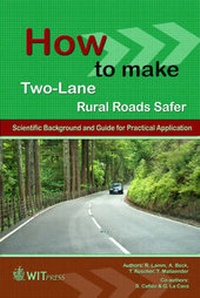
How to Make Two-Lane Rural Roads Safer
Scientific Background and Guide for Practical Application
Published on 20. October 2006
Book
Hardback
144 pages
978-1-84564-156-6 (ISBN)
Description
When accidents happen, drivers are blamed for the mishap. When drivers consistently fail at certain locations, it then becomes obvious that the problem lies not with them, but with the geometry of the road itself. Because accidents are not evenly distributed throughout the road network, locations with high accident rates are a clear indication that there are other factors involved, besides driver error, which are characterized by the road itself. In most countries, two-lane rural roads make up about 90 percent of rural networks and they account for over 60 percent of highway fatalities worldwide, approximately 500,000 people per year. The methodology described in this book will support the achievement of quantified measures of: design consistency; operating speed consistency; and, driving dynamic consistency. The safety criteria are then combined into an overall safety module for a simplified general overview of the safety evaluation process. The authors also encourage the coordination of safety concerns with important economic, environmental and aesthetic considerations.This book will be an invaluable aid to educators, students, consultants, highway engineers and administrators, as well as scientists in the fields of highway design and traffic safety engineering.
More details
Language
English
Place of publication
Southampton
United Kingdom
Target group
College/higher education
Illustrations
Illustrations
Dimensions
Height: 230 mm
Width: 155 mm
ISBN-13
978-1-84564-156-6 (9781845641566)
Copyright in bibliographic data and cover images is held by Nielsen Book Services Limited or by the publishers or by their respective licensors: all rights reserved.
Schweitzer Classification
Content
Chapter 1: Highway safety evaluation terminology, framework and overview Curvature Change Rate of the singular circular curve with transition curves; Design classification based on accident and operating speed research Chapter 2: Three quantitative safety criteria for highway geometric design Classification of Safety Criterion I; Classification of Safety Criterion II; Classification of Safety Criterion III; Safety Criteria vs. alignment design; Safety module Chapter 3: Comparative analyses of the actual accident situation with the results of the Safety Criteria Database: Schneider; Database: Ruscher Chapter 4: Case studies Example I; Example II; Example III; Example IV Chapter 5: Influence of road equipment on traffic safety Pavement width; Radius of curve; Curvature Change Rate of the single curve; Road equipment and design (Curvature Change Rate) classes; Road equipment and Safety Criteria Conclusion and Outlook