

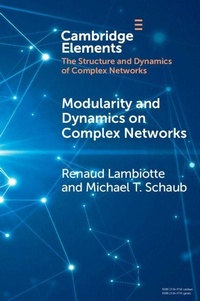
Modularity and Dynamics on Complex Networks
Published on 3. February 2022
Book
Paperback/Softback
340 pages
978-1-108-73353-3 (ISBN)
Description
Complex networks are typically not homogeneous, as they tend to display an array of structures at different scales. A feature that has attracted a lot of research is their modular organisation, i.e., networks may often be considered as being composed of certain building blocks, or modules. In this Element, the authors discuss a number of ways in which this idea of modularity can be conceptualised, focusing specifically on the interplay between modular network structure and dynamics taking place on a network. They discuss, in particular, how modular structure and symmetries may impact on network dynamics and, vice versa, how observations of such dynamics may be used to infer the modular structure. They also revisit several other notions of modularity that have been proposed for complex networks and show how these can be related to and interpreted from the point of view of dynamical processes on networks.
More details
Series
Language
English
Place of publication
Cambridge
United Kingdom
Product notice
Paperback (trade)
Illustrations
Worked examples or Exercises
Dimensions
Height: 229 mm
Width: 152 mm
Thickness: 6 mm
Weight
161 gr
ISBN-13
978-1-108-73353-3 (9781108733533)
Copyright in bibliographic data and cover images is held by Nielsen Book Services Limited or by the publishers or by their respective licensors: all rights reserved.
Schweitzer Classification
Other editions
Additional editions
Renaud Lambiotte | Michael T. Schaub
Modularity and Dynamics on Complex Networks
E-Book
01/2022
Cambridge University Press
€15.49
Available for download
Persons
Content
1. Introduction; 2. Background Material; 3. Modularity, community detection and clustering in networks; 4. Time scale separation and dynamics on modular networks; 5. Symmetries and dynamics on modular networks; 6. Dynamical methods for assortative communities; 7. Dynamical methods for disassortative communities and general block structures; 8. Perspectives; References.